

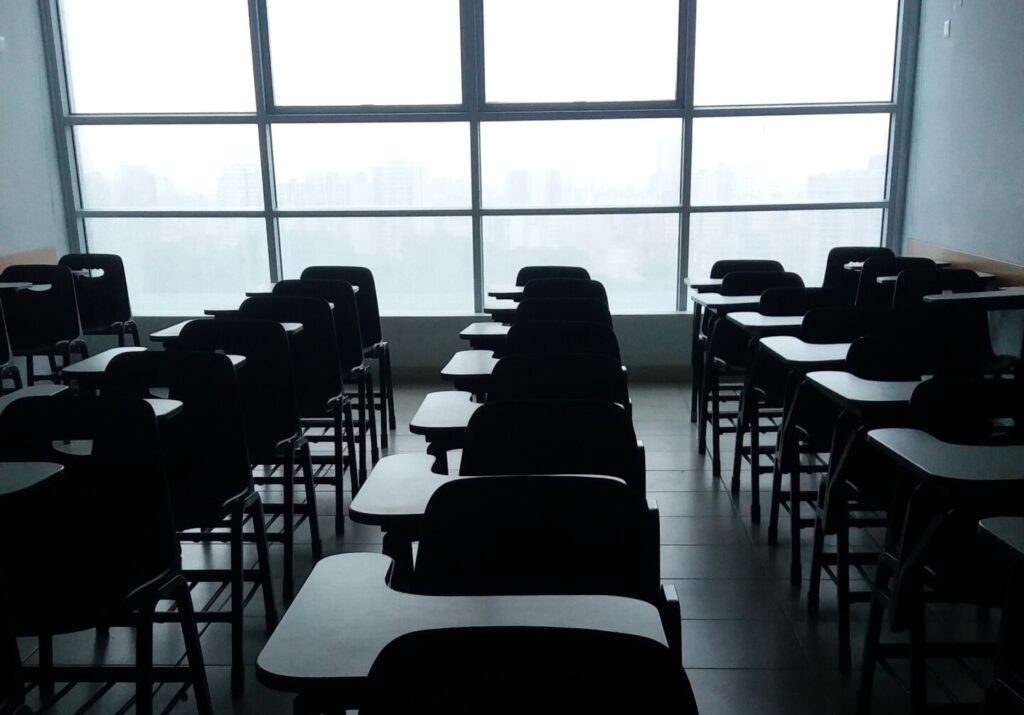
Since the start of this semester, Metro Nashville Public Schools have received 15 threats of violence, according to police. That has resulted in lockdowns, anxious texts to family and friends, and large crews of law enforcement showing up to find that the threats were a hoax.
Two Nashville students shared with WPLN News what it was like when their schools went on lockdown.
Emely Lopez is a senior at Martin Luther King Jr. Magnet High School, which received a threat on Sept. 13.
“It had started off as any ordinary day. I was in my English class at that time, which is on the first floor of the building,” she said. “What we had heard is that we got, like, a threat phoned in, and then, there was word of a shooter.”
Lopez said she felt “deeply scared” when she heard the announcement that they were going into lockdown, saying she could hear fear in the principal’s voice over the intercom. After last spring’s Covenant School shooting, Lopez said she assumed the worst.
Nathalie Gomez, who’s a senior at John Overton High School, said she also felt scared when she heard a lockdown announcement on Sept. 25.
“Scared,” Gomez said. “Yet at the same time, not surprised at all.”
Police take these threats seriously
Although the threats at both schools were later determined to be false, the Metro Nashville Police Department responded as though they were real.
Lopez estimated she saw around 50 police cars blocking off roads around her school.
“We could just hear, like, running back and forth and all of that. And then, there was sound of a helicopter,” Lopez said. “But it was a stressful three hours of just sitting there and not knowing what was going to happen next.”
Even after they determined the call to MLK High was a hoax, a release from the school district stated that police “are continuing to search all the rooms out of an abundance of caution before the school returns to normal operations.”
Gomez said although the lockdown at her school was frightening, she appreciated the way police and administration handled it.
“Even though there was that false alarm, the way that things were conducted made me feel safe,” Gomez said. “It helped me have a sense of maybe not security — maybe security isn’t the best word — but it helped me feel okay to be there.”
Texting family from lockdown
Lopez said she was torn about whether to text her mother that the school had gone on lockdown.
“It was a like mental battle,” she said. “You never want to think of the possibility of something happening to your child.”
In the end, she decided to send a message explaining that she didn’t have many details, and telling her mother that she loved her.
“Sending it, it made me cry because that’s not a text you want to send, like, to anyone.”
Gomez said she texted her sister, who was getting ready to pick her up from school.
“‘Don’t freak out. We’re in a lockdown and I don’t know if it’s real or not. Me and other six girls are in the storage room with no windows and a locked door. We barricaded the door and we’re still sitting on the floor,'” Gomez sent.
After the lockdown lifts
Gomez said the drive home from school that day was quiet.
“I got home and continued to do my assignments because I knew that I had to do them,” she said. “I didn’t know what to feel because technically nothing happened. But that scare and that fear was still in me.”
Then, when her father got home from work, he asked, “How was school?”
“And I just, like, started bawling. And I guess that was my way of like … understanding what had actually gone on,” Gomez said.
After learning the threat turned out to be a hoax, Lopez experienced a “roller coaster of emotions.”
“Relief. Sadness. Anger. Like, feeling traumatized after that happened,” Lopez said. “It’s just very upsetting that this has become normalized for a lot of young teenagers and young kids that attend school. That, like, leads to people not feeling safe in their schools.”
Lopez said if she could send a message to the people who make these threats, she would ask them to reconsider what they’re doing to students’ mental health.
“It’s definitely very traumatizing for the young generation coming up and also the older generation, the adults having to deal with this,” Lopez said.
Some of the threats made to Nashville schools have come from students, who face an automatic one-year expulsion if caught. Other threats have come from outside the state, and police have not ruled out the possibility that they’re related to a larger national trend.
What could help students feel safer?
When asked what measures could help them feel safer at school, both students said stricter gun laws.
“Because at least that way we aren’t sitting in a potential bloodbath,” said Gomez. “Obviously, killing people is illegal. But the fact is that one can easily buy a gun and do whatever they please with it.”
Lopez also took issue with the easy access to firearms.
“We need to have stronger gun laws. We need to have background checks,” she said. “More, like, legislative action from people that have the power to make these changes that the people are asking for and have been asking for, for years.”
 On Air - 90.3 WPLN-FM