
Tennessee State University plays its home football games at Nissan Stadium, and it has generated some confusion – and pushback – about how much this costs the school.
Many alumni want games returned to campus, but TSU’s athletic director says the current arrangement is the most financially beneficial.
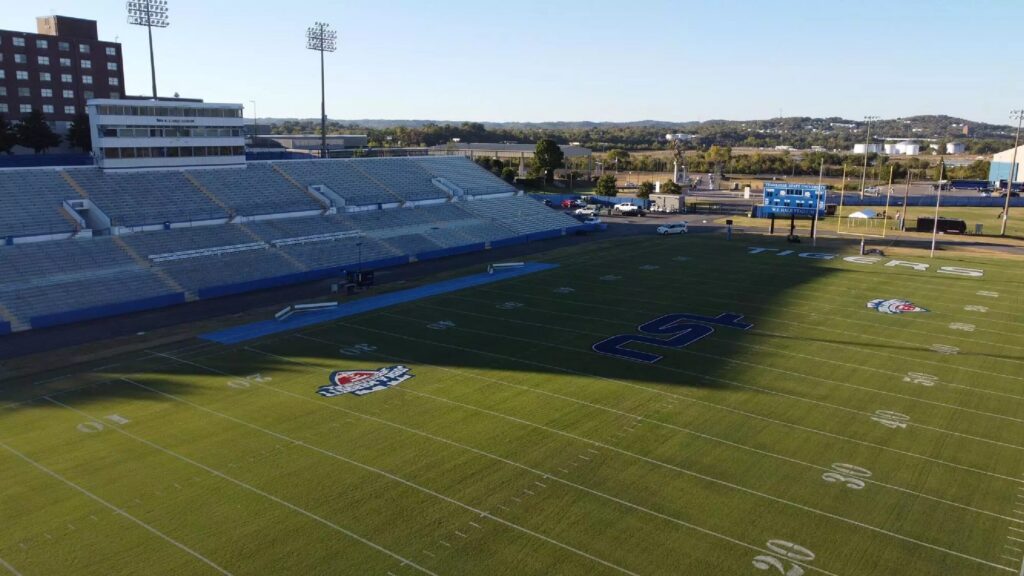
It’s been nearly thirty years since TSU held regular football games at Hale Stadium – also known as “the Hole.” In addition to monetary concerns, many graduates of the historically Black university cite nostalgia and a sense of community as a reason to return to the campus stadium which school officials say needs major renovations.
‘It’s just electric’
Daniel Hayes is among those hoping to bring games back to Hale. The Nashville native played the trumpet and drums for the university’s award-winning marching band, the Aristocrats of Bands, and going to football games on campus as a kid cemented his decision to attend TSU.
“Seeing the Aristocrats play, that’s what drew me in,” he told WPLN News. “I wanted to do that, and, of course, the place I first saw them was at Hale Stadium.”
The games had long been moved to Nissan stadium by the time he started TSU in 2005. He said performing in such a large arena doesn’t offer the same intimacy as Hale Stadium, particularly during a “battle of bands” performance where bands of opposing schools play sequentially to win the title of “best band.”
“I prefer the HBCU versus HBCU game atmosphere,” he said. “It’s just electric.”
TSU and Titans agreement
TSU entered into an agreement with the Titans in 1997 to allow the school to play games at Nissan stadium. The move has sparked much discourse over the years, including an open letter on Facebook from a TSU alum asking Titans leadership to help pay for Hale stadium’s renovation. The letter also noted that TSU pays hundreds of thousands of dollars per game to play at Nissan stadium.
However, that’s no longer the case, sine 2023 when the lease agreement between TSU and the Titans was amended and enhanced. Now, TSU pays no rent to play at Nissan Stadium, as required by Metro Sports Authority. The Titans pays the fee for that to Metro Sports Authority.
The Titans also waive all game-day operations expenses for TSU games and TSU keeps all net revenue for parking, concessions and ticketing, according to Kate Guerra, vice president of communications and corporate affairs for the Titans.
Additionally, if TSU opts to play any home game at an alternative venue– on campus or another site– instead of Nissan Stadium, the Titans will pay TSU $150,000 for each unused date, up to six per season. While this may seem like a financial incentive for TSU to occasionally host home games at Hale, TSU’s athletic director Jennifer Bell said the costs of doing so might outweigh the benefits.
“We have to provide security. We have to provide event workers. We have to provide our own concessions. We have to provide our parking, and all that comes with personnel,” she told WPLN News. “You have to kind of look at what your gross revenue is going to be when you add up all of those different expenses.”
Future plans for Hale
Bell also says that Nissan’s ability to hold over 60,000 people – versus Hale’s capacity of about 8,000 – is another bonus.
However, Henderson Majors, a TSU alum, said the extra seats can’t replace the sense of community felt at Hale.
“There’s not that closeness that I remember feeling when my parents took me to a TSU game back in the day and I was sitting literally elbow to elbow with somebody,” he said. “You had music playing in the background from Jefferson street. It’s just an atmosphere that can’t be duplicated and I think that is a treasure within itself.”
TSU President Dwayne Tucker also previously spoke to WPLN News about how bringing games back to campus would generate excitement in the surrounding North Nashville community. He said the university may start a capital campaign to raise funds for Hale’s renovation.
Jennifer Bell, TSU’s athletic director, said Hale is functional enough for players to practice, but more renovations, which will be done in phases, are needed to get the stadium in shape to host games. For now, she said, playing at Nissan makes the most financial sense.
The lease agreement between TSU and the Titans that began in 2023 will be replaced with a lease for the new stadium beginning in 2027 for a 30-year term.

 On Air - 90.3 WPLN-FM