

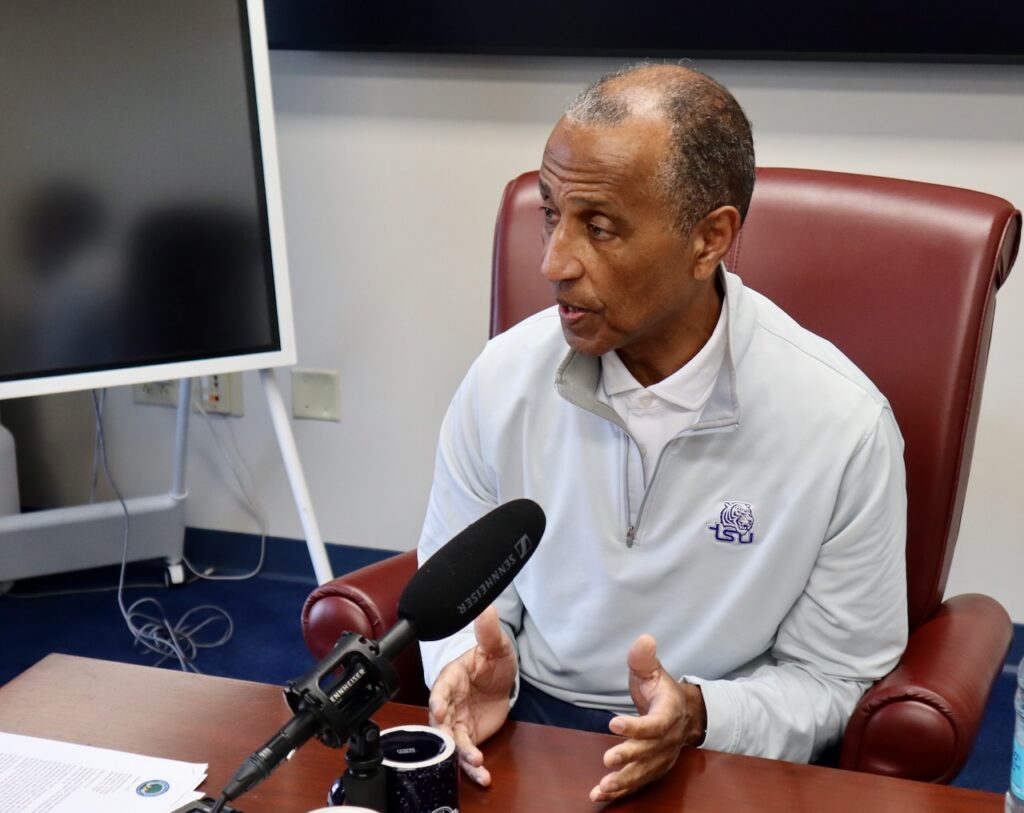
Despite years of chronic underfunding and past fiscal missteps, Tennessee State University has made a stunning financial turnaround in the last year. To keep this momentum going, the university’s president is exploring new revenue options to help ensure long-term sustainability.
TSU was in dire financial straits when Dwayne Tucker became interim president in December 2024. Tennessee Comptroller Jason Mumpower even questioned if the historically Black university would be able to keep its doors open.
This came on the heels of Gov. Bill Lee removing the school’s board of trustees and a scathing financial audit showing administrative issues that left students without promised scholarships and freshmen in hotels. WPLN’s podcast special, The Debt, highlighted how these issues were compounded by decades of the state underfunding the university.
Prioritizing student needs and increasing revenue
Tucker’s first priority in his new role was fixing what he saw as a customer service problem caused by a lack of communication between departments.
“The first thing we had to focus on was ensuring that if a student had an issue that was raised, such as financial aid, does somebody respond back to them within a reasonable time?” Tucker told WPLN News. “And then you see all these stories on local social media. ‘Hey, I got this outstanding balance, and I don’t know where it came from.’ Well, because the systems weren’t talking to each other effectively.”
Tucker then set out to restore TSU’s financial reputation within the state legislature, which included the university created a turnaround plan showing cost-cutting measures. The plan is scheduled for five years but Tucker said he wants to do it in half the time. By December 2025, the university had surpassed its financial goals – decreasing its budget deficit by $13.2 million.
Lawmakers also suggested TSU sell some of its property, like the Avon Williams downtown campus. But Tucker pushed back against this, saying he’d like to monetize that property, along with the 35 acres outside of John C. Tune Airport the university owns, rather than sell it. He plans to work with developers to create some reoccurring revenue for these properties.
Tucker also tapped a new source of revenue that the university hasn’t fully utilized in the past – the homecoming events that bring thousands of alumni back to the university each year.
“Everybody up and down, John Merritt, all the way down to 28th, is selling merchandise that has our logo and our copyright. They’re not giving anything back to the university,” he said. “For homecoming this year, we set up tents all around the track in Hale stadium. If you wanted to sell merchandise that had our name on it, you had to come in, pay a fee for your tent and then give us a piece of what you sell.”
He’s also implementing smaller ways to increase revenue, like raising parking fees. One of the biggest revenue generators is bringing in more students; but Tucker wants to ensure that the school has the funding to support this, which includes making structural improvements.
“Some of the students, they’re going to chuckle at this. ‘They say, well Mr. President, my mom went to Tennessee State, and my mom’s mom went to Tennessee State University and stayed in the same dorm that I’m in,’” he told WPLN News. “I said, wow, that’s gotta be maybe 60, 70 years. We do need to modernize our campus.”
Recovering full debt from the state
Tucker has also spent time working with the legislature to gain more control over how TSU can spend the $250 million that Gov. Bill Lee allocated to the university in 2022. This move came after a legislative joint committee determined that the state owed TSU $544 million in land-grant funding.
While Tucker is happy that some of that money can now cover TSU’s operational needs, this influx of funds still leaves the state owing TSU a balance of $294 million. Tucker believes that the university’s financial progress should prompt the state to release the additional funds.
However, some say that still wouldn’t be enough based on a 2023 report from the Biden administration stating that Tennessee owes TSU $2.1 billion based on per-pupil funding. Tennessee lawmakers never agreed to this figure and Tucker has no immediate plans to go after it.
“To go walk into your legislative body and say, ‘Hey, I know y’all don’t believe it, so the only way I’m going to get it out of you is to sue you. That’s going to take a decade or more,” he said. “And if I’m the legislative body, I’d say, well, how do you want me to keep funding you when you’re trying to sue us for 2. 1 billion? It just doesn’t fit, in my opinion.”
Tucker also said that while TSU being a historically Black university offers a sense of community to its students, this may not resonate with some lawmakers so he’s focused on showing them results.
“I know how to run an efficient university and drive outcomes for those who come to Tennessee State,” he said. “People like to be tied to a winner or an organization that seems to be excelling at what you do. That’s my focus. And then how people want to vote on it, I leave it up to them.”

 On Air - 90.3 WPLN-FM