

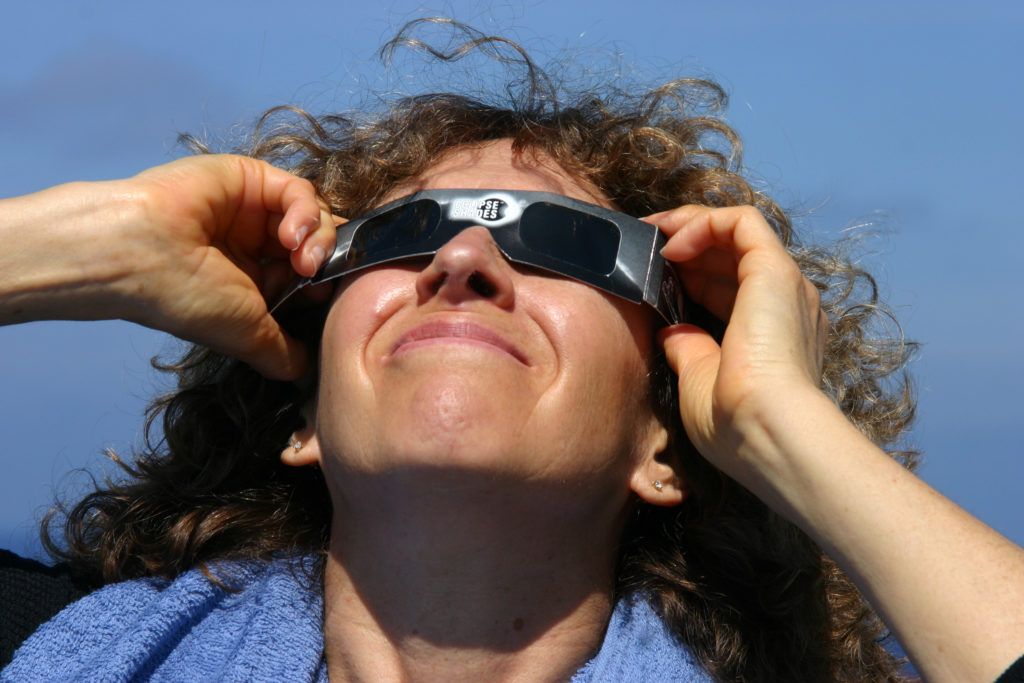
In the largest recall so far in Middle Tennessee, Vanderbilt University Medical Center says it can’t trust the 8,000 pairs of eclipse glasses it gave out over the weekend at the Williamson County Fair.
“Unfortunately, the rarity of the eclipse has elicited vendors that may be less scrupulous than typical vendors who provide sanctioned eclipse glasses,” says Dr. David Calkins, director for research at the Vanderbilt Eye Institute.
The mostly white cardboard shades with a Vanderbilt logo carry the proper labeling, but Calkins says there’s now some doubt about whether they meet national specifications.
“We are happy now to approve those glasses from an approved vendor,” Calkins says. “We’re acting out of an abundance of caution.”

Calkins declined to comment on whether potential liability for eye damage was part of the decision to replace the glasses. He also won’t vouch for the discredited shades offering any kind of protection. Recipients can trade theirs in at Vanderbilt walk-in clinics around Middle Tennessee.
Metro Public Health is also offering replacements for 500 pairs of questionable eye protection it gave out earlier this month. Unlike Vanderbilt’s situation, Metro’s shades didn’t have the right certification.
“The Metro Health Department ordered the original glasses from a supplier who assured us the glasses were appropriate for viewing the eclipse. The vendor provided a document that the glasses (ISO 12312-1 certification) ‘passed’ for viewing the eclipse. According to the International Organization for Standardization (ISO) — only glasses with the ISO 12312-2 certification provides eye protection for direct observation of the sun.”
Metro is offering certified glasses at the Lentz Health Center. Due to the scarcity, the city had to get them from the Adventure Science Center and Vanderbilt.
The Tennessee State Museum is also offering replacements for 300 pairs of glasses sold in its gift shop. Museum officials say they ordered theirs from Amazon, which then issued a recall.
For those who can’t get trusted protection in time for Monday’s eclipse, health officials suggest using alternative methods, like
pinhole projection. Or look at the ground below a leafy tree. During the partial eclipse, the ground should be dappled with crescent suns projecting through the leaves. During the roughly two-minute duration of totality, it should be safe to look up without glasses.


 On Air - 90.3 WPLN-FM