

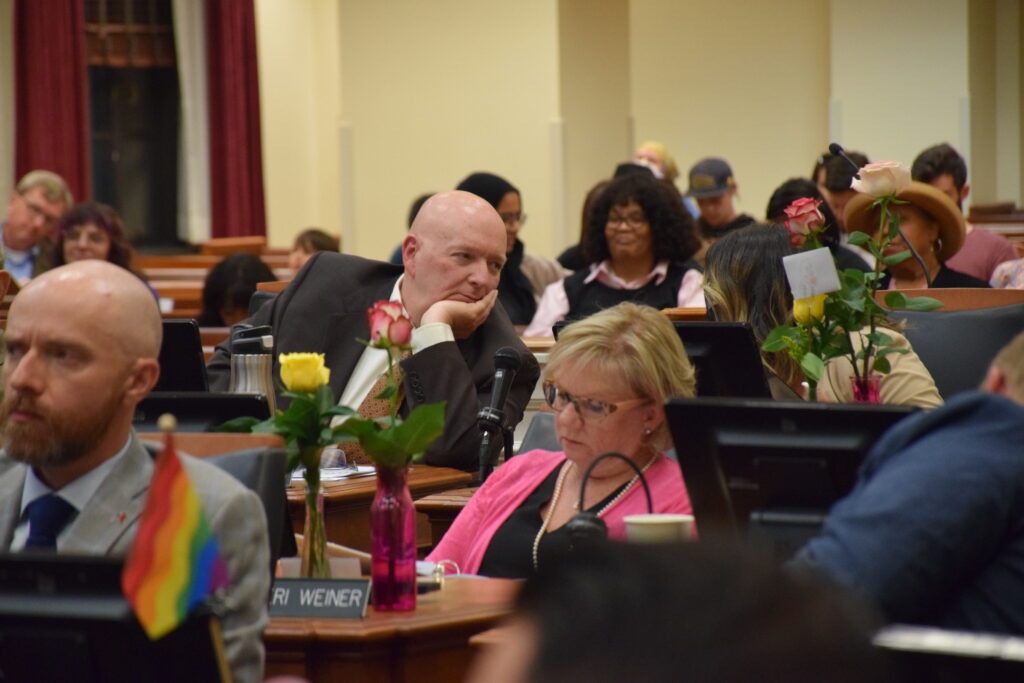
Oral arguments for a case that could have major consequences for Nashville’s Metro Council will be heard at the Tennessee Supreme Court on Thursday.
If the state’s highest court rules in favor of the state, the city would be forced to slash its council membership in half. That’s in accordance with a state law passed in 2023, which capped the size of metropolitan governing bodies at 20 members.
Nashville’s Metro Council is the only body in the state to have more than 20 members. It has featured 40 members since Davidson County and the city of Nashville consolidated in 1963. The large size played a role in getting voters on board with the consolidation effort, including reassuring residents who had been concerned about the representation of Black Nashvillians.
Listen to an update from Thursday’s hearing:
Back in 2023, the law was passed alongside a swath of preemption bills that limited Nashville’s right to self-governance. In some circles, these were viewed as an act of political retaliation by the statehouse’s Republican supermajority after Nashville’s left-leaning Metro Council rejected a proposal to host the Republican National Convention.
Nashville sued over four of the bills. The city saw early victories in the lower courts. But, in the case of the Metro Council Reduction Act, the Court of Appeals sided with the state.
State lawmakers in support of the law said that it intends to address inefficiencies in large governing bodies.
“Twenty is the maximum because you will find very few successful and effective cities or any group, quite frankly, that goes beyond 20,” bill sponsor and House Majority Leader William Lamberth said during a floor session in 2023. “Group dynamics get to a point where it simply doesn’t work very well together.”
The council’s efficiency is something that has been discussed at length by the council itself. In recent years, the council has made changes to try to pass more simple and procedural items on the “consent agenda,” which is a shortcut that doesn’t require debate.
Earlier this week at a state budget hearing, Democratic Rep. Harold Love, Jr. urged Tennessee Attorney General Jonathan Skrmetti to “let Nashville go about its business” if the state loses the case.
“My father was on the initial Metro Council, before it was merged, and often talked about the desire to have a larger council because of the efforts to make sure everybody had representation,” Love said on Feb. 11. “I would hope that at some point that the state would would take those things into consideration.”
The city is arguing the state law is in violation of the Tennessee Constitution on two counts: that it unfairly singles out Nashville, and that the constitution gives metropolitan governments the power to set their own council size, and that they can only be altered by local voters through ballot measures. Metro is also arguing that the case is unfounded based on deadlines in the statute that are specific to 2023, when the bill was first passed. They say these bygone deadlines render the case moot.
If the city were to lose, the council would be forced to shrink itself ahead of the 2027 elections. The Metro Planning Department would likely revisit the redrawn council districts they hastily drafted back in 2023. In recent weeks, some councilmembers have expressed concern about this outcome, and indicated they would like to start preparations.

 On Air - 90.3 WPLN-FM