
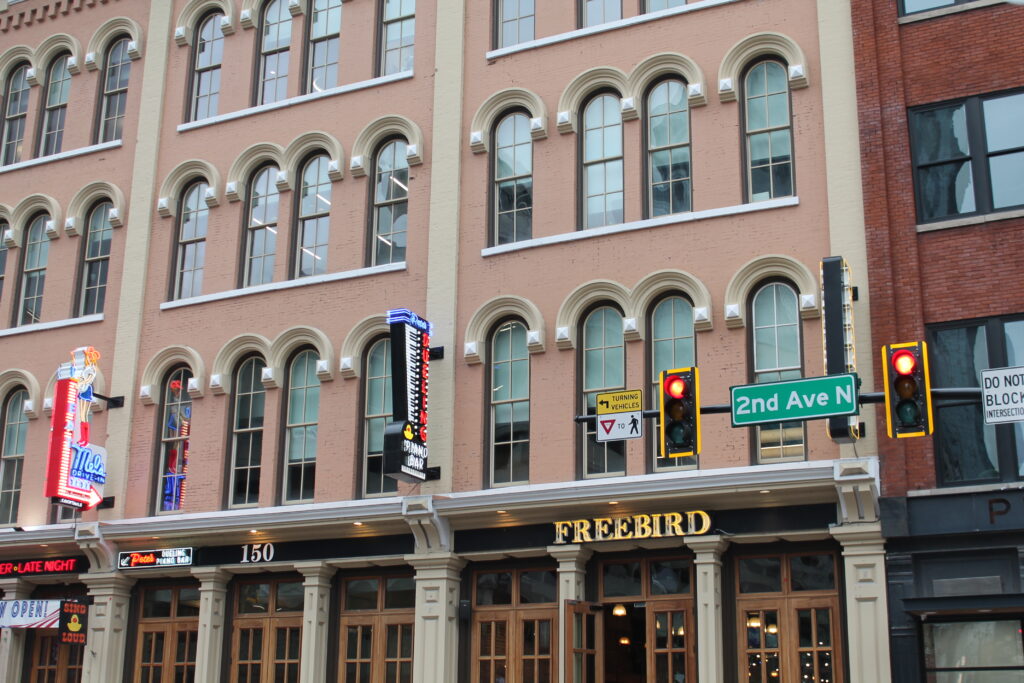
Monday afternoon was a celebration in downtown Nashville; the city’s oldest street is open for business.
Five years ago, a bomb exploded in downtown Nashville on Christmas morning. A local man blew up an RV at 6:29 that morning. The eruption left wide swaths of historic Second Avenue in tatters. It displaced 400 people, and damaged 65 buildings. Some are still evocative of World War II ruins — urban brick buildings with their tops blown off.
“You can still see our wounds back behind me,” said Michele Scopel, who led the city’s rebuilding efforts in her work at the Metropolitan Development and Housing Agency. “We have scars.”
There were balloons, applause and promises of a bright future. But throughout the event, it was hard to overlook the lingering heartache.
“I will tell you, I remember personally so clearly Christmas Day five years ago, the sounds of our girls bounding down the stairs in our house,” said Mayor Freddie O’Connell. “But then quickly, those familiar sounds were followed by the steady chime of my phone, alerting me that something was wrong.”

Michelle Scopel of the Metropolitan Development and Housing Agency (left), MNPD Officer James Wells (center) and Mayor Freddie O’Connell discuss the Second Avenue bombing at the reopening ceremony on Dec. 22, 2025.
He noted that he represented the area as a metro council member at the time. And that time wasn’t easy.
“If we think back even just to 2020 and how difficult a year it was for the city of Nashville, to have a devastating tornado tear through big parts of the city, to then — as we had just begun recovery of that — have to contend with COVID,” he said. “And then to end the year on this devastating exclamation mark.”
The 2020 tornadoes hit on March 3 and killed 25 people in Middle Tennessee. They destroyed 1,600 buildings, including hundreds of homes. Not even two weeks later, the world started shutting down because of the coronavirus.
On Christmas morning, downtown dwellers started hearing gunshots. Police calls about the sounds started coming in around 5:30 a.m. Then, the RV’s speakers sounded a warning: “There’s a limited time to evacuate this area. There’s a large bomb inside this vehicle.” The broadcast changed to a stream of “Downtown” by Petula Clark. The blast happened at 6:29 a.m. and was audible 10 miles away. Callers told police they saw a massive fireball, and then clouds of smoke.
“I’m not going to sugarcoat it, this hurt,” Scopel from MDHA said. “This was really hard.”
The pain didn’t end Christmas Day. Reconstruction meant closed streets, barricades and caution tape.
The shops, restaurants and bars in the area depend on foot traffic spilling over from Broadway. Before the bombing, 27% of visitors turned onto Second Avenue from the major thoroughfare. After the bombing, that number dropped to 20%, and after the fences went up, it trickled down to 12%.
“We were doing construction right at the front door of all of these businesses,” Scopel said. “Because it was 12 months per block, it was really hard to do that and keep everybody open.”
Some did close.
“This is our oldest street in the city,” she said. “It’s had a lot life. You can see that, the history of it.”
It’s easier to see the history now that the sidewalks have 47 inscribed pavers embedded in them. They each bear a historical tidbit about businesses in the area and cultural events that took place on the street.
The area — which was known as Market Street — got its name when the town’s first store opened in 1786, according to Nashville Public Library’s archives.
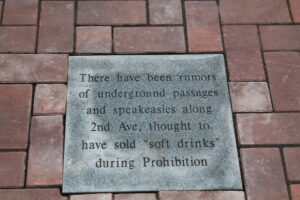
There are now 47 granite pavers throughout the Second Avenue corridor, sharing tidbits of the street’s history.

 On Air - 90.3 WPLN-FM