

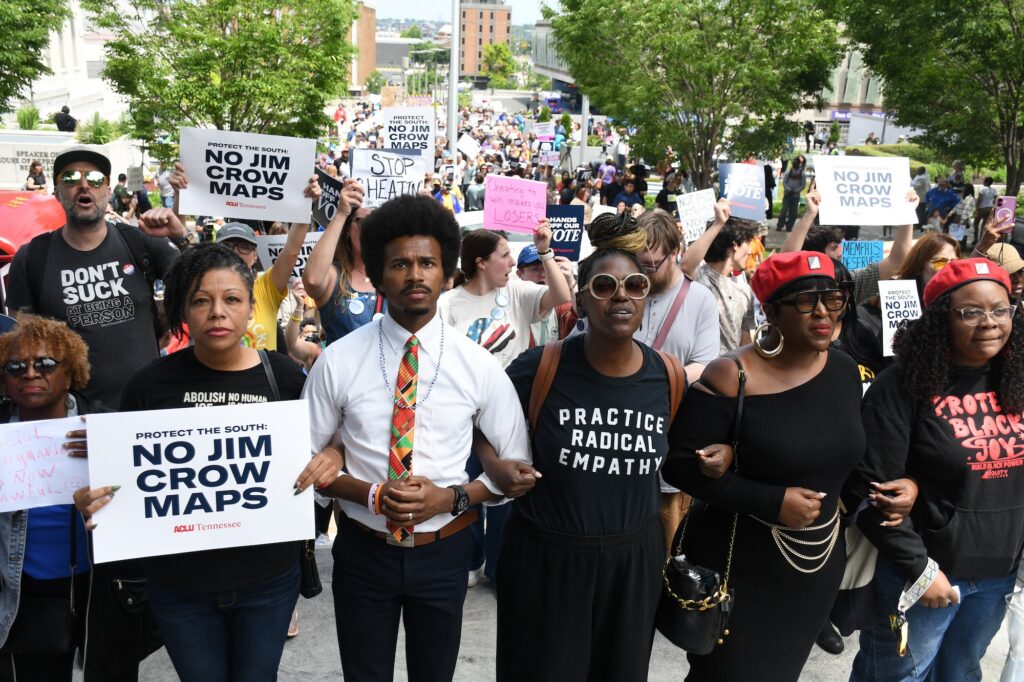
Hundreds of protesters gathered at Tennessee’s capitol Tuesday as lawmakers began a special session to consider splitting Memphis’s Democratic stronghold into reliably red districts.
Tennessee’s Republican supermajority is heeding a call from President Donald Trump to give the GOP more seats in Congress. Republican Gov. Bill Lee — initially hesitant about the timeline of new maps — called the special session after a phone call with Trump.
Lawmakers will likely only have three days to redistrict, a process that usually takes months.
Republicans began by striking down Democratic proposals to give the public more feedback in the redistricting process. In a House committee Tuesday morning, GOP leadership quashed efforts to hold public feedback meetings with constituents or to release the proposed maps publicly 72 hours before a final vote. The House Ad Hoc Committee also voted to ban disruptive observers from the entirety of the special session.
Republican leadership will have to undo a 50-year-old state law that prohibits mid-decade redistricting before they can pass new maps. Of the first bills filed for the special session, one would strike down that precedent and pave the way forward for mid-decade redistricting.
Other measures would clarify how the 2026 midterm elections would move forward under new maps, like allowing congressional candidates to run in districts they don’t live in.
More: Special session live blog
The last-minute redistricting effort was spurred by a U.S. Supreme Court case that undid protections for majority-Black districts like Memphis.
Rep. Justin J. Pearson, D-Memphis, told WPLN News that these new maps threaten to undo years of progress for Black voters.
“Mid-decade redistricting is new but attempts to take away the voting rights of Black people is not new,” Pearson said.
Pearson, along with other Democratic lawmakers and Black organizers, led protesters in a march on Tuesday afternoon. In a speech before the crowd, Pearson pointed to historical obstacles Black voters have faced, from physical violence to Jim Crow-era laws that kept them from casting a ballot.
 Marianna Bacallao WPLN News
Protesters march to the state capitol as lawmakers consider new congressional maps.
Democratic U.S. Rep. Steve Cohen, Pearson’s opponent in the District 9 primary, has asked state lawmakers not to adopt new maps.
“They don’t have to do it, but they’re getting immense amount of pressure from the White House. That’s where it’s coming from. Donald Trump wants an extra seat,” Cohen said Friday.
Others speakers, like Tequila Johnson, CEO of The Equity Alliance, invoked Tennessee’s history as the birthplace of the Ku Klux Klan — and Nashville’s history as the first city to desegregate lunch counters.
“So, don’t you dare let nobody tell you we don’t have hope because we a red state. You hear that? Tennessee is a movement state,” Johnson said.
Some Republicans have expressed caution, from those who represent Memphis to those in their first term. State Rep. Mark White, R-Memphis, told local reporters that he doesn’t think “now is the time” to redistrict. Rep. Michele Reneau, R-Signal Mountain, has asked her constituents to weigh in.
“If the goal is to reflect voters, we could look at recent election results. In the last presidential election, Tennessee voters split roughly 60% Republican and 40% Democrat,” Reneau wrote. “A proportional approach would reflect that balance more closely than a map designed for a single-party outcome.”
Hearings on the new maps will begin Wednesday morning.
 On Air - 90.3 WPLN-FM