

📲 Get the latest on the midterms & more in the NPR App
Starting last year, President Trump and his political team put pressure on Republican-led states to redraw congressional district lines to favor Republicans. It was supposed to build a firewall for Republicans hoping to avoid the historical pattern of heavy midterm losses for the president’s party.
“It just has not turned out that way,” said Nathan Gonzales, editor of Inside Elections.
Instead, Republicans are spending millions of dollars on House seats that were supposed to deliver easy wins and may end up losing them anyway.
Loading…
Among those districts is North Carolina’s 1st Congressional District, which the state legislature aggressively redrew late last year to try to make it a reliably Republican district. Under the new lines, Trump would have won the district by more than 11 percentage points in 2024. Now it is widely considered a toss up.
Trump recently headlined a rally in eastern North Carolina where former Republican Party chairman turned U.S. Senate candidate Michael Whatley got most of the attention.
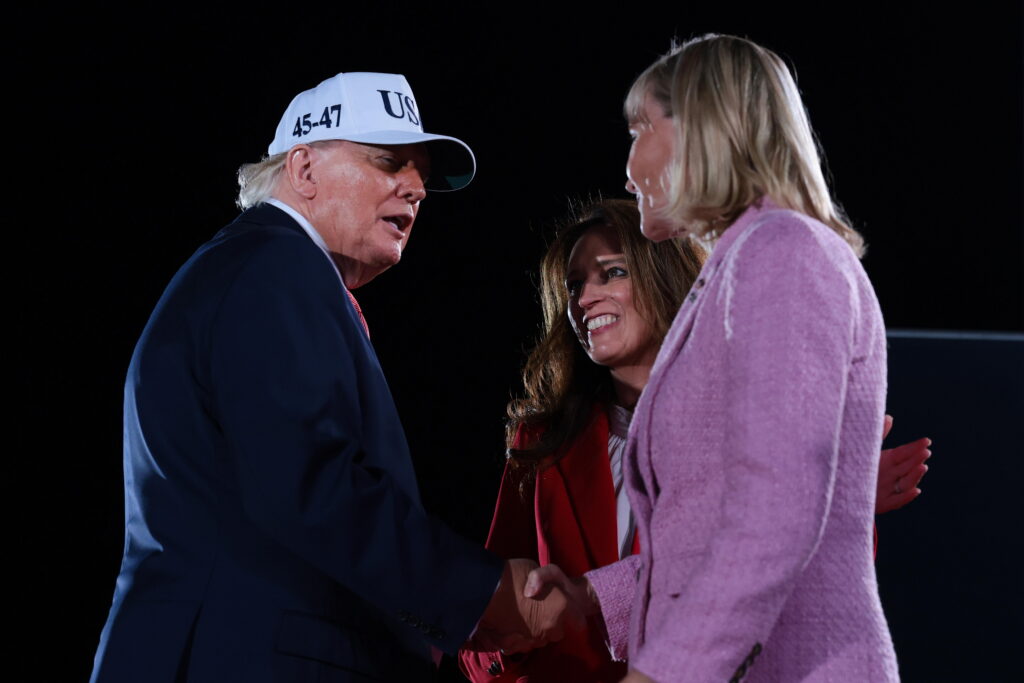
It was cold and getting late when Trump finally got around to mentioning two congressional candidates sitting in the VIP section.
“Come up. The two of you, we have to get them in,” Trump said of Laurie Buckhout, the Republican nominee in NC-01 and Jennifer Balkcom, the Republican running to represent NC-11 on the opposite side of the state. “We have to vote for them. These are two special people. Come on up.”
On stage, Buckhout, a retired Army colonel, who ran and lost in the district two years ago, leaned into the partisan advantage Republicans should have in the district, saying it’s “simple math.”
“There are more of us,” said Buckhout. “All you’ve got to do is get out the vote. God bless you, Mr. President.”
But concern about turnout is exactly why Trump was in the state, begging voters to cast their ballots as if he were on it. Trump told the rally crowd that House Speaker Mike Johnson had asked him to give an extra boost to Buckhout and Balkcom, describing the situation as “tough.”
“He said ‘if you could, give them a special call out tonight, because they’re going to have close races’,” Trump said.
Buckhout and her team didn’t respond to requests to participate in this story. But, if this redraw was meant to notch an easy Republican win, it hasn’t worked out. This is now one of the most expensive House races in the country, with more than $42 million spent on advertising between Sept. 1 and Election Day, according to an NPR analysis of AdImpact data.
New district lines, same issues
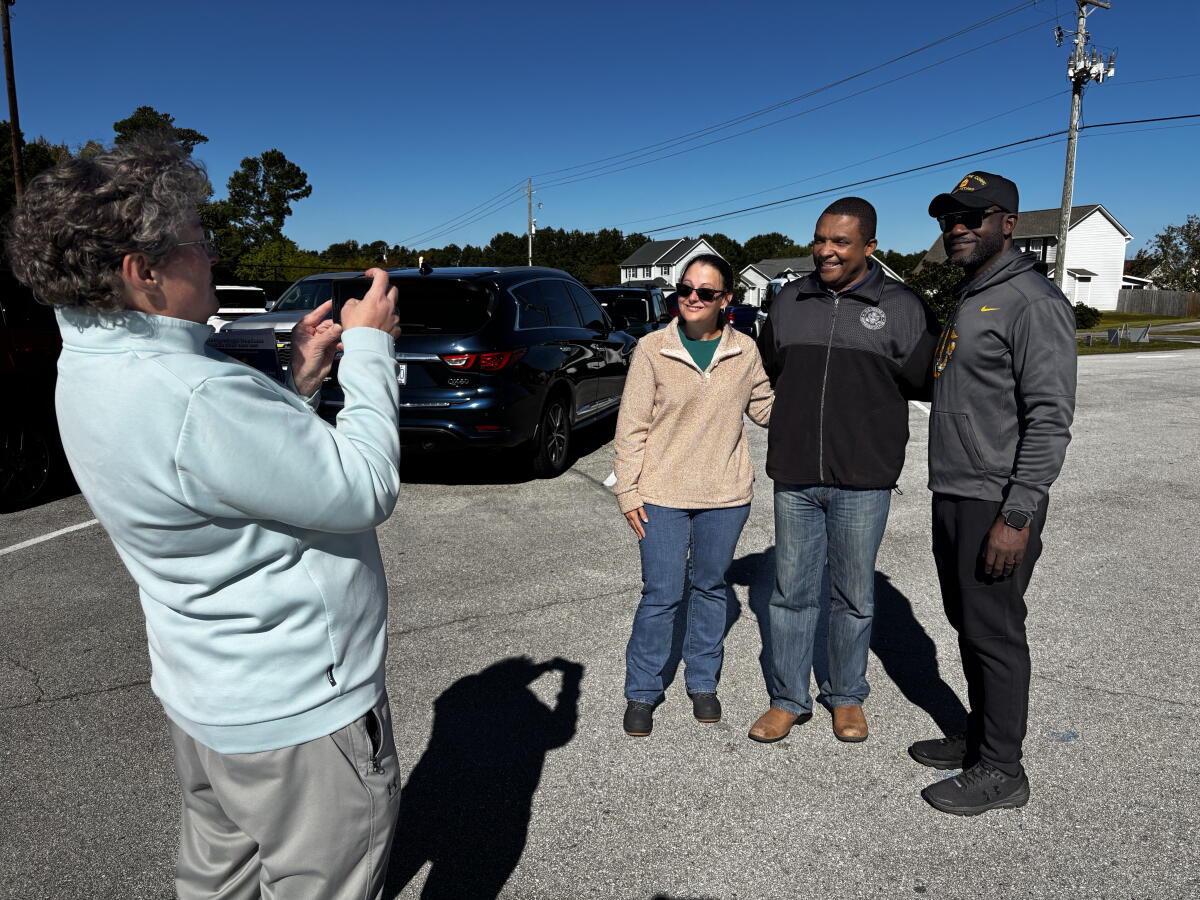
One recent morning, Democratic Rep. Don Davis, was greeting voters at an early voting location in Swansboro, at the far southeastern tip of the district, an area he hasn’t represented before.
As Davis introduced himself to a voter walking out of the polling place, the man told him he wasn’t in his district.
“Oh, I’m sorry,” Davis said, laughing and noting this has been happening to him a lot lately.
“This is my third run on a third new map,” said Davis.
Davis has been a top target for Republicans in multiple rounds of redistricting. This time his home county was drawn out of the district and he got all or part of six new counties. He says issues in eastern North Carolina, though, are universal.
“You hear so much about affordability, inflation and costs but I believe this is becoming for many about survivability,” said Davis, referencing farmers, truckers and fishermen hit by high fuel prices. “Just how they’re able to make it and survive during these tough times.”
Davis is a happy warrior, even joking about his predicament with a volunteer handing out flyers in front of the polling place.
“I just don’t know how many other ways you could redraw it now, other than maybe, you know if you just start annexing Virginia or something or maybe taking it into the Atlantic Ocean or something,” he said adding with a laugh, “I’ll just swim and talk to the fish, you know.”
Republicans and Democrats alike acknowledge Davis is a formidable campaigner, making this race more competitive than it should be just based on the way the lines were drawn.
“I think they believed that they had beaten Don Davis with the redistricting pen,” said Morgan Jackson, a prominent North Carolina political consultant, who is running Democrat Roy Cooper’s U.S. Senate campaign. “As it turns out, Don Davis has always been a tough out. He’s a local politician who runs really strong.”
Incumbent Democrats in several redrawn districts around the country decided to stay in and fight and now look well positioned to win, said Inside Election’s Gonzales.
“Republicans gained an advantage in 15 congressional districts nationwide but what we are seeing this close to Election Day is that some of those that were supposed to be easy victories are not turning out that way and the party is having to pour in millions of dollars to win districts that were supposed to be easy victories,” said Gonzales.
A Republican strategist involved with midterm races, but who wasn’t authorized to speak publicly, pushed back on the idea that the redistricting push has been a bust, saying “redistricting creates new battlefields, it doesn’t create outcomes.” That’s a lot less confidence than Republicans were projecting about these districts just a few months ago.
Two Florida congressional districts redrawn to boot Democratic incumbents are nearing a combined $90 million in ad spending. In Texas, districts drawn to have a 10-point Trump advantage have shifted toward Democrats and a previously safe Republican district that had some Democratic voters added to it in the redrawn maps now appears to be at risk as well.
“I think at the end of the day, this will go down as a dummymander rather than a gerrymander,” said Jackson.
Copyright © 2026 NPR
Transcript:
STEVE INSKEEP, HOST:
We’re nearing the end of election season. Former President Obama spent part of the weekend rallying Democrats in Michigan and Ohio. President Trump is doing everything he can to motivate his party’s base to show up.
(SOUNDBITE OF ARCHIVED RECORDING)
PRESIDENT DONALD TRUMP: And we’re also going to win a Republican House and a Republican Senate.
LEILA FADEL, HOST:
Recent polling and recent history lean against that result, despite Republican efforts to keep control of the House through redistricting. We have an update this morning on how that plan is working out. NPR senior political correspondent Tamara Keith reports.
TAMARA KEITH, BYLINE: It was cold and getting late when President Trump finally got around to mentioning two congressional candidates sitting in the VIP section at his rally in eastern North Carolina.
(SOUNDBITE OF ARCHIVED RECORDING)
TRUMP: Come up, the two of you. We have to get them in. We have to vote for them. These are two special people. Come on up.
KEITH: Laurie Buckhout, a retired Army colonel, is the Republican nominee in North Carolina’s 1st Congressional District, which the state legislature dramatically redrew late last year to try to make it a reliably Republican district. It’s an advantage she leaned into in her short remarks.
(SOUNDBITE OF ARCHIVED RECORDING)
LAURIE BUCKHOUT: And that’s simple math. There are more of us. All you got to do is get out the vote. God bless you. Mr. President, thank you so much. God bless you, sir.
KEITH: With the new lines, President Trump would have won this district by more than 10 points just two years ago. But now…
(SOUNDBITE OF ARCHIVED RECORDING)
TRUMP: It’s tough, you know?
KEITH: …He told the rally crowd Speaker Mike Johnson had asked him to give an extra boost to Buckhout and another North Carolina Republican struggling in her race.
(SOUNDBITE OF ARCHIVED RECORDING)
TRUMP: He said, if you could give them a special call out tonight because they’re going to have close races. But this guy name is – is his name Don Davis? I hear he’s, like, a disaster.
(BOOING)
TRUMP: No.
DON DAVIS: How are you, sir?
UNIDENTIFIED PERSON: Good, good, good.
DAVIS: Don Davis. Let me say hello to you.
UNIDENTIFIED PERSON: OK.
DAVIS: How are you, sir?
UNIDENTIFIED PERSON: You’re not in my district.
DAVIS: Oh, I’m not in the district. Oh, I’m sorry.
KEITH: This happens a lot to Democratic Congressman Don Davis as he’s out campaigning. On a recent morning, he was at an early voting location in Swansboro, North Carolina, at the far southeastern tip of the district, an area he hasn’t represented before.
DAVIS: This is my third run on a third new map.
KEITH: Davis has been a top target in multiple rounds of redistricting. This time, his home county was drawn out of the district, and he got all or part of six new counties to try to represent. He says issues in Eastern North Carolina, though, are universal.
DAVIS: You hear so often about affordability, inflation, and costs. But I believe this is becoming, for many, about survivability, just how they’re able to make it and survive, you know, during these tough times.
KEITH: Davis is a happy warrior, even joking about his predicament with a volunteer who’s handing out fliers in front of the polling place.
DAVIS: I just don’t know how many other ways you can redraw it now. Other than maybe, you know, if you just start annexing Virginia or something or maybe taking…
UNIDENTIFIED VOLUNTEER: (Laughter).
DAVIS: …It to the Atlantic Ocean or something, and, you know…
UNIDENTIFIED VOLUNTEER: Right.
DAVIS: …Then we just have to…
UNIDENTIFIED VOLUNTEER: Fish can’t vote, right?
DAVIS: Well, I can go out to swim and talk to the fish, you know?
KEITH: Buckhout and her team didn’t respond to requests to participate in this story. But if this redraw was meant to notch an easy Republican win, it hasn’t worked out. This is now one of the most expensive House races in the country, and it is widely considered a toss-up.
MORGAN JACKSON: You know, this is going to be known as a dummymander rather than a gerrymander.
KEITH: Morgan Jackson is a prominent North Carolina political consultant who is running Democrat Roy Cooper’s U.S. Senate campaign.
JACKSON: I think they believed that they had beaten Don Davis with the redistricting pen. As it turns out, Don Davis has always been a tough out. He’s a local politician who runs really strong.
KEITH: But it’s not just Davis. Incumbent Democrats in several redrawn districts around the country decided to stay in and fight and now look well positioned to win, says Nathan Gonzales, editor of Inside Elections.
NATHAN GONZALES: Republicans gained an advantage in 15 congressional districts nationwide. But what we are seeing this close to Election Day is that some of those that were supposed to be easy victories are not turning out that way, and the party is having to pour in millions of dollars to win districts that were supposed to be easy victories.
KEITH: A Republican strategist involved with midterm races, but who wasn’t authorized to speak publicly, pushed back on the idea that the redistricting effort has been a bust, saying redistricting creates new battlefields. It doesn’t create outcomes. Which is a lot less confidence than Republicans were projecting about these districts just a few months ago.
Tamara Keith, NPR News, Swansboro, North Carolina.
 On Air - 90.3 WPLN-FM