
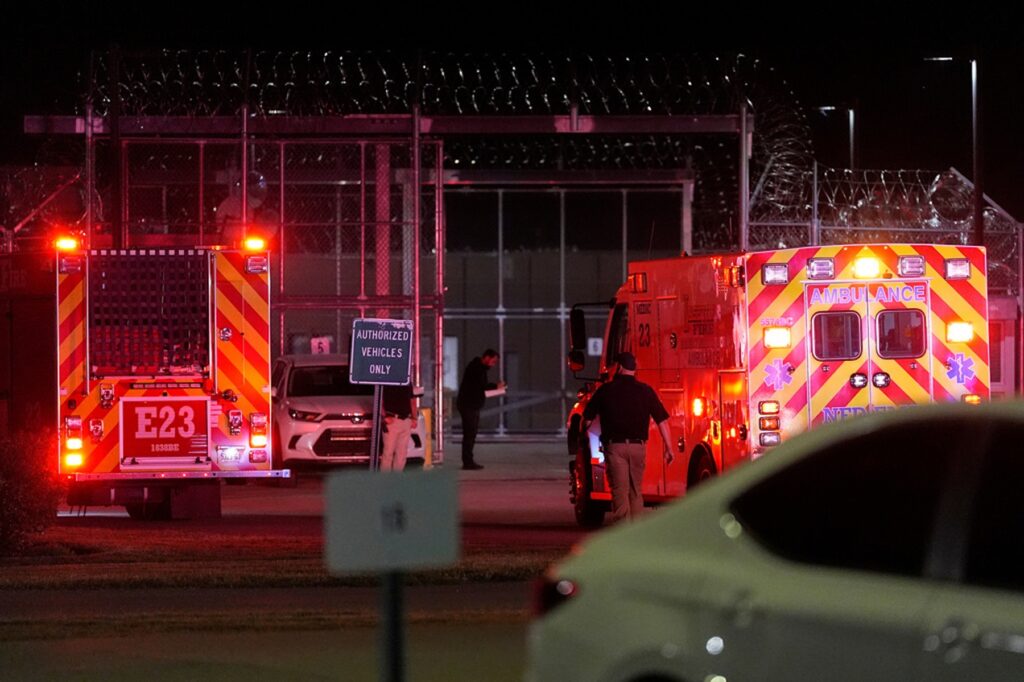
After the second round of lethal drugs failed to kill Christa Pike, she lay on a gurney for an hour and a half before an ambulance took her to a hospital.
Newly released recordings from Nashville’s emergency dispatch reveal why. A communication breakdown kept the caravan of emergency vehicles from getting to the prison. At one point, Department of Emergency Communications workers were trying to figure out if the requests for help were even real.
“We are trying to find out if that is an actual thing that is happening, and we need to send an ambulance … or if this is someone that is just, basically, prank calling,” a dispatcher said in one call.
Nashville DEC provided WPLN with nearly a dozen recordings — all but the first call for help. An agency representative said in that call, the prison worker’s voice would be too recognizable, so it was released as a transcript.
“We’ve been carrying out an execution tonight,” the transcript reads in part. “We’ve administered 10 grams of pentobarbital. The person is not yet deceased. That started approximately one hour ago. And we’re calling for an ambulance.”
Shortly after, one of Pike’s attorneys called for help as well. Neither he nor other callers had a code to verify the call was real and coming from the prison. That code would have to come from staff.
But workers at Riverbend Maximum Security Institution explicitly denied needing help several times.
“We didn’t call anybody,” one prison worker told dispatch, after being told crews were standing by. “I would have been the one to call you guys. We didn’t call anyone.”
Under Tennessee’s lethal injection protocol, there’s a five-minute waiting period after all the killing drugs have been injected. After that, a curtain closes over the witness bay, and the doctor comes out to certify death.
The curtain closed after Christa Pike’s second dose of the drug at 8:16 p.m. Witnesses sat listening to Pike’s ragged breathing over a loudspeaker until 8:53 p.m. It’s unclear whether medical workers in the death chamber were giving her care when the curtain was closed. In a later press briefing, Pike’s attorneys said they still don’t know what was happening in the room.
At 9:53 p.m., an emergency services worker told dispatch the ambulance carrying Pike was en route, according to the recordings.
In the lead-up to the failed execution, Pike’s attorneys argued the Department of Correction needed a backup plan. Their medical experts had predicted Pike’s small, fragile veins would make it hard to administer the drugs into her properly, and a failure was possible. Tennessee Supreme Court judges determined that the concern was too speculative for them to act.

 On Air - 90.3 WPLN-FM