
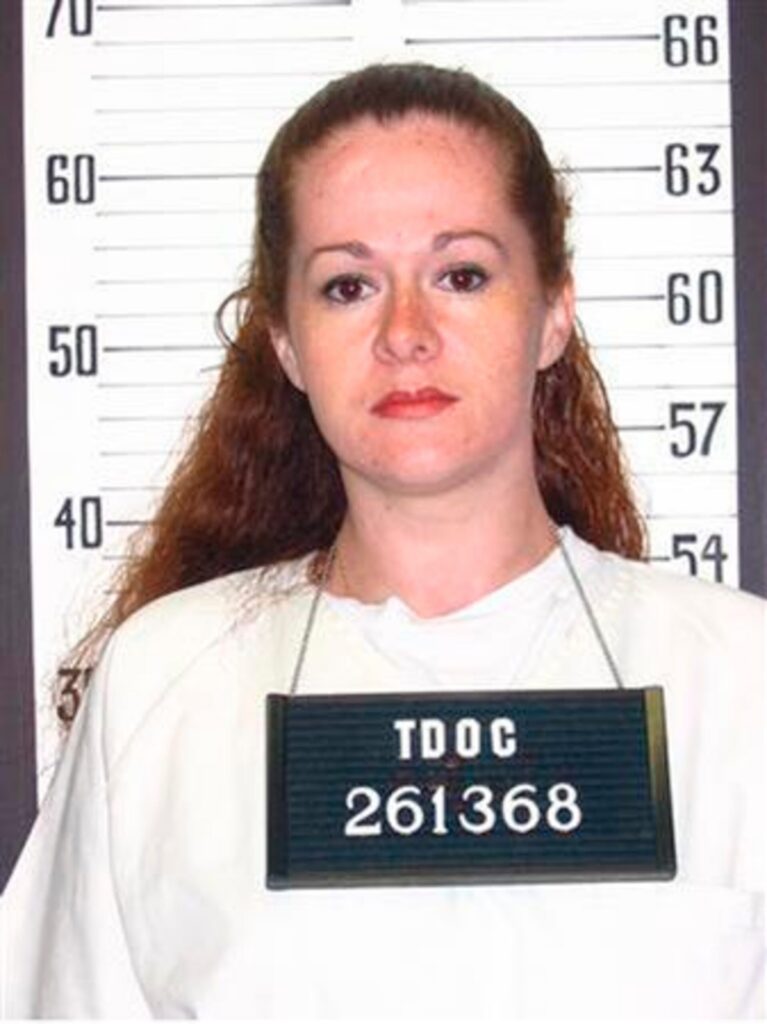
After several days of hearings, the Tennessee Supreme Court’s investigator issued a report saying death row inmate Christa Pike failed to convince him the state’s execution process would violate her constitutional rights.
Pike is scheduled to be executed on September 30. She would be the first Tennessee woman put to death in more than 200 years.
Her legal team argues that she’s at risk of a torturous death for several reasons hinging on health conditions. She has post-traumatic stress disorder from a lifetime of sexual trauma. She also has a blood-clotting disorder that affects her circulatory system, meaning that it could be difficult to place IVs into her arms.
The report says Pike’s legal team failed to prove she was at substantial risk of pain, serious illness or needless suffering.
As part of the legal challenge, Pike’s team also had to propose alternatives to the typical lethal injection process as execution methods. They pitched requiring the Tennessee Department of Correction to forgo attempts to place traditional IVs and go straight to the legally mandated backup plan of a central line. They also pitched hanging. But the report said the team failed to prove either method would be safer.
“The State clearly doesn’t care about a girl victim of childhood rapes and sexual abuse, and it will be complicit should Christa’s last moments be torturous,” one of Pike’s attorneys, Stephen Ferrell, said in a press release.
The team has until next Friday to file objections. The Tennessee Supreme Court will have the final word.
Before issuing the report, the special master declined to reopen the investigation. Pike’s legal team had made the request after the doctor involved in Tennessee’s executions delivered an interview to a national news outlet.
Under Tennessee’s lethal injection protocol, if the staff fails to place IVs in the arms, the doctor on site is tasked with placing a central line as a backup. The doctor on site for Tony Carruther’s attempted execution in May, Dr. Mark Fowler, tried and failed to place a central line until the governor called in and ordered the execution halted.
Several death row inmates, including Pike, have argued in legal filings that they are at risk of an unconstitutionally painful death because TDOC failed to hire a contractor physician who can place a central line effectively. The courts have ruled each time that this doesn’t qualify as a constitutional violation, in part because it’s speculative whether TDOC will continue to use Fowler. TDOC has argued that although Fowler was unmasked, he retains protections of anonymity granted under state law.
The doctor’s role in the Aug. 13 execution of Anthony “Darrell” Hines was confirmed when Fowler discussed the event in an interview with CBS News. That execution took place during the hearings on Pike’s case.
“The State continues to hide behind a veil of secrecy, which the physician has torn open,” Ferrell said in a separate press release.

 On Air - 90.3 WPLN-FM