
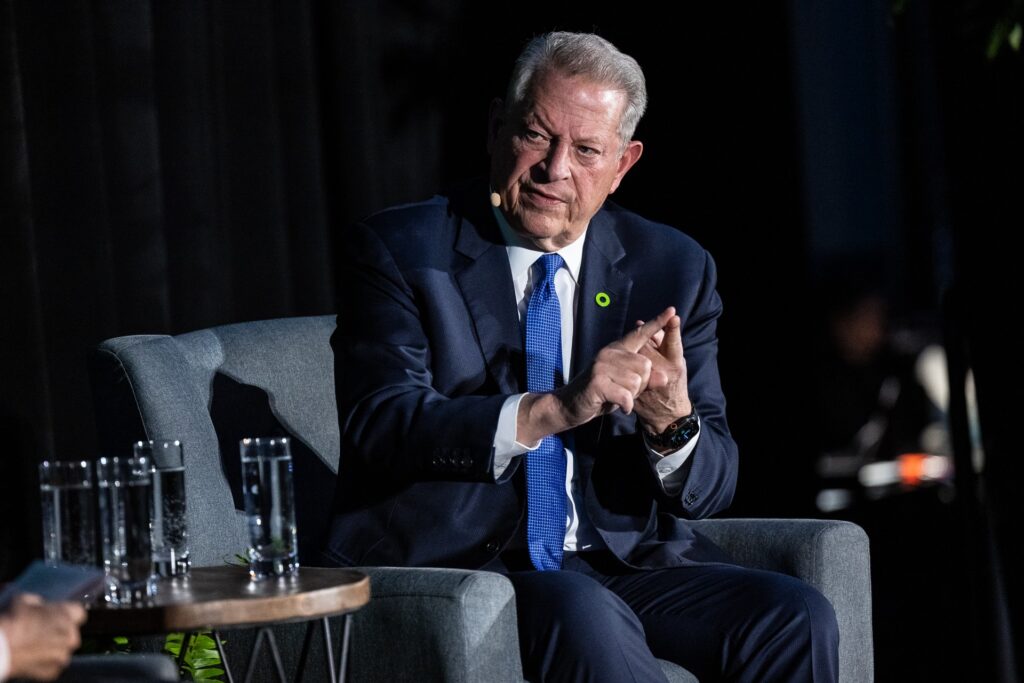
Former Vice President Al Gore’s message on the climate remains stark 20 years after his influential documentary, “An Inconvenient Truth.”
Climate pollution is at a record high, as nations continue to burn fossil fuels that emit heat-trapping emissions into the atmosphere.
“It’s trapping as much extra heat every day as would be released by 750,000 Hiroshima-class atomic bombs exploding on the Earth,” Gore told an audience Thursday at the kickoff to a multi-day climate training in Nashville.
Gore and his nonprofit, the Climate Reality Project, are hosting a workshop for community leaders from around the nation to talk climate science and solutions. It’s the first of three stops on a global tour.
Earth is hotter. Here’s the latest
The past three years on Earth have been the warmest on record. In Nashville, three of the past four years have set new records, with 2023 and then 2024 taking the top spot.
Both of those years were influenced by the El Niño pattern. Last year was influenced by a weak La Niña event, which is typically associated with modest cooling in the global mean temperature.
This year, El Niño conditions are likely to return as early as the May-July period, according to the World Meteorological Organization.
Warming is caused primarily by fossil fuel use, deforestation and animal agriculture, all of which release greenhouse gases into the atmosphere. The consequences of warming are far ranging, from more severe storms and drought to a loss of species and health risks.
Global carbon dioxide and methane emissions likely reached a record high last year. In the U.S., greenhouse gas emissions rose by 2.4% in 2025, a departure from the declining emission amounts of the prior two years, according to a preliminary analysis from the research firm Rhodium Group.
‘Suffocating’
While fossil fuel use remains high overall, some nations have accomplished various markers of progress in stopping warming, Gore said. Countries like Costa Rica and Ethiopia run on virtually 100% renewables, while the majority of cars sold in countries like Norway, Nepal and China are electric vehicles.
But progress in the past two decades has been far slower than possible, Gore suggested, due to the fossil fuel complex’s hold on politicians, including those in Congress. He attributed this to the rise of television consumption as a primary way to get information, as opposed to newspapers, and the subsequent shift by members of Congress to spend a lot of their time raising campaign contributions.
“The system has been suffocating under this blanket of special interest money, and often now they allow the lobbyists to actually write the legislation that they’re going to be voting on,” Gore said.
The key difference now, Gore said, is that the solutions to get off fossil fuels have never been easier or cheaper. A prime example: Solar is the least expensive source of new electricity in a significant majority of countries.

 On Air - 90.3 WPLN-FM