

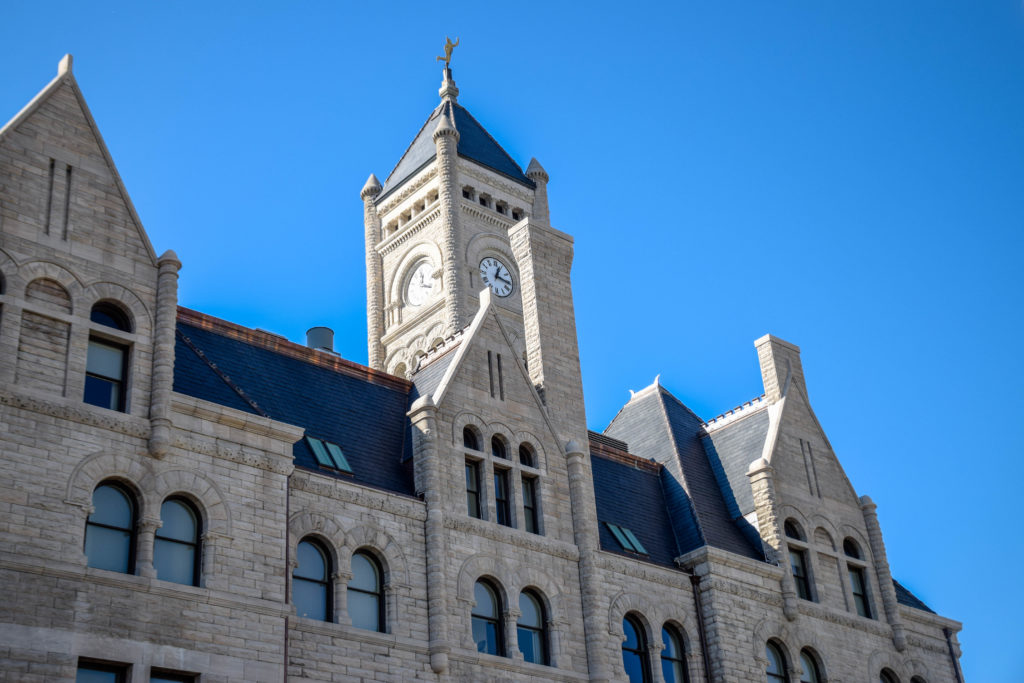
If you know where to look, there’s a god frolicking amid Nashville’s skyline. It’s the mythological messenger Mercury, and he’s gleaming at the top of the Union Station clock tower. But he’s had his share of ups and downs.
The high-profile figure once took a tumble. And that prompted WPLN listener Christina to call Curious Nashville with a question:
“It came down, was never put back up … we have a very primitive replica up there. But the original, I’m wondering where it could be!?”
The bronze statue’s fall happened in 1952. Chasing down what happened next opens up rich tales from local history, ties to other prominent landmarks, and even an infamous storm.

This glass plate negative shows the 1897 Tennessee Centennial Exposition. It was recently discovered among negatives kept in storage for nearly 30 years. Credit: Metro Nashville Archives
Mercury’s first home
The clock tower wasn’t the intended destination for the statue. The architect Baxter J. Hodge designed it for the Centennial Exposition in 1897. Mercury was first fastened to the top of the Commerce Building at Centennial Park.
Later, around 1900, locals decided to place it atop Union Station. As the god of communication and travel, Mercury’s presence at a major train depot made sense. And the statue remained there for over 50 years.
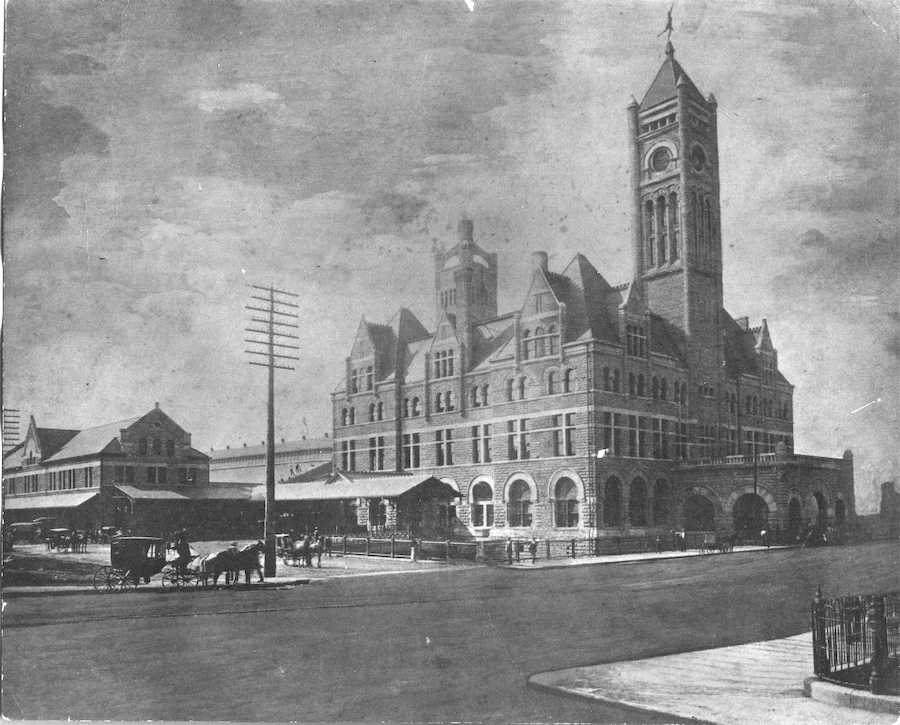 Courtesy Tennessee State Library and Archives
 Nashville’s Union Station, with horses and carriages, is shown in this undated archival image.
However, the bronze deity could only withstand so much, as its metal frame measured less than a tenth of an inch thick.
And on March 22, 1952, at around 10 a.m., Mother Nature put it to the test. A heavy wind collided with the statue, sending it down nearly 100 feet, where it met its demise on the Broadway viaduct.
The statue was recovered. But it’s fate would not be a return to the clock tower.
This Is Nashville: Surprising tales behind Nashville’s public sculptures and landmarks
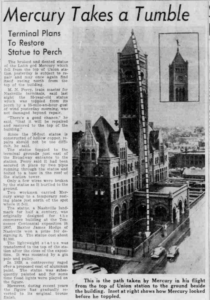
Article from The Tennessean, March 23, 1952.
Mercury redux
After a few decades — including the time of Union Station’s fall into disrepair and eventual comeback as a hotel — a new Mercury was placed atop the tower in 1997. That version is a two-dimensional copy of Giambologna’s statue of Mercury.
As if cursed, that too was affected by inclement weather: the April 1998 tornado caused the statue to bend. But instead of a catastrophic fall, it led to a repair project.
But what about the original bronze?
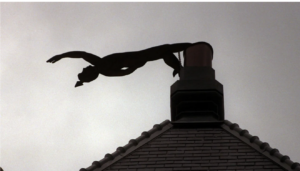
Second Mercury Statue Bent by April 1998 Tornado Outbreak. Source: The Tennessean
Architectural salvage
When the Curious team went looking for answers, a 2023 Facebook post by “Nashville Then” unleashed a deluge of comments reminiscing about the lost artifact. One of them stuck out, from retired architect Randy Diamond, who commented about how the present-day Mercury was about “half the size” of the original, and a “cheap replica.”
“I was only 6 years old when it fell the first time. I’ve always been interested in the architecture, and Union Station is on of the crown jewels of Nashville’s historic architecture,” Diamond told WPLN.
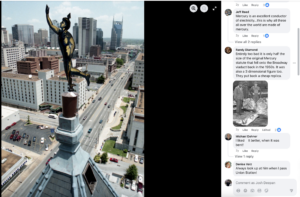
Comment by retired architect Randy Diamond.
But where the original statue went remained unknown. And Facebook, despite its tentacular presence in everyday life, came up short. So, the next stop was the Tennessee State Library and Archives and its newspaper holdings.
It turns out the original statue was likely headed to a scrapyard in Louisville, where it would be melted down for potential military use during the height of the Second Red Scare.
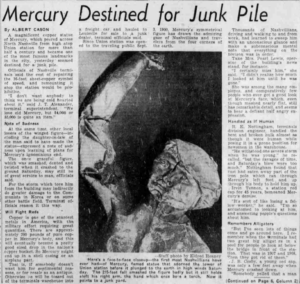
Newspaper article from “Nashville Tennessean.” March 26, 1952.
Before that could happen, the statues were bequeathed to Davidson County agricultural extension agent Oscar L. Farris. He was passionate about local agriculture, and he was concurrently working on founding the Tennessee Agricultural Hall of Fame, which happened to need bronze for some new honorary plaques.
That hall of fame is housed at the Tennessee Agricultural Museum, and that’s where we can find the answer for Christina.
“These are the only two [plaques] that are made from the Mercury statue,” says museum Director Elaura Guttormson. “It’s the Goodlettsville Lamb and Wool Club, and then the one on Harcourt A. Morgan.”
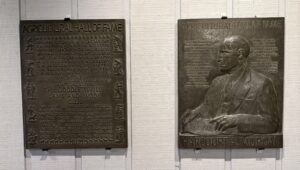
The bronze plaques as they exist today at the Tennessee Agricultural Museum.
Morgan was a president of The University of Tennessee, and helped contain southern cattle tick outbreaks — which makes sense as to why agricultural historians wanted to keep his memory alive.
“The Department of Agriculture wants to continue to be a steward of the existing plaques,” Guttormson added. “We’re proud to have them.”
The museum is on Hogan Road in the Crieve Hall neighborhood, and that’s where visitors can see one of Nashville’s many examples of how a damaged or destroyed artifact can be repurposed. And thus, immortalized.
 On Air - 90.3 WPLN-FM