
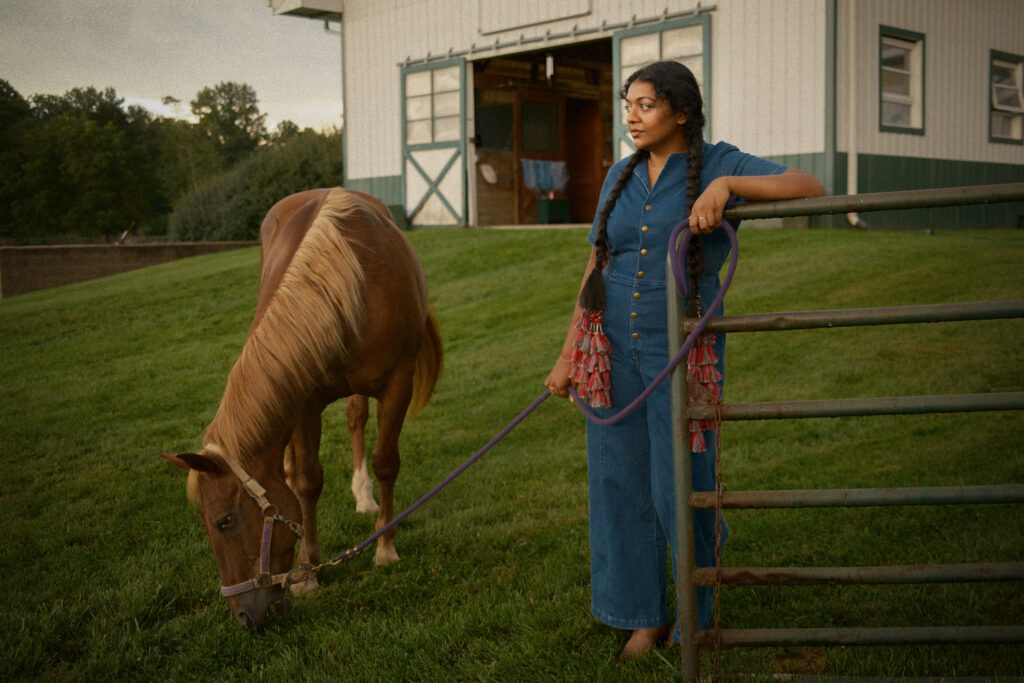
Years ago, Pooja Reddy left her home state in the American South for a prestigious international internship. And her supervisor there didn’t conceal their surprise at her background. “I’ve never met anyone from Kentucky,” they told her. “It’s probably because they’re not smart enough to leave. And how could you be from there? I thought only white trash lived there.”
They may have intended those comments as a compliment to the sharp, young intern, but they’d misread their audience. Sure, Reddy was first-generation Indian-American and positively brimming with ideas and ambition. She was also uninterested in distancing herself from her upbringing in a farming community in southern Kentucky.
After several interactions with people dumbfounded by how dramatically her experience diverged from the uninformed Southern and rural stereotypes they treated as fact, Reddy conceived of a strategy. She would write autobiographical comedy. Disarm the narrow-mindedness with satire. Acknowledge that picturing a Hindu-practicing brown child of immigrants learning to shoot a gun and harboring country singing dreams might seem absurd—and make that very embrace of multiplicity seem truer to life, and more appealing, than flattening people into types.
Reddy’s proven herself to be so adept at that comedic mission that she’s created a country cabaret show, with the mischievous, insult-upending title “Pooja Reddy is White Trash,” that has its world premiere at the famed nightclub Joe’s Pub beginning this week. Even though New York audiences will get to see it first, the show is bound to resonate across regions when she eventually takes it on the road. It’s a brilliant contribution to the new wave of voices reimagining the comedic potential of country music and storytelling and defying hidebound assumptions of who gets to represent country culture in the process.
‘I’ve never been confused about my identity’
Reddy’s familial roots are in Hyderabad in South India, but she grew up in Glasgow, Ky. after her parents immigrated to the U.S. To secure a green card, her doctor dad agreed to practice medicine in that then-underserved area. But Reddy says the rural setting felt familiar: “They really appreciated the pace of life and they thought it would be a good place to raise kids.”
Reddy was introduced to the Grand Ole Opry by elderly white neighbors who became something like surrogate grandparents, and inspired a joke about her inner voice being that of an old white man named Everette. At her elementary school, she was the only South Asian kid. Her show includes an amiable folk-country original called “Wish You Were Here” that recalls how insistently her classmates assumed she was Mexican.
Her family sometimes trekked to the closest Hindu temple 90 miles away in Nashville. At the same time, she was savvy enough to see that having a social life meant joining friends for activities at their local evangelical Christian congregations. “I felt I had a very normal southern upbringing, just like any of my other classmates did,” Reddy observes. “But at the end of the night, I was just going home and eating pappu and annam and biryani. And at home, we spoke Telugu.”
What she gained by exploring with curiosity was the ability to relate to all sorts of people and, on top of that, a real sense of ownership of who she is. “I don’t think I’ve ever been confused about my identity in terms of how Indian I am or how American I am,” she says. “That’s never been a conflict for me. I think my main internal identity conflict is about being coded as a Southerner and what the rest of the country or world projects onto that.”
Reddy began college on a pre-med track before switching to psychology, international studies and political science. Then came the ultimate internship: working for First Lady Michelle Obama during her husband’s second term. It was in D.C. that Reddy began dabbling in comedy writing, mainly in dispatches to friends. She got serious about performing after moving to New York in 2017. There she diligently made the open mic rounds until she found one for women and queer people. Then she and her Bengali-American bud Zubi Ahmed started their own live comedy showcase called Kutti Gang that centers South Asian and LGBTQ+ voices and other comics of color.
Writing herself into the music
The work on “Pooja Reddy Is White Trash” began when Reddy secured the St. Nell’s Humor Residency in 2024. Things really accelerated when she landed a spot in the Joe’s Pub Working Group, a year-long artist-development program. She also found her director, Neal Gupta, teamed up with fellow artist Emma Jayne to write songs and, during trips to Nashville, enlisted multi-instrumentalist Freddy Angelico to arrange and produce the music.
Reddy’s kin have all left Kentucky, but during a recent visit back, she reflected on the ways she cultivated her creative skills during her rural youth. Gazing around the courtyard of one of the many churches she sometimes attended with friends, she recalled her early reliance on storytelling as a means of bridging cultural differences. “I felt like I was constantly storytelling and trying to connect the dots for people in this town that my family was not so different from their family,” she says.
Just as often, it was a tool she used to help her parents understand why she was so keen on participating in local cultural practices. Like attending a sleepaway camp operated by the Kentucky Department of Fish and Wildlife where kids got their fishing, firearms and boating certifications. In a delightful bit about it, Reddy suggests that her parents only let her go because its name, Camp Currie, gave the impression that she was going there to learn cooking.
Strolling along the shore of a nearby lake dotted with pontoon boats, she’s reminded of the popular country music that used to soundtrack her days on the water, and how she staked her claim to it. At the time, bro country come-ons practically ruled country radio. “I would listen to the country songs, and the protagonists would be, you know, ‘blonde hair, mini skirt,’” she imitates their sing-song melodies. “And I was like, ‘Wait, that’s not me.’ So I would be writing myself into the music like, ‘brown skin, mustache…’” Her singing dissolves into laughter.
The first country song that Reddy strongly identified with, and sang at karaoke, was Gretchen Wilson’s “Redneck Woman,” a hard-twanging and harder-rocking mid-2000s smash famous for Wilson’s rousing defiance towards anyone who looked down on her backwoods, working-class lifestyle as trashy. “I felt like there was fearlessness and audacity,” Reddy marvels. She’d even recognized parallels between the type of classist condescension Wilson sang about and the way that South India, where her family was from, was compared belittlingly to North India when she was growing up.
Reddy’s comedy is rich in that sort of insight. Where fixating on difference camouflages the kinship between people’s experiences, she plays up the benefits of looking for connections. And she delivers her material with such sly, sparkling understatement that it accentuates how assured, and funny, her perspective is. “We’re not all that different,” she says. “And maybe if somebody who looks like they wouldn’t be a typical southerner—maybe if it’s coming from me—then you might actually buy it and believe it.”
 On Air - 90.3 WPLN-FM