
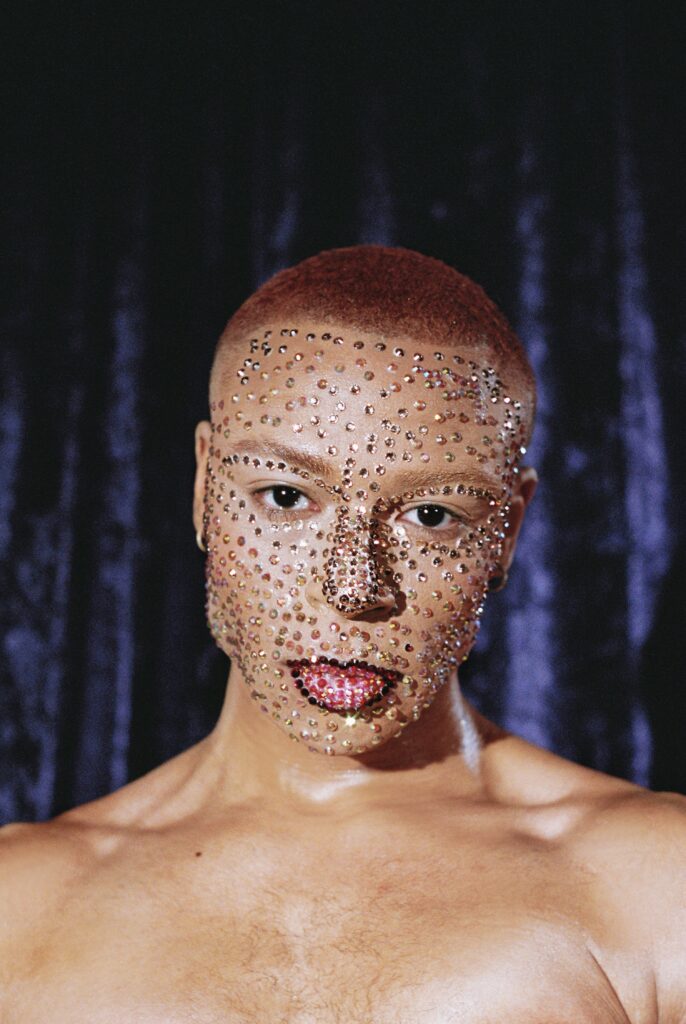
Houston Kendrick has never been a timid performer. Even so, his new music finds him flexing his expressive range more vigorously. Take the song “Paper Doll.” There’s no instrumental intro to set the tone. Instead, he opts for an instantly striking opening, animating the track’s first 18 seconds with anguished, operatic lines sung in a stratospheric register. Then he turns on a dime, suddenly all sleek club-ready syncopation, before layering on precisely synchronized harmonies as though he’s a one-man boy band.
“In my brain, I’m just a pop star,” Kendrick explains. “I just make big songs. Being able to have that operatic inflection and also go straight into the rap-singing is exactly why I do this. It’s expansive and it’s huge and it’s weird and it does not make any sense to your ear — but you like it.”
Arresting as his performance is, it’s also a definite departure from the proper singing styles he was taught by choir directors and music instructors during his suburban Birmingham youth.
“Funnily enough,” he says, “I just never allowed that to be much of an influence on me or what I thought was possible. I never had any doubt that I could be whoever I wanted to be or do whatever I wanted to do.”
That belief in limitlessness was put to the test in recent years as he worked on what would become his newly released album “Portrait of a Boy on Fire.” He thought he’d secured the industry support to go as big as he wanted, only to wind up on his own again. And yet he still found a way to complete a full-length so rangy, extravagant and charismatic that “Paper Doll” is but one of its many outlandish show-stoppers.
“Pulling from this deep, deep well”
As he entered the commercial music program at Belmont in the mid-2010s, Kendrick increasingly staked his music-making on his embrace of his own multiplicity and fluidity as a young, Black, queer man from the South who dared to explore both his feminine and masculine sides. “I saw what everybody was doing,” he says of his classmates. “Everyone was a singer-songwriter at that time. I was like, ‘Well, what if I want to be all of that but I also want to be Frank Ocean, Beyoncé, Rihanna, Lady Gaga, and Madonna and Prince at the same time? Why can’t we do it all?”
During the pandemic lockdown, he made his debut album “Small Infinity” in his bedroom with a maximalist mentality, and visuals to match, as he puts it, “just doing as much as I could and pulling from this deep, deep well.” That’s when I first interviewed him for one of WNXP’s early Nashville Artist of the Month features.
Blog coverage of “Small Infinity” caught the attention of hit songwriter Kaydence, whose credits include Ariana Grande’s “7 Rings” and Beyonce’s “Black Parade.” A duly impressed Kendrick flew out to L.A. to work on new material with this new connection: “That was one of the first times professionally that I was like, ‘Okay, this is somebody who really sees this as a marketable product, as well as a piece of art that can contribute to culture.’”
“Little did I know”
Kendrick made L.A. his new home base and continued to grow his network. “We found a deal partner, somebody that we really believed in and thought that believed in us,” he recounts. He did sessions with lots of top-flight pros, and was particularly excited to land a couple days in the studio with the in-demand R&B producer Camper. But even after a final round of recording with Kaydence, Kendrick still didn’t have a completed project. And he could no longer count on record label funding, since his deal had disintegrated.
“Long story short, that didn’t go amazingly well for me,” he summarizes. “I just fell into such a crazy depression. Could not cope. …I was about to have to get a day job again out in LA and I was like, ‘I can do this back in Nashville.’”
So often, the recordings an artist has labored over can become casualties of terminated business partnerships, but Kendrick couldn’t bear to let that happen. He called on the highly creative and capable friends in his tight-knit Nashville circle to help him finish not only the music, but photos and videos that complemented it.
“Make a lot out of a little”
One person he called was his bestie Prana Supreme, who’s navigated her own music career in her mother-daughter country partnership O.N.E. the Duo.
“As an artist myself, I completely understood the uphill battle that is trying to get a team of people to understand your vision and having them actively work towards a different vision,” Supreme says with a knowing half-chuckle.
She assisted while another buddy, Blaire Beamer, designed such complex looks that Kendrick grew nervous. He recalls protesting, “Blaire, this sounds crazy and expensive! I can’t do this!”
Beamer had faith in their resourcefulness. “As queer people from the South or who live in the South,” they reason, “it is intrinsic to our nature to know how to make a lot out of a little.”
That’s precisely what Beamer did, translating recycled materials into striking costumes. A structured mermaid skirt fashioned from a shower curtain and CDs, a corset dyed with pomegranate and lines with old computer keyboard keys, and plenty else that Kendrick donned for hasty yet truly high-concept photo shoots.
“I really just think anything is possible through community,” they emphasize.
The visuals they made together accentuate how Kendrick defies dominant narratives in songs like “American Trash.”
“In the chorus I say, ‘Look at me all in my American drag,’” he quotes. “To me, that’s really the whole point: This bravado, this exceptionalism, all the things that we are taught to feel proud about our American identity, all of it is drag. All of is a costume. And from my perspective, Black gay boy from Birmingham, Alabama, there are real things that I’m proud of.”
Kendrick can count the look and feel of his second album “Portrait of a Boy on Fire” among them. Even without a budget, he realized his grandest vision yet the DIY way.
It was his old Belmont classmate and “Small Infinity” collaborator Bobby Knepper who he turned to with the “big old hard drive full of files from every single person who’s touched every single song.” The two of them spent countless hours taming that chaos.
“The album is a seamless flow from song to song because of that real attention to detail that he brings to everything that he does,” Kendrick reflects. “And with my neuroticism, it was a perfect match.”
He chose the title with a “restorative kind of fire” in mind. “It’s about being lit ablaze in order to become new again,” he goes on. “And when I think about the creative process, it was waves of burning down and regrowing, burning down and regrowing.”
Kendrick’s become even better at asserting his imaginative freedom, even when he’s operating within very real practical limitations. In this new music, he dares anyone to tell him that he is too much, or wants too much for his art.
 On Air - 90.3 WPLN-FM