

A Japanese nuclear company is betting on Tennessee as a hub for fusion power.
Kyoto Fusioneering is moving its U.S. headquarters here to partner with Oak Ridge National Laboratory, the longtime hub of nuclear and energy research. It’s building a facility where fusion companies can test a component of their designs for fusion power plants.
“We are saving developers from absorbing immense vertical integration costs alone. We came to East Tennessee to build a physical anchor for an allied fusion supply chain,” said Bibake Uppal, president of Kyoto Fusioneering America.
Fusion powers the stars, and people have been trying to recreate controlled fusion on Earth for about a century. Oak Ridge, which is the Department of Energy’s largest lab, has been involved in fusion research for about 70 years.
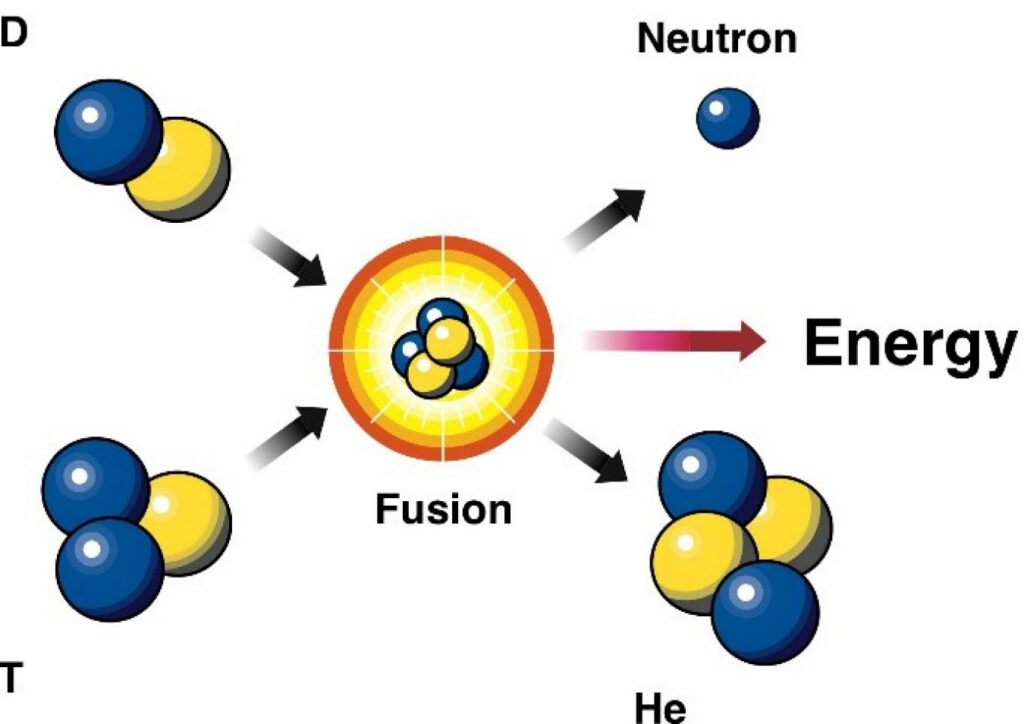
To achieve fusion, researchers use isotopes of hydrogen: deuterium and tritium. Deuterium is naturally abundant, while tritium is quite rare.
 Courtesy U.S. Department of Energy
 Fusion reactions require deuterium and tritium, which are both isotopes of hydrogen.
But people can produce tritium by wrapping a shell containing lithium around a fusion reaction.
That shell is called a breeding blanket, and that’s where Kyoto Fusioneering comes in. The company is building a particle accelerator with ORNL that will allow researchers to test prototype blankets.
The facility could serve as a critical piece in the future of fusion.
A potential game changer
Some clean energy advocates think nuclear, whether fusion or fission, is unnecessary since renewables are cheap and can be brought online quickly. Technically, people have already figured out how to harness the power of a star via solar power.
Fusion supporters, however, see the energy source as a way to clean up electrical grids with a few key differences from fission, which powers the nuclear power plants of today. Fission requires uranium and necessitates a complex supply chain, while fusion’s deuterium is abundant in seawater. Waste from fusion is less radioactive and shorter-lived.
“When you think about energy justice, and you want to be able to have a source of energy that is accessible to all countries, that is exactly what fusion brings,” Oak Ridge’s Kathryn McCarthy previously told WPLN. “Fusion has the potential to be a real game changer.”
She estimated that researchers could bring a fusion pilot plant online around 2035 to 2040.
Scientists reached a milestone in 2022 when Lawrence Livermore National Laboratory produced a nuclear fusion reaction that resulted in a net energy gain, but researchers still have a lot to figure out to make fusion a reality.

 On Air - 90.3 WPLN-FM