
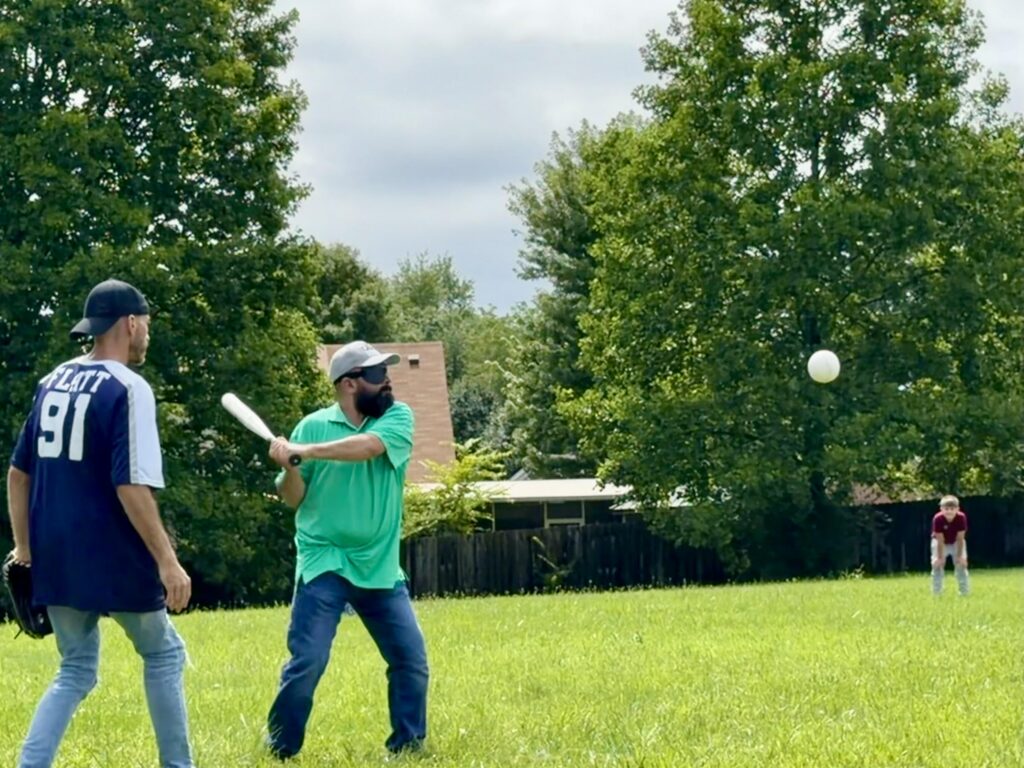
Conjure the sounds of summer. The sizzle of burgers on the grill. A kid’s cannonball piercing the pool. The buzz of mosquitoes. But what about the buzz of first base?
In beep baseball, blind athletes rely on sound to hit the ball and run to a base. Louisville’s blind community recently got a demonstration of the game where players keep their ears on the ball.
The Indianapolis Thunder, an adult beep baseball team, hauled their bases and bats to a field near Kenwood Heights Christian Church, in Louisville’s South End late last month. The East Louisville Lions Club hosted the event.
Where balls beep and bases buzz
The grass was still wet from a summer storm, so players walked carefully, finding a spot that’s not too soggy – and not too close to cars.
Once they lay down home plate and set up a base – a shoulder-height blue foam pillar with a buzzer inside, it’s time to play ball.
The first thing to know about beep ball is that the pitcher and batter are on the same team.
Jared Woodard, the sighted pitcher and coach of the Indy Thunder, guides the batter with his voice.
“Ball set. Ready. Pitch,” he calls.
The batter misses.
“So good swing, but did you notice the ball went past you before you swung? Yeah, you want to swing a little earlier, alright, there we go.”
Woodard wants the batter to hit the ball, so he pays close attention to their swing. He encourages them to listen to his voice, not the beeping ball. He watches their swing and tries to match it with his underhand pitch.
“Here we go, me and you, me and you…Ball set. Ready. Pitch…”
Thwack! The batter makes contact.
“Chase the base, chase the base!” Woodard yells.
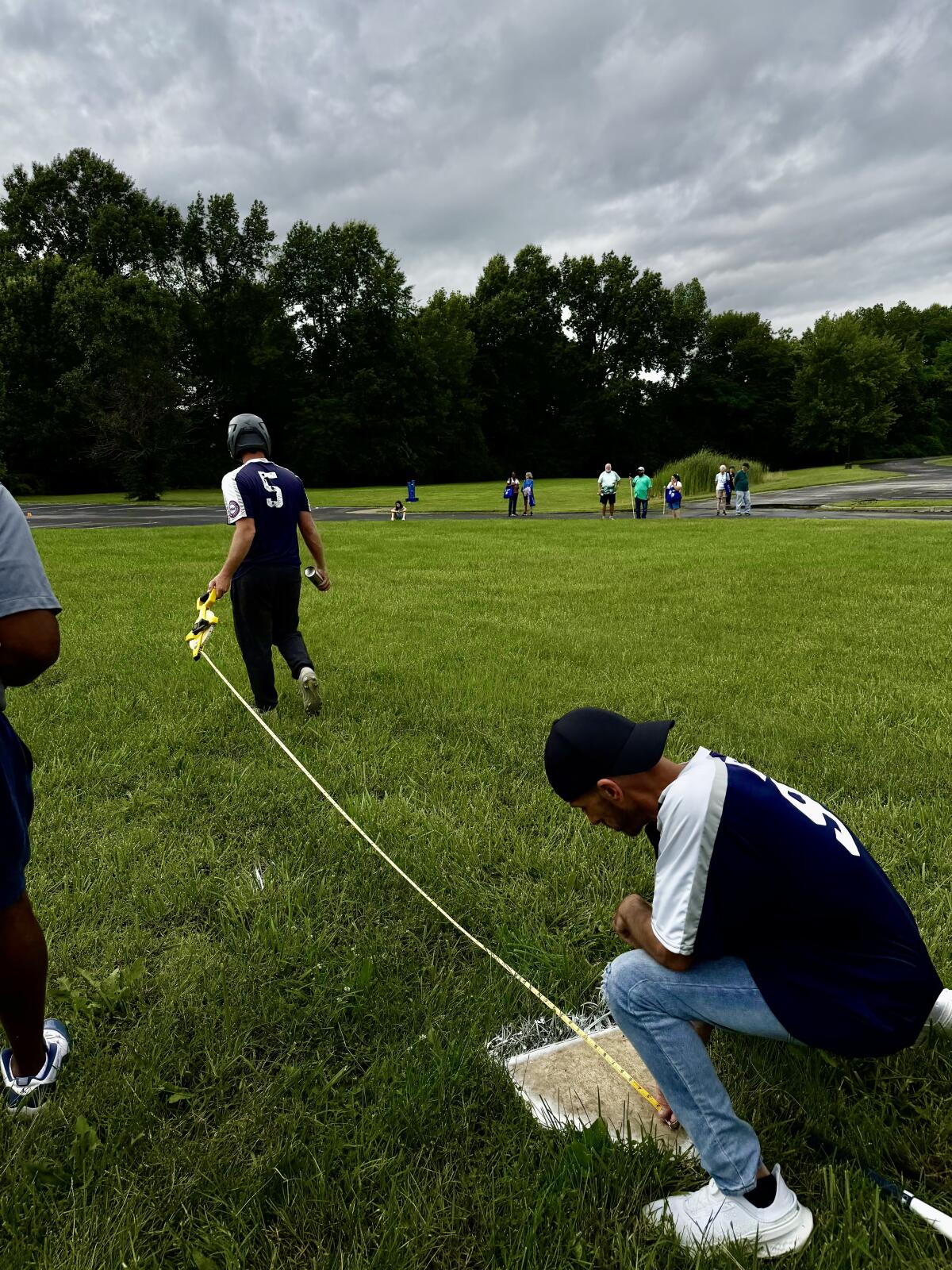
In beep ball, there are only two bases, and the batter doesn’t know which one they’ll run to until after they swing and one of the bases begins to buzz. A player is safe if they hit or tackle the foam base before a fielder catches their ball.
The fielders, who are blind, listen for the ball, and position themselves for the catch. The ball is a large softball that emits a repeated tone, like a flying metronome.
Two sighted spotters help by calling out a single number corresponding to a part of the field. Spotters use different inflections to indicate how the ball is traveling. A fast drive might sound like a short, punchy “two!” to indicate where on the field it’s headed. A high and slow hit might sound more sing-songy and slower. The spotters can only call one number, so ultimately it’s up to the blind fielders to find the ball.
Woodard grew up learning the game from his father, who’s blind.
Many blind sports use guides or spotters to interpret the visual world for players from the sidelines or after a play. But, in beep ball, they’re all players on the same team.
The team helps each other off the field as well. Woodard works in vision rehab when he’s not pitching. As an orientation and mobility instructor, he taught one of his players, Joel Taulbee, how to use the familiar white cane when he first started losing his sight.
“He gave me some of my independence back,” Taulbee says. “I’ve truly met the best people in life, I believe, through beep ball.”
Darnell Booker, founder of the Indy Thunder, says independence is one of the gifts of the game.
“Once the ball is hit, they’re running freely to that buzzing base. They’re not having any help.”

That unencumbered 100-foot sprint builds confidence that players take into their careers, school work and social lives. Booker is the Thunder’s general manager and the first vice president of the National Beep Baseball Association (NBBA). He also knows the game personally; he started as a player recruited at high school graduation from the Indiana School for the Blind in 1985.
The sport can be highly competitive.
“If you’re going to be in the NBBA, you’re there to compete,” Booker says.
There are teams across the country: the Chicago Comets, the Cleveland Scrappers, the Indy Thunder, the Philly Fire, and the Gateway Archers out of St. Louis. There’s also an all-female team out of St. Louis called The Sirens.
Kentucky doesn’t currently have a team, but Booker says he’d love to help get one started.
Locals take their swings
After the Indy Thunder finishes their demonstration, they invite rookies up to bat.
Israel Cazares, 38, lost his sight when he was six years old. He’s tried beep ball once before, but he still needs some coaching.
Cazares misses the first two pitches. But on the third, he connects.
After an exciting play, a winded Cazares says he was just so thrilled, he didn’t know what to do.
“I took off running and took the bat with me,” he says.
Joel Taulbee has been playing beep ball for five years. As a person with vision loss, he says nothing quite compares to the feeling of running freely to a base 100 feet away.
He catches himself and pauses. There is something better.
“My 2-year-old saw me up at the plate, and I hit the ball and made it to third base safely. And he ran up to me saying ‘congrats, Dad. I’m so proud of you!’ That, that really did it for me. I don’t think I’ll have any better moment this year than that right there.”
The team packs up their gear, trying to beat an incoming summer storm.
New players and fans now count down to the 50th Beep Baseball World Series taking place next month in Illinois.
 On Air - 90.3 WPLN-FM