
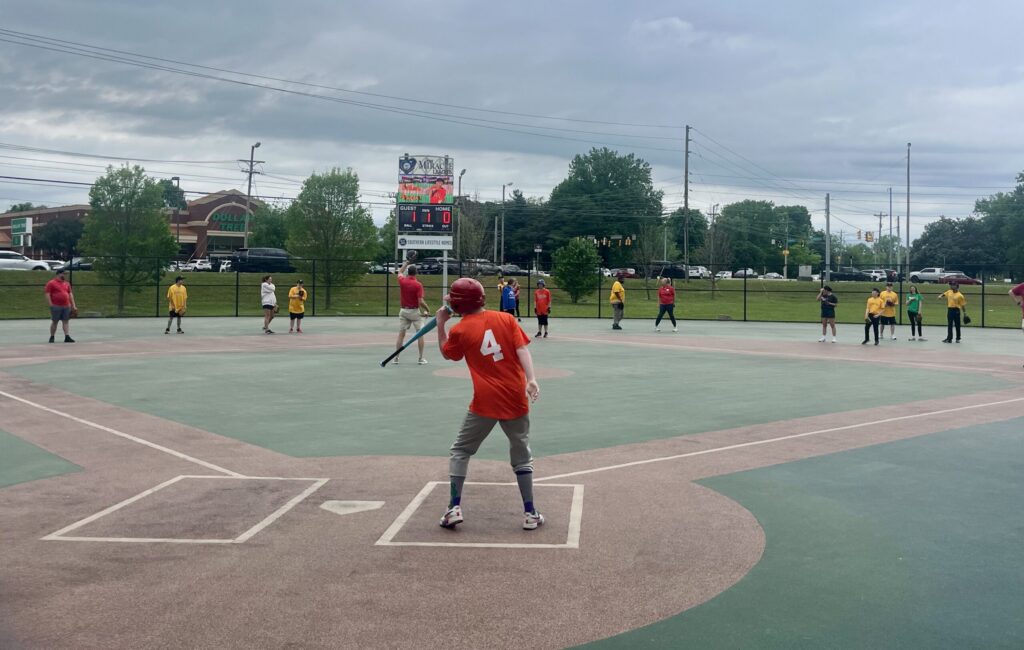
Saturday afternoon at McKnight Park in Murfreesboro feels like the hub of youth baseball: Little league games are underway in every direction, with parents dishing out Capri Suns as kids run around in dirt-stained uniforms.
While the park features 10 baseball diamonds, one field is a lot livelier than the rest. Players walk up to blaring music, an announcer calls out names and applause frequently erupts for the oft-hit home run.
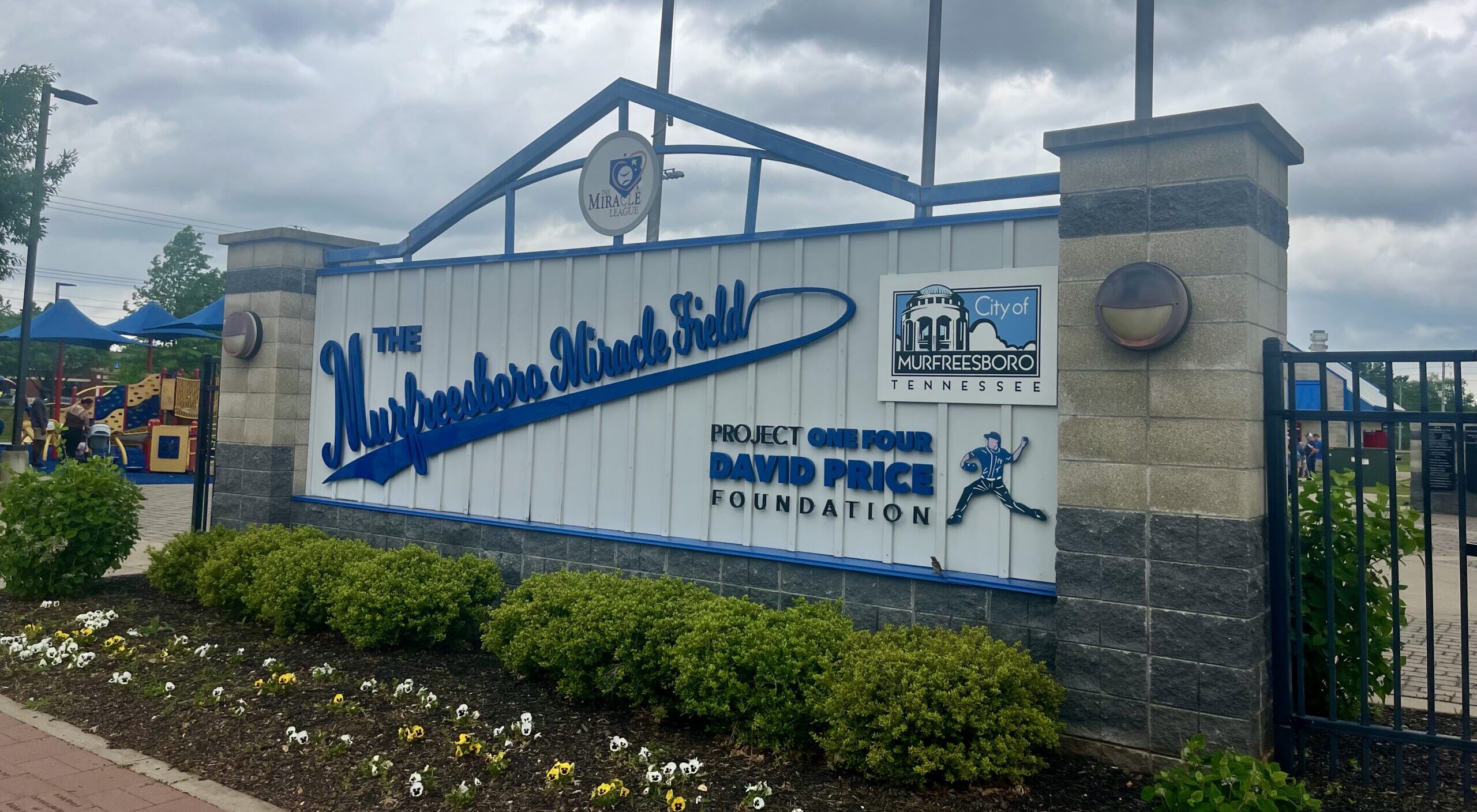
This is the David Price Miracle Field. Opened in 2017 — and named after former Major League Baseball pitcher, Murfreesboro native and Miracle League supporter David Price — it’s part of a growing trend of accessible baseball facilities for players with disabilities. The baseball diamonds are constructed as rubberized turf fields that can accommodate wheelchairs or assistive devices.
 Cynthia Abrams WPLN News
Murfreesboro’s Miracle Field has been in operation since 2017.
But Miracle League games aren’t just about the facilities — they are also about the community, the experience and the spectacle.
“We try to make it like a Major League experience for them,” said Tam Clark, Murfreesboro’s Miracle League announcer. “They’ve got their picture on the big board. We give them their own walk-up music they get to choose. We get to announce them like they are the stars of the show.”
Some players dance before getting to the plate. There’s a “second inning stretch” (Miracle League games only have two innings) where mascot Homer mingles with the players on the field. And there’s a lot of home runs.
“It’s just the best feeling to see these guys because they’re working so hard and to appreciate them and show them how much we love them,” Clark said. “It’s inspiring.”
In some ways, it feels more like a party than the sometimes overly competitive spirit of youth sports. And that’s likely because Miracle League’s origins center on inclusivity.
Stephanie Davis, the vice president of Miracle League’s national programming, said the idea came about when the sibling of a youth baseball player couldn’t participate because of his wheelchair.
“He came to every practice and every game,” Davis said. “And finally, one day, the coach decided that he would love to invite this child on the field to play … and we quickly realized that the venue was, you know, not going to work for any child in a wheelchair or with any walking device.”
Miracle League partners with parks and recreation departments, YMCAs or other nonprofits to secure the land and kick-start the leagues.
What started as one accessible baseball diamond in Georgia in 2000 soon spread to hundreds of fields across the country. Tennessee has twelve Miracle Fields complete or in development. Murfreesboro’s field has been around since 2017, while Nashville is currently looking to secure funds to build one at Cedar Hill Park. The leagues employ a “buddy system” that pairs the players with a volunteer. Oftentimes, these are players from high school sports teams. It’s a system that, Davis said, forges an important relationship.
“That barrier just took two seconds to break down when you get on the field and you just realize they’re just normal kids,” Davis said. “They like the same things we do. They just may have a few other obstacles.”
Not only do Miracle League games build community across players, but they can also be equally important for parents.
Les Pearson is the father of 22-year-old Jaden, a Miracle League player. While Jaden described baseball as “perfect,” Les said he has also found his own value in the games.
“You have the same community of parents that go, ‘Okay, we’re not alone in this. There are other people that can support us and help us grow too,’” he said.
Angie Keating, the Miracle League coordinator in Murfreesboro, said supporting parents has always been one of her priorities.
“One of my biggest goals is to get a mama up in the stands to eat popcorn and have a Coke for one hour,” Keating said. “Just one hour, she’s not paying a therapist. She’s not taking them to school and wondering what they’re doing. She’s sitting there, watching her kid play ball.”
Players aren’t always kids. Murfreesboro has two leagues — one for ages 5-14, and one for anyone ages 15 and up.
People with disabilities often lose access points to community when they age out of school. So inclusion of adults is a key component of Miracle League.
“We see, a huge number of participants in this 20 and up just because at that point, that’s when they really need that support, that social aspect and that outlet,” Davis, the Miracle League vice president, said.
No matter their age or ability, each game holds many surprises for every player. But in Murfreesboro, they all end the same: with a home run and a tie score.
This story was produced by the Appalachia + Mid-South Newsroom, a collaboration between West Virginia Public Broadcasting, WPLN and WUOT in Tennessee, LPM, WEKU, WKMS and WKU Public Radio in Kentucky, and NPR. Sign up for the weekly Porch Light newsletter here for news from around the region.

 On Air - 90.3 WPLN-FM