
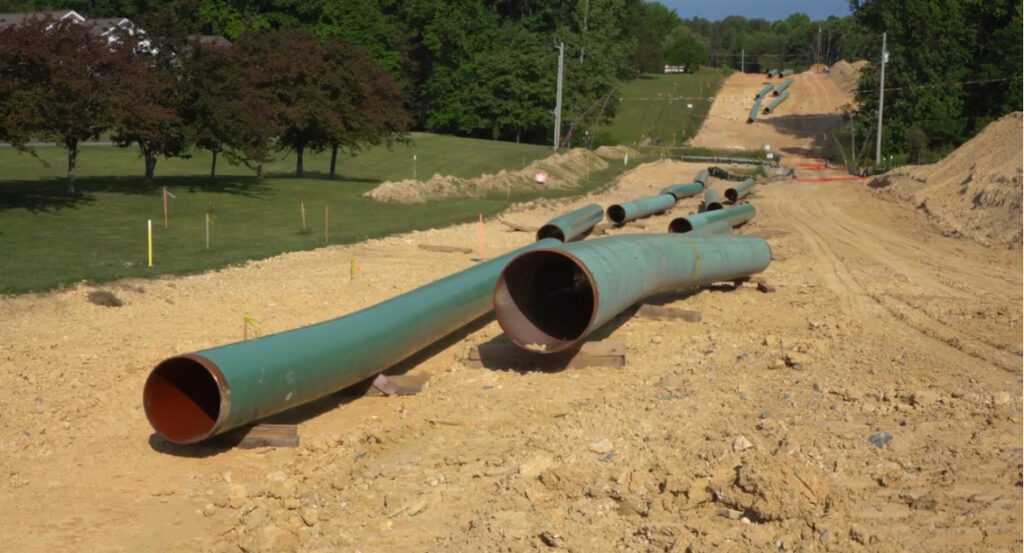
Kinder Morgan plans to construct one of its largest pipelines in decades through the Southeast.
The company proposed trenching 470 miles of gas pipeline through its “Southeast Connector” project, with 150 miles in Tennessee and additional segments continuing through Alabama, Georgia, South Carolina and Florida.
In Tennessee, the company plans to dig a route north to south from Sumner County, just northeast of Nashville, down to Marion County, just west of Chattanooga. The pipeline may also cut through Macon, Trousdale, Smith, Dekalb, Cannon, Warren, Coffee and Franklin counties.
Kinder Morgan expects to transport at least 2.6 billion cubic feet per day through the pipeline. Based on that volume, the pipeline could supply enough methane gas to power about 17 gigawatts of electricity, which is equivalent to 45% of the Tennessee Valley Authority’s entire electric capacity, according to Shelley Robbins, a utility expert at the Southern Alliance for Clean Energy.
But the pipeline could expand to an even greater capacity, estimated at 3.5 billion cubic feet per day.
“This proposed pipeline is mammoth, and it could get even bigger,” Robbins said. “But Kinder Morgan isn’t telling the public who the end customers are. They have signed agreements with shippers that are being kept secret, so right now, we don’t even know who this pipeline is actually for.”
The pipeline would be physically larger than average with a diameter of 48 inches. Most interstate pipelines are around 30 inches wide, typically not exceeding 42 inches, according to the U.S. Pipeline and Hazardous Materials Safety Administration, or PHMSA.
”What you can expect from pipelines of this size are extreme risks,” said Jasmine Vazin, deputy director of the Sierra Club’s Beyond Dirty Fuels campaign.
Gas pipelines pose ‘blast’ risks
Gas pipelines can leak and cause explosions. In the U.S. alone, pipeline explosions killed an average of 12 people each year during the past two decades, according to PHMSA, which has recorded 234 deaths and nearly $12 billion in damage from pipeline explosions since 2006.
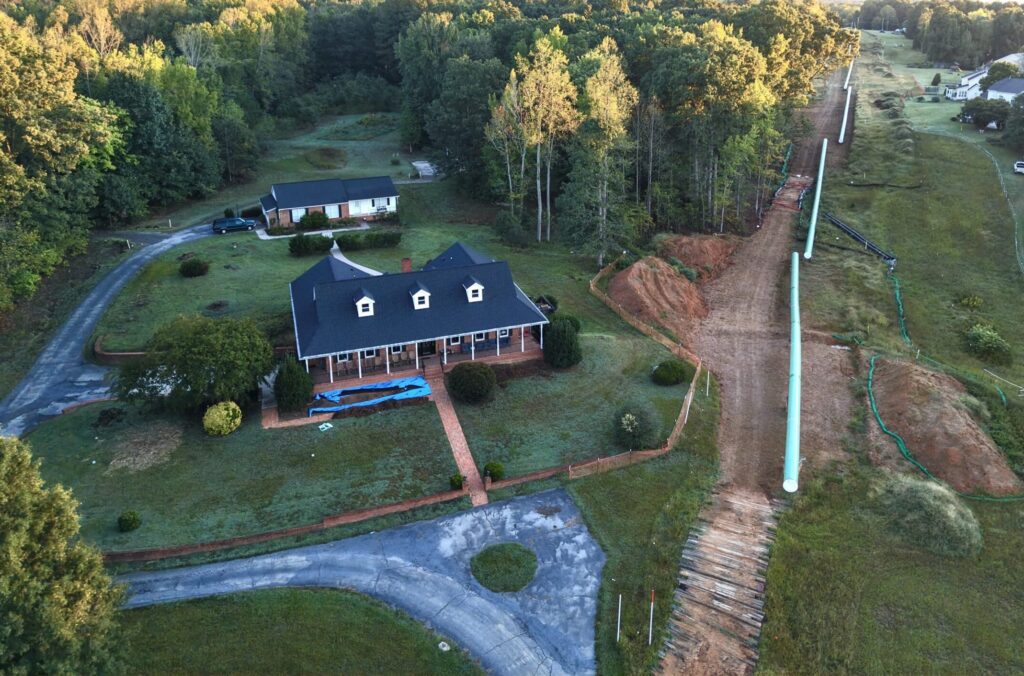 Courtesy Tom Pelton/Environmental Integrity Project
The Williams Companies is building a gas pipeline next to a home near Kernersville, North Carolina on its Transcontinental Pipeline, also called Transco.
Kinder Morgan’s pipelines transport about 40% of all gas produced in the U.S. In 2012, one of the company’s pipelines leaked and sparked an explosion that killed 22 workers in Reynosa, Mexico. In 2021, another of its pipelines exploded, killing two people in Coolidge, Arizona. Earlier this year, a Kinder Morgan pipeline explosion killed a worker in Jackson County, Texas. The company had 90 safety incidents that caused more than $53 million in property damage between 2013 and 2025, according to PHMSA.
“Safety is our top priority. The Southeast Connector Project will incorporate multiple layers of protection, including 24/7 monitoring from a centralized control center, regular right-of-way inspections, periodic advanced internal integrity testing, corrosion protection systems, and emergency response plans,” Kinder Morgan said in a statement on behalf of its subsidiary Southern Natural Gas, which is overseeing the project.
The new pipeline poses considerable risks due to the planned volume of gas flowing daily, according to Vazin.
“The blast zone that you can calculate based on averages of pressure from the pipeline could be almost half a mile,” Vazin said.
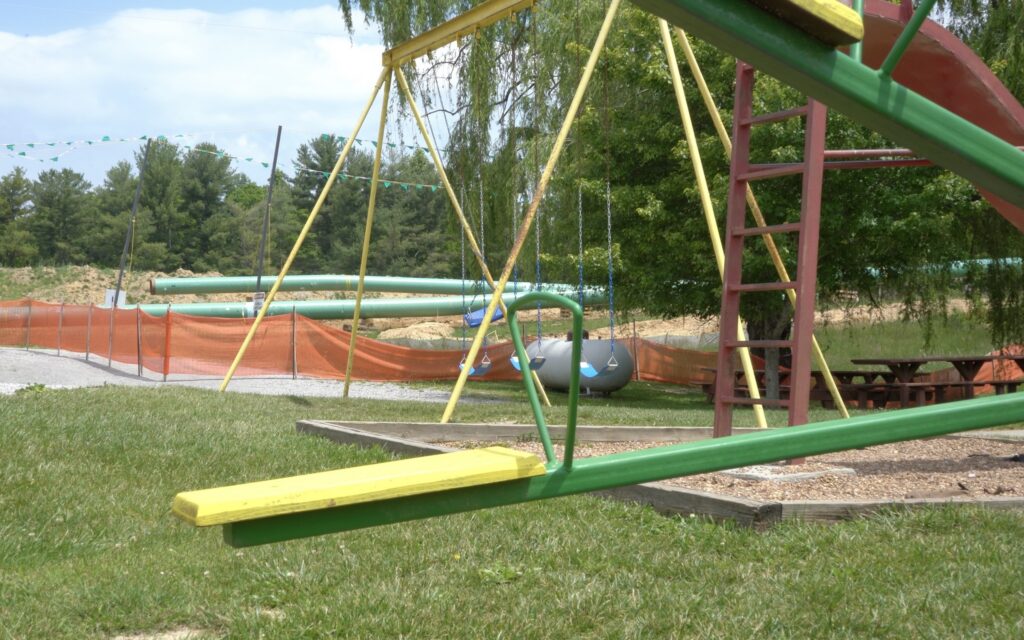 Courtesy Josh Doke
Enbridge constructs a pipeline in Morgan County, Tennessee near a playground. Tennessee does not have a setback between public spaces and pipelines.
Tennessee does not have a minimum setback regulation to dictate how close a pipeline can be placed next to homes or buildings. In 2022, the state passed preemption legislation designed to prevent local governments from blocking any type of fossil fuel infrastructure, including pipelines.
Memphis and Shelby County are the only communities with a setback requirement.
The ‘Southeast Connector’ is part of a broader gas buildout
Nearly 200 projects are underway nationwide to build more than 17,000 miles of pipelines, primarily to transport gas, according to a new report by the Environmental Integrity Project, which described the scale of construction as the largest since the hydraulic fracturing (also called “fracking”) boom about two decades ago.
The report points to two main factors. The U.S. is exporting more liquefied gas: The nation has been the top gas producer globally since 2009 and the top exporter since 2023, shipping off roughly a fifth of the gas drilled here each year.
The U.S. is also consuming more electricity for data centers, both via utilities and directly on location. Developers are building at least 98 gas-fired plants directly connected to data centers, according to the report.
“This is not for ratepayers to have more reliable, affordable energy,” Vazin said. “This is to make corporations money.”
In Tennessee, for example, a data center developer wants to build a private gas plant near Chattanooga with a capacity of 1 gigawatt, which is about how much power a traditional nuclear reactor produces. (The “Project River” data center would also entail building a half-gigawatt biomass plant, which could burn upwards of 65,000 acres of forest each year to produce electricity.)
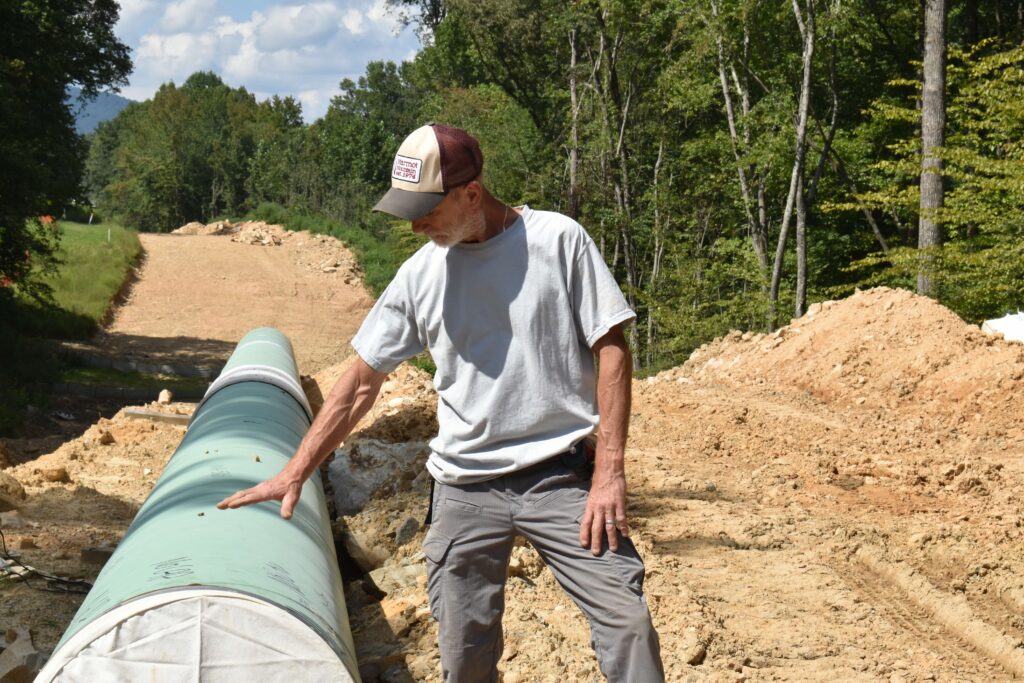 Courtesy Brendan Gibbons/Environmental Integrity Project
Jeffrey Gilliam inspects Enbridge’s 30-inch pipeline being constructed near Wartburg, Tennessee for TVA’s Kingston gas plant.
The Tennessee Valley Authority, which generates electricity for virtually all of the state, may build as many as a dozen gas plants by 2031 to double its current capacity from gas, which is generally its second-largest source of electricity behind nuclear.
More: TVA broke law in building Kingston gas plant, court ruling finds | WPLN News
TVA is considering two gas plants with a combined capacity of 2.3 gigawatts in Trousdale County, which is along the potential route, according to the utility’s transmission queue.
The precise route of the pipeline will be determined following environmental surveys and meetings with landowners, Kinder Morgan said in a statement.
The Trump administration is fast-tracking pipelines
Nationally, some of the planned pipelines are larger and have more capacity than most existing pipelines. The new projects alone could deliver almost 40 percent more gas than the U.S. consumed per day in 2025, according to the report.
Many projects have requested or received expedited reviews from agencies like the Federal Energy Regulatory Commission and the Army Corps of Engineers while citing President Donald Trump’s “energy emergency” order.
The Trump administration has weakened pipeline safety rules, narrowed protections for endangered species, sped up wetland permit reviews, and limited the scope of wetlands that require permits. Companies can now also increase the pressure of pipelines in densely populated areas and conduct fewer pressure tests, according to the report.
The administration has also proposed curtailing the ability of states to protect rivers or streams from pipelines through the Clean Water Act.
“We have really seen landowners’ rights stripped away through the changes in the permitting process,” Vazin said.
The nation’s fossil fuel buildout of plants and pipelines is concentrated in the Southeast and Texas. The uptick in methane gas infrastructure and use will cause more air pollution, planet-warming emissions and environmental degradation.
The Tennessee pipeline segment could be built fast
Kinder Morgan set a target in-service date of late 2030 for the Southeast Connector.
To build a new pipeline, companies have traditionally had to pre-file and then get permits at the state and federal level.
Pipeline developers must also confront the people living nearby — landowners in 10 counties received notices in their mailboxes from Kinder Morgan this month. The company will either create a contract with them or attempt to seize the property in court.
“Companies are able to take private property through the legal process called eminent domain, which was given to energy companies in the 1940s,” Vazin said.
Nearly a century later, communities still don’t have a seat at the table, Vazin said.
She encouraged landowners who received notices to seek out community support in Tennessee or even in Mississippi where similar pipeline projects have been advancing.
“There’s a lot of knowledge to be shared and things to be learned,” Vazin said. “No one dealing with this is alone.”

 On Air - 90.3 WPLN-FM