
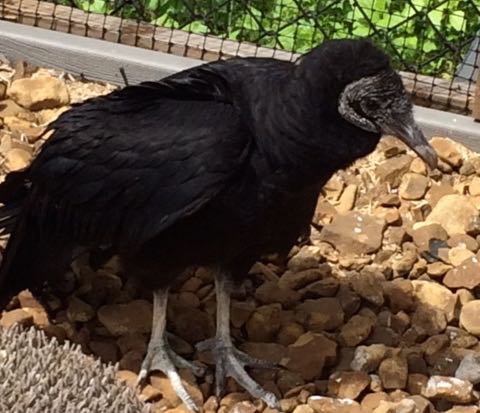
Okay, let’s admit it. The vulture has an image problem.
Around here, we call them buzzards and mostly spot them flying over or feasting on road kill.
But where we see a hallmark of death, the Rangers at Radnor Lake State Natural Area see a bird that’s an important part of the ecosystem and one whose smarts could begin to endear it to park visitors.
Striding down a winding boardwalk, Park Manager Steve Ward shows off Radnor’s new aviary. Perched on the side of a cliff, it offers a sweeping view of the lake and the forest around it.
Ward admits he’s rather smitten with the black vulture.
“Other than the American Eagle, the bald eagle, this will be the rock star of this facility.”
When you hear the word vulture, you might think of a big, menacing creature just waiting to drop down to scoop up its next meal. But here, we see a small, shy one retreating to a corner. She was found in Shelby County, unable to fly because she’d been shot twice with a pellet gun.
“This is one of the most misunderstood birds of prey,” says Ranger Ward. “People see them flying up high, they see them roosting on TVA lines or whatever else. They’re kind of thought of as a nuisance by some landowners and farmers.”
Vultures are scavengers. They chow down on dead animals. And as biologists will tell you, the longer carcasses stick around the more likely they become a breeding ground for disease. Think of the vulture as nature’s cleanup crew.
‘Still A Wild Animal’
Ranger Jesse Germeraad opens the first of two doors leading to the vulture and the bird takes a step back.
“She’s still a wild animal, she still fears us, you know, which is good, that’s fine.”
Her timid nature belies the “rock star” status she’s been given. But not unlike a “rock star” who requests certain color M&Ms or room-temperature bottled water, the vulture also knows exactly what it wants to eat, the filet mignon of vulture food: dead mice – 10 of them – in the bottom of a bucket. 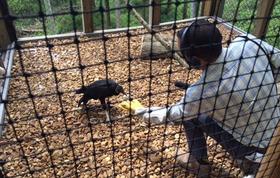
“She knows when food time is coming,” says Germeraad.
Unlike what you might see in nature, the vulture doesn’t immediately pounce on the mice.
“Flatten your glove. Hold your glove out like that. That way she’ll be used to the glove,” Germeraad says, giving instructions.
The bird tiptoes over and slowly inspects the mouse before grabbing it with her beak and taking it a few steps away to devour it.
“Oh yeah, she doesn’t waste any time,” says Germeraad.
Cool As A Cucumber
Ranger Ward says he was met with raised eyebrows when he suggested bringing in a vulture to be part of the new birds of prey exhibit. The bald eagles, the hawks and the owls were naturals – but a vulture?
“I’ve always liked them and I’ve always heard they were phenomenal birds,” says Ward.
So the vulture actually became the first to call the new facility home. Ward says on Day 1 she paced nervously back and forth for three hours before finally calming down.
“And by the next morning it was sitting up there cool as a cucumber, just hanging out like it’d been there its entire life,” Ward says.
Ward says that ability to adapt will be priceless when visiting school kids and families are sitting just a few feet away. He says of the birds on site now, none have been as trainable as this vulture. With the others, it’s fight-or-flight when a person approaches. But he sees a day when the vulture will be comfortable enough to go without a tether and even fetch a dollar bill from a crowd.
“It’s not your most pretty bird from a distance,” says Ward. ” I’ll guarantee nobody leaves here and doesn’t think that black vulture doesn’t serve a purpose or isn’t a pretty bird.”
The next phase at Radnor Lake is to build a larger netted area that actually extends above the trees where two American bald eagles will have room to soar.
Those eagles promise to be majestic; the owls and hawks stately; but the vulture, these rangers say, is the one to watch.

 On Air - 90.3 WPLN-FM