
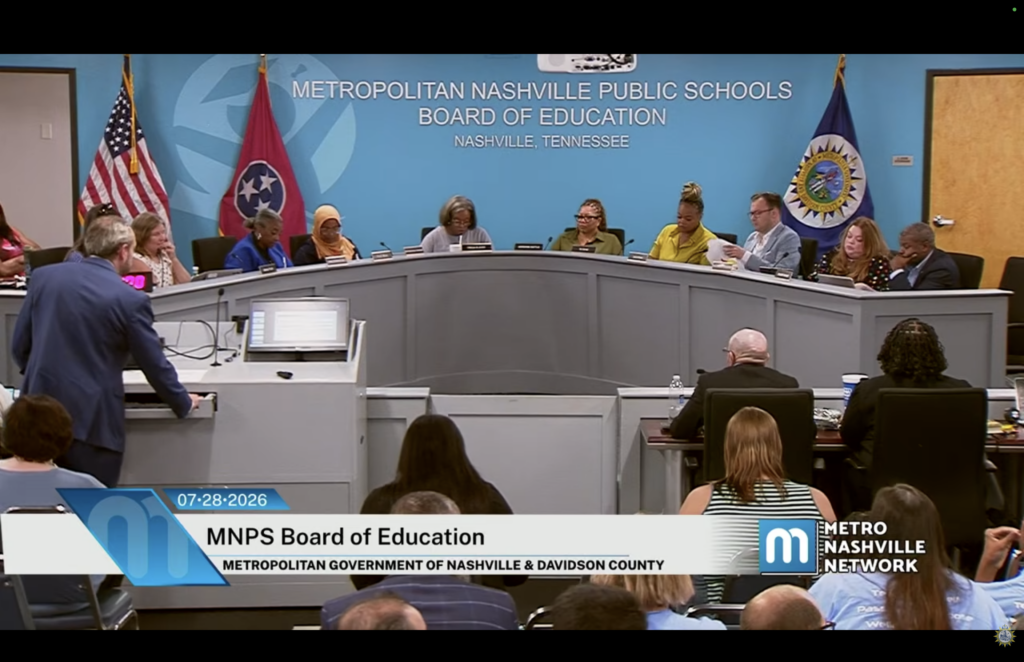
The board for Metro Nashville Public Schools voted nearly unanimously to deny the applications of four proposed charter schools for the second time – citing financial strains on the district’s budget.
The amended applications included a mix of elementary, middle and high schools. Aside from financial concerns, the board cited lack of oversight, inadequate performance evaluations and unclear leadership plans as reasons for not approving the charter schools, which are publicly funded but run privately.
Dozens of community members spoke before the board for about 30 minutes, expressing support for the Gate School, Music City Academy, Empowerment Academy and Nashville School of Excellence.
Despite denying all four applications, some board members stated that the schools could potentially serve students well. However, Vice Chair Berthena Nabba-MicKinney stressed that it’s not about whether the schools are good or bad, the board must serve as good financial stewards of the district’s limited resources.
“I believe our priority should be strengthening the public schools that serve the vast majority of Nashville’s children,” she said. “Ensuring that we have the resources necessary to continue improving student outcomes, which we have seen over the last few years before creating additional financial obligations that weaken the system as a whole.
Nabaa-McKinney has often spoken against charter school expansion, citing accountability concerns during her successful bid for re-election last May. She went on to note that MNPS only gets 18% of its budget from the state and has to rely primarily on funding from the local government, and that financial pot, she says, is already stretched thin with the expansion of vouchers.
Siphoned resources, missing progress reports and governance oversight
When voting to deny the Gate School’s application, board member Erin Block highlighted that new charter schools take students away from nearby traditional public schools. This, she says, results in reduced course offerings, staffing and diminished programming for the kids who remain.
Board member Robert Taylor was the lone dissenting voice– voting yes for the applications of Music City Academy, grades 9 – 12, and the Gate School, grades 6 – 8. He said that if the board denies these applications, the schools can then just appeal to the Tennessee Public Charter School Commission, and, if they’re successful, those fiscal impacts will still hit the district.
He further noted that families regularly reach out him, seeking alternative educational opportunities for their kids who were waitlisted for magnet schools.
The founder of Music City Charter School, educator and former Tennessee Titans player Kevin Dyson, told WPLN News that while his school would offer kids sports-related career opportunities, athletics serves as a catalyst for student engagement.
“Sports in itself, it generates and creates leaders. It creates perseverance. It creates responsibility. It creates accountability,” Dyson said. “That’s just from being a part of something, being a part of something bigger than yourself, being a part of a team.”
Still, board member Rachael Elrod insisted that the school has a strong emphasis on sports and she questioned how that would impact kids who have disabilities or are trans and can’t participate in sports per state law.
Elrod also questioned its partnership with Tennessee State University, whose president, Dwayne Tucker, penned a letter of support offering the possibility of providing space on campus for the school and access to the university’s athletic facilities. She said the plan wasn’t fleshed out enough considering the high expenses of offering sports activities at charter schools.
The board found that Empowerment Academy, grades K – 5, failed to provide a clear outline of leadership –with inconsistencies on the number of teachers per grade level. Its application, board members stated, didn’t include academic performance metrics or reasoning for why it needed to be an all-boys school.
Nashville School of Excellence, grades 6 -12, only partially met the board’s standards. Elrod noted that the school’s reported ACT scores are below both state and MNPS averages. She also took issue with the governing board not having regular local meetings which, she says, creates an accessibility problem for families and an oversight problem for the school board.
After being denied twice by the board, the schools can now appeal to the Tennessee Public Charter School Commission. That decision will be final with no method of appeal.

 On Air - 90.3 WPLN-FM