

How did one Tennessee find turn out to be a hoax?
The story of the Bat Creek Stone. Plus, the local news for August 25, 2026, and Johnny Cash’s archives.
Below is a partial transcript of the episode:

It’s August 25, 2026
On this day in 1609, Galileo demonstrated his brand new invention: the telescope. He went on to use that telescope to confirm a scientific theory the church considered a dangerous hoax: that Earth was one of several planets orbiting the Sun instead of being the center of the known universe.
And exactly 226 years later, on this day in 1835, the New York Sun newspaper printed the first in a series of stories about amazing discoveries that they said the British astronomer Sir James Herschel had made using a very powerful telescope.
This time, people believed what they read. But they should have been more skeptical.
The articles said he spotted rushing rivers and towering crystals of amethyst on the moon, creatures like unicorns and two-legged beavers, even bat-winged Moon people.
The stories were actually intended as satire. After a few weeks, the paper published a clarification that it was, in fact, fiction. From that point on, the articles became known as the Great Moon Hoax.
Well, speaking of hoaxes, Tennessee has a part to play in the story of a more recent one, with layers of developments spanning generations.
The Bat Creek Stone or Tablet first emerged in 1889. At that time, the Smithsonian Institution was sending scientists around the U.S. to study Native cultures, traditional practices and their history. Part of that effort involved examining man-made earthen mounds. There had been a lot of pseudoscientific claims that essentially amounted to folk mythology about their origin, including stories that said some mysterious group of people had come from somewhere else and built the mounds to hold their treasure. And let’s just say it, generally folks would claim it was white people who had come over, built amazing things, and then died off because the people who shared those theories couldn’t believe that Native groups had that capability.
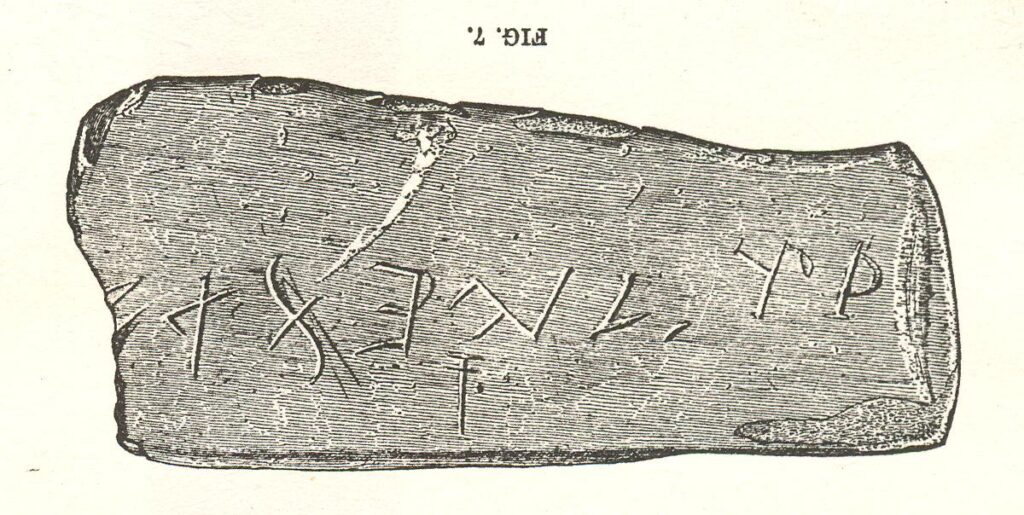
The Smithsonian excavations sought to debunk those theories. One dig happened in East Tennessee on the banks of Bat Creek, which is a tributary of the Little Tennessee River. A field assistant named John Emmert said he found a stone lodged underneath a skull. And that stone was etched with eight symbols that appeared to be some kind of writing.
The interpretation the scientists on hand took, and that they published, was that this was an early example of the Cherokee writing system. Which, on the one hand, bolsters the correct understanding of the mounds as being built by Native Americans. But, on the other hand, it makes no sense because there is a great deal of evidence to show that a man named Sequoyah developed that writing system in the 1820s.
The stone was catalogued, put in the Smithsonian’s storage vaults, and largely forgotten about until the 1970s.
That’s when it caught the attention of a controversial scholar of Near East studies named Cyrus Gordon. Now, Gordon is a man whose career was full of instances where he got big ideas that other people in his field tried to scale back. Initially, it was that he wanted to take on projects he wasn’t really ready to handle. But eventually, Gordon became fixated on very big theories linking multiple societies together…theories that didn’t quite hold up to scrutiny.
Gordon was particularly interested in languages: Ugaritic texts, early Hebrew writings, Akkadian cuneiform. And when Gordon saw the Bat Creek Stone, he thought he was seeing writings from another closely related language. He said it was a very early form of ancient Hebrew, but upside-down.
That interpretation fueled brand new theories that people from the ancient Near East had somehow ended up in East Tennessee. And notice how similar that is to the 19th century folk mythology about the mounds? It ended up resurfacing some of those old ideas.
But finally, after that had a chance to build up steam for a couple of decades, someone made yet another discovery: that the text on the stone was not unique. It is an almost exact match for an image printed about 15 years prior to that Smithsonian dig in a book for Freemasons.
Now, the stone has been tested. The geological material matches the other items found in that mound. It likely was placed in the mound more than 1,500 years ago.
So, then folks took a closer look at the man who discovered the stone in the first place. John Emmert had been downgraded from archaeologist to field assistant because of bad behavior. His professionalism had been questioned on multiple occasions. And the conclusion that many have reached since the Masonic text was identified in 2004, is that Emmert did find that stone in the mound. But before he handed it over, he inscribed the message on it.
In other words, it was a hoax all along.
Credits:
This is a production of Nashville Public Radio.
Host/producer: Nina Cardona
Editor: LaTonya Turner
Additional support: Mack Linebaugh, Tony Gonzalez, Megan Jones and the staff of WPLN and WNXP
 On Air - 90.3 WPLN-FM