

How did a monkey center in a Tennessee opioid lawsuit that just ended?
When the people in one small town wanted hydrocodone, a primate helped them know they’d found the pharmacist who’d hook them up. Plus the local news for February 19, 2026, and a conversation with new conductor of the Nashville Symphony, who happens to be one of the most prominent American conductors of our time
Below is a partial transcript of the episode:

It’s February 19, 2026
And this Saturday marks the anniversary of the day in 1919 when the South became a little less colorful. It’s when the last Carolina parakeet died in captivity. The birds had green bodies, yellow heads and red faces. They were native to much of the Southeast, including Tennessee. But as white settlement moved in and cut down forests to make farmland, they all died off.
Well, on that bright note, about the Carolina parakeet, let’s talk about opioids. And a monkey! Don’t worry, the monkey is ok. It seems to be in fine health. It’s adjacent to opioids, not whatever bad thing might have come to your mind. There is a cute and loveable monkey in this story.
But I should start a little earlier than that.
For years now, Tennessee has been using the courts to fight the epidemic of opioid abuse. That led to headlines a couple of years ago about settlements with really big names involved. Walgreens and CVS, major drug manufacturers, paying out hundreds of millions of dollars to end the court cases. The state basically alleges that these companies looked at the highly addictive medications as a cash cow, and that their policies made it easy for people with addictions to get the drugs their bodies craved.
Those high profile cases can obscure the ones that operate on a smaller scale. And honestly, a lot of the opioid problem in Tennessee is happening in communities that aren’t big enough for a Walgreens. But some of these places have multiple mom & pop drug stores. Too many to make sense for the local population.
One of those places is Celina, near the Kentucky border in Clay County. Fewer than 2-thousand people live there. The local hospital dwindled, and then closed. But there are pharmacies. Multiple pharmacies. Back in 2017, those pharmacies dispensed so many opioids that it was as if every single resident of Celina had come through needing the powerful painkillers — twice. KFF Health News reported that those pharmacies were dispensing opioids at nearly three times the national rate.
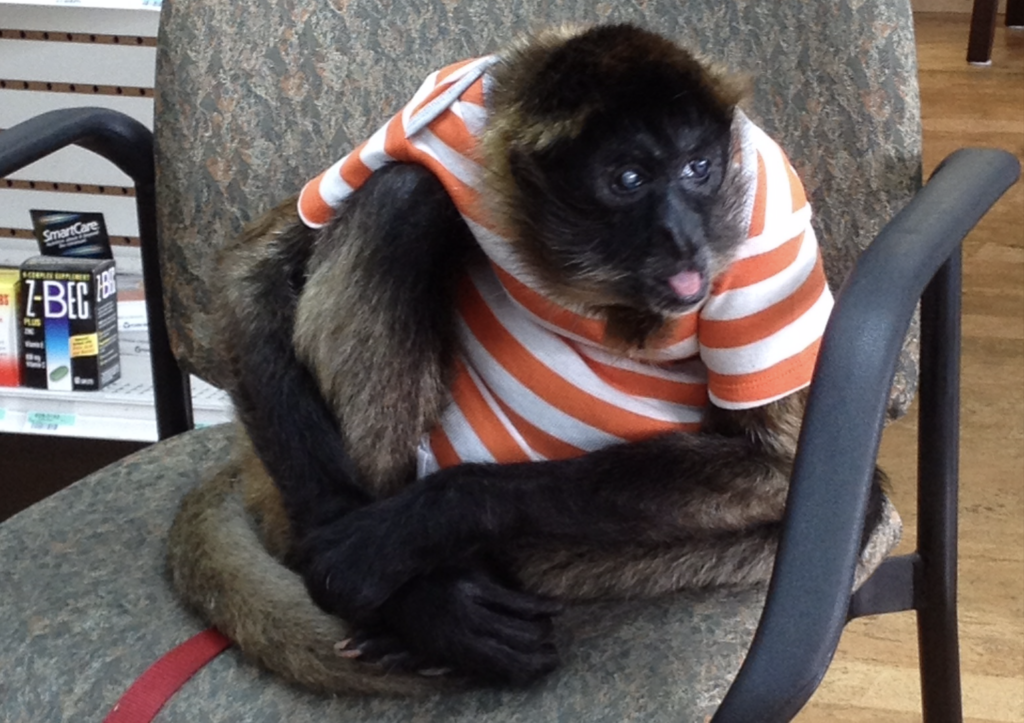
A few years ago, the law came down on one particular pharmacist, and he admitted to illegally selling hydrocodone — one of the most commonly prescribed opioids — without a prescription. The people who were using him as their hookup may not have known the pharmacist’s name, but he was pretty well known for bringing a monkey to work with him. The monkey’s name is Carlos. He’s said to be an emotional support monkey. He also wears clothing and poses for pictures with customers.
The pharmacist served time for his crimes. The drug store bearing his name changed ownership and got a new name. But if anything, the new management doubled down on feeding opioid addictions. Once the pharmacist did his time, he went back to work at his old store. And if people looking for their opioid connection had any doubt where to look, prosecutors say a new promotion cleared any doubts. That promotion was something called “monkey bucks,” with Carlos the monkey as a mascot. According to prosecutors, they effectively made that monkey in human clothing the face of the illegal opioid trade in Celina.
Which is how a monkey came to be one of the central figures in a court case that lasted a long time. Almost exactly two years ago, The Tennessean explained that lawyers were fighting over whether photos of Carlos the monkey could be admitted as evidence. The problem was that prosecutors said they’d been told a lot about how the pharmacy was using monkey bucks to drive opioid sales, and they contended it amounted to an illegal kickback scheme. But they didn’t have any physical examples of the in-store currency. They did, however, have photos of Carlos, and they used those photos to make the case that he’d become an important mascot to the whole operation.
And so what is in many respects a really important case about a very serious health problem at one point hinged on whether or not a jury should be shown pictures of a super cute exotic animal.
There was nothing like this in the CVS case. I mean, you can’t make this stuff up.
The federal investigation began a full decade ago. After years of that probe, and all of that court wrangling over photos, the case was finally set to go to court this past September. It could have ended up being a new kind of monkey trial, with all kinds of testimony about Carlos. But about a week before the scheduled trial date, the main owners of the pharmacy entered guilty pleas. The trial wasn’t necessary, after all.
The owners ended up agreeing to pay nearly $1.5 million in restitution to Medicare and Tenncare, and to forfeit their properties, plus fines. Sentencing was scheduled for the Friday before the ice storm hit, but federal prosecutors haven’t released any information about what the judge decided.
Opioids aside, I am always a fan of a store with an animal, like the Hatch Show Print cats or the shop dogs at Parnassus Books. A monkey, though…definitely depends on how well behaved it is. Or, I guess, how well behaved its owners are.
Credits:
This is a production of Nashville Public Radio.
Host/producer: Nina Cardona and LaTonya Turner
Editor: LaTonya Turner
Additional support: Mack Linebaugh, Tony Gonzalez, Megan Jones and the staff of WPLN and WNXP
 On Air - 90.3 WPLN-FM