

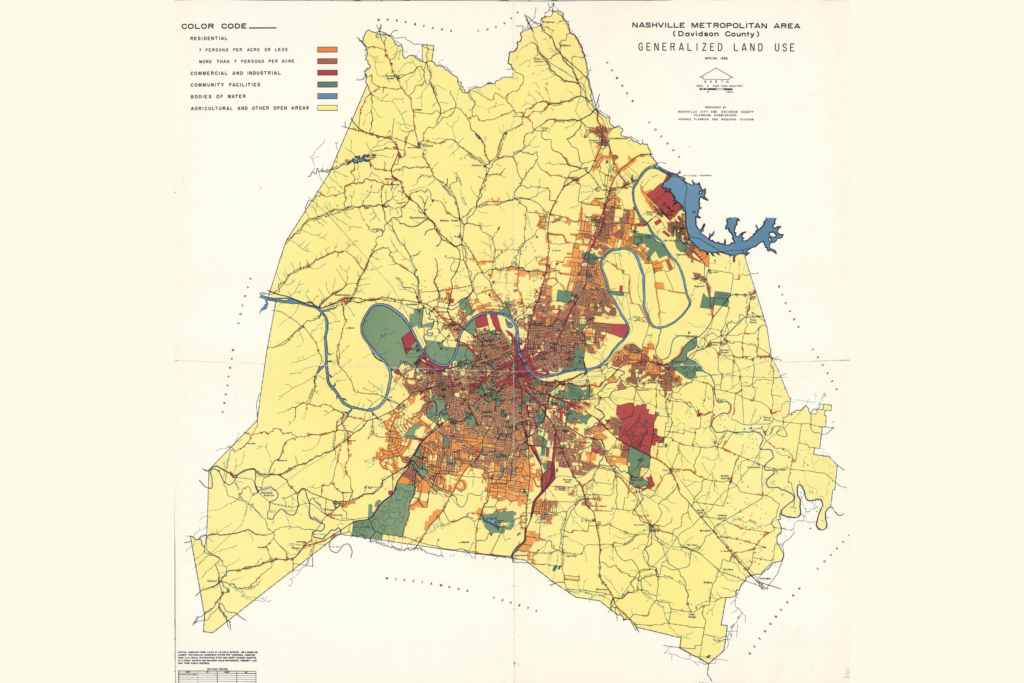
Would there even be a Metro Nashville if there wasn’t a 40-member Metro Council?
Today, an explanation of how Nashville stopped being a city and became Metro instead, and how a major part of that transformation may have to change. Plus, the local news for July 18, 2025, and this week’s edition of What Where When’s-Day.
Below is a partial transcript of the episode.
 It’s June 18, 2025.
On this day in 1958, Davidson County voters rejected a proposal to merge the county government with the city of Nashville. It took some real maneuvering over the next couple of years to change public opinion on the matter and establish what we now know as Metro. And one of the key aspects of the second, successful metropolitan proposal may have to go away soon.
One of the things that seems to confuse transplants when they first move to Middle Tennessee is the way we use the word “metro” around here. It’s not a subway system, like the Metros in DC or Paris. It’s not shorthand for the greater Nashville area with all of its suburbs. It’s the way we refer to the local government that runs most things inside the boundary of Nashville and Davidson County. And, to further confuse things, Nashville is Davidson County and Davidson County is Nashville. They aren’t separate. There isn’t really a city, as far as government is concerned, and there isn’t really a county. There’s just Metro.
But it wasn’t always this way. For almost two hundred years, the city and county were separate, and over those centuries, a number of smaller towns sprung up in the county. Towns that were absolutely not Nashville. Farming communities that didn’t particularly identify with Nashville, except that it was their neighbor. Places that we now think of as neighborhood names, like Antioch, Bellevue, Madison, Hermitage, Whites Creek.
A lot of things were different then. Much of Davidson was rural. The county was mostly run by a judge and a group of court magistrates, known then as squires. There were also some boards and commissions to run more specific functions of the county government. But for the most part, it was a system set up to govern in only the broadest of strokes. A lot of the people who lived outside of Nashville’s city limits felt little need for more government than that.
But some of the suburbs were having a little more trouble, especially on the infrastructure front. Our rocky soil isn’t always so great for septic systems, and a lot of people in the suburbs were eager to hook up to Nashville’s sewer lines. Some of them really wanted the fire and police protection they saw in the city. And they didn’t necessarily love the way that everyone outside Nashville’s limits had to pay extra fees in order to buy power from the city-owned Nashville Electric Service.
Meanwhile, people in the city felt like they bore a lot of the burden of services that were used by folks who worked in the city limits, who shopped and sought out entertainment in Nashville, but who lived out in the county.
In 1946, a group started holding meetings to brainstorm a new way of doing things. It’s interesting to me that they weren’t the politicians. They were prominent citizens, but not office-holders. And they basically determined that the way forward was to make more of Davidson County part of Nashville. At first, that meant annexing smaller communities into the city, but the mayor at the time wasn’t really hot on that idea, so it never happened. But then the state passed a law allowing governments to consolidate, and from that the idea of Metro was born.
Consolidating the city and county would solve a lot of problems. County Judge Beverly Briley endorsed the idea. So did the city’s mayor, Ben West. And in late 1956, a concrete plan was made public. Its proponents got the state legislature to sign off, and work on drafting a Metro charter got underway.
Now, at this point, a worry started to bubble up in the Black community. They had a much stronger presence in city government than in the county’s. Through a lot of concerted effort over the years, they’d managed to elect two Black members to Nashville’s city council. Remember, this is before the Civil Rights Movement, before desegregation. Getting that representation in the city government had taken a lot of work. Would consolidation mean starting over from square one?
Separately, people in a few of the newest suburbs (most of which were also the wealthiest), really didn’t want to be lumped in with Nashville. Belle Meade, Forest Hills and Oak Hill had only recently been carved out as exclusive communities for rich folks who wanted to leave Nashville behind. Why should they reverse course?
The charter proposal that went in front of voters in 1958 tried to solve that last problem by letting the wealthy suburbs retain some independence. It tried to address the concerns of rural county residents by establishing separate urban and general services districts, with different tax rates.
But they didn’t really convince those groups. And they really didn’t do much to address the concerns of Black voters.
The referendum failed. The city started coming up with ways of taking things into its own hands, like starting to annex new land and implementing a wheel tax that applied not just to residents, but to everyone who worked in Nashville. Tensions arose, and very quickly, consolidation again was suggested as a more orderly way forward. So work resumed on a potential metropolitan charter.
This time, it worked. Six incorporated suburbs would be able to keep their charters and handle certain functions within their boundaries. The idea of general and urban services was better honed. But what really changed, and this was definitely a major factor that led to passage of that second referendum in 1962, was the structure of the proposed Metro Council. The first proposal had called for a legislative body with 21 members. But the one that passed carved the county into smaller districts, better ensuring that disparate constituencies and small communities would each be able to have a council member who really represented them, rather than having their needs averaged out with other groups in a much larger district. That was especially important for ensuring that the Black community continued to have the level of representation in a Metro government that they’d achieved on Nashville’s city council.
Now, 40 members is a big council. But that’s what it took to make Metro happen.
Now, it looks like Metro may be forced to change to essentially the kind of council that the first, failed referendum suggested back in 1958. This isn’t the first time that change has been suggested. Mayor Bill Purcell recommended shrinking the council back in 2003. Council member Emily Evans wanted to reduce it in 2014. There were also referendums on that kind of idea in 1996 and 1998. The argument each time was that a smaller council could be more efficient. But again and again, the city has decided one way or another that 40 members is the right size for a Metro Council that offers adequate representation to the many subcommunities who make up Davidson County.
But the state legislature disagrees. Two years ago, the General Assembly passed a law limiting the size of councils in consolidated metropolitan governments to 20 members. Of course, Nashville-Davidson County is the only Metro that exceeds the limit. Metro sued, claiming it was being illegally singled out in a way that violates Tennessee’s Home Rule law. A trial judge ruled in Metro’s favor. But earlier this month, the state appeals court reversed that ruling. It said the other two, smaller metropolitan governments in the state would be limited from expanding their council in the future, so the argument that the law targets Nashville didn’t fly.
And that’s where things stand now. That ruling was handed down a couple of weeks ago. Metro officials said at the time that they were weighing their options, so it’s possible they could ask the state Supreme Court to reconsider.
If the ruling stands, the change will be felt in 2027, when Metro Council seats are next up for re-election.
Credits:
This is a production of Nashville Public Radio
Host/producer: Nina Cardona
Editor: Miriam Kramer
Additional support: Mack Linebaugh, Tony Gonzalez, LaTonya Turner and the staff of WPLN and WNXP
 On Air - 90.3 WPLN-FM