

When will we be honest about what monuments to Nathan Bedford Forrest are honoring?
Nathan Bedford Forrest once denied the KKK existed. Now, many Forrest enthusiasts follow suit and deny the fullness of who the Confederate general was. Plus the local news for August 28, 2024 and this week’s edition of What Where Whens-Day.
Below is a partial transcript of the episode.

It’s August 28th, 2024. On this day in 1868, Middle Tennessee native and former Confederate General Nathan Bedford Forrest gave an audacious interview to an Ohio newspaper. In it, he denied the existence of the Ku Klux Klan. He said he’d travelled throughout the South and seen no sign of such an organization. As for the widespread reports that he was one of its leaders? Well, here’s a direct quote: “the charge is so absurd that I often wonder who could have furnished such information, or whose idle brain could have conceived it.”
And yet, in that same interview, Forrest basically lays out a defense of the Klan. In one breath he’s saying it doesn’t exist, in the next, he’s justifying exactly the kinds of crimes that history has clearly shown were committed by the KKK. He seems to suggest that the only reason anyone is bothered by reports of things like killings is that they are labeled as Klan activity. He says people murder in every state of the union, the only difference being that in the South, and this is a direct quote, “the victim by his conduct tempts the murderer to his bloody work.” In other words: they asked for it. They had it coming.
Nathan Bedford Forrest is the ghost that just won’t stop haunting Middle Tennessee. Around here, anytime there is a statue or a bust or a named building that becomes a point of contention between people wanting to cleanse the Confederate stain and those wanting to keep the Confederacy alive, the name or likeness in question is probably his.
In large part, that’s because he’s the local guy. Robert E. Lee was a wealthy Virginia planter who went to West Point. But Forrest was born dirt poor in Chapel Hill, Tennessee, a small town on the banks of the Duck River. He left to find his fortune in Memphis trading enslaved people. During the Civil War, he roamed around much of Middle and West Tennessee, acting like the military equivalent of a mosquito, using guerilla tactics to sting the Union with small bites here, there, and everywhere, but never really trusted with serious command.
And the other factor that I think is really important to understanding the extent of Forrest’s legacy is that a Confederate apologist can basically make of him whatever they want. He didn’t give a ton of interviews or speeches, at least not ones that were written down and preserved. He was almost certainly mostly illiterate, which means there aren’t letters and journals to help us understand what was on his mind.
So, for those who just want to see him as a military genius, they can look at his clever tactics in the small battles that he was able to conduct off around the edges of the main theaters of war. And there are no pesky records of his thoughts popping up to definitively say “oh, and he also was a hateful SOB.” For those who want to find some kind of winner in the Confederate war effort, they can point to the victories Forrest kept racking up after the South started to otherwise lose the war. Never mind that, again, those battles didn’t matter much.
All too many people will try to say Forrest came to see Black people as equals because of one of his few speeches that was recorded: brief, polite remarks delivered near the end of his life at a picnic put on by Black folks. Never mind that, at that point in his life, he was once again living in poverty. He was quite sick with diabetes. He was just generally in the kind of pitiful and powerless position that can inspire a last gasp of end-of-life contrition. There are also indications that he agreed to the appearance to try and court the Black vote for White Democrats who were starting to realize just how outnumbered they potentially were at the polls in Memphis. However you want to look at the speech, it’s a pretty strong overreach to hold it up as any kind of trustworthy indication that Forrest had truly come around out of love and tenderheartedness.
Why does any of this matter? Well, as I said, his memory just won’t stop haunting us. In recent years, MTSU has tried repeatedly to change the name of its Army ROTC building, Forrest Hall. So far, the state has not let them, calling it a historic memorial. This state makes it very hard to change historic memorials, and the law that puts up all those hurdles was passed out of anger that the city of Memphis removed a statue of — you guessed it — Nathan Beford Forrest from a city park.
In the discussion over that statue, or the MTSU building’s name, or removing the bust of Forrest from the statehouse, a talking point that often emerges is the idea that removing an honor to an ugly piece of the past is ignoring or covering up history in some way. Okay… so what history is that? Like I said, we don’t have many words from him to go by, so the only other thing to do is to look at his actions.
Actions like the way that he operated an inhumane slave yard that sold human beings literally down the river. One of his newspaper ads boasted that he ran a jail that could hold 300 hundred men who that ad described as “fresh supplies of likely Young Negros.” He was particularly ruthless, known around the city for delivering exceptionally brutal public whippings, and is believed to have engaged in the illegal import of laborers directly from Africa.
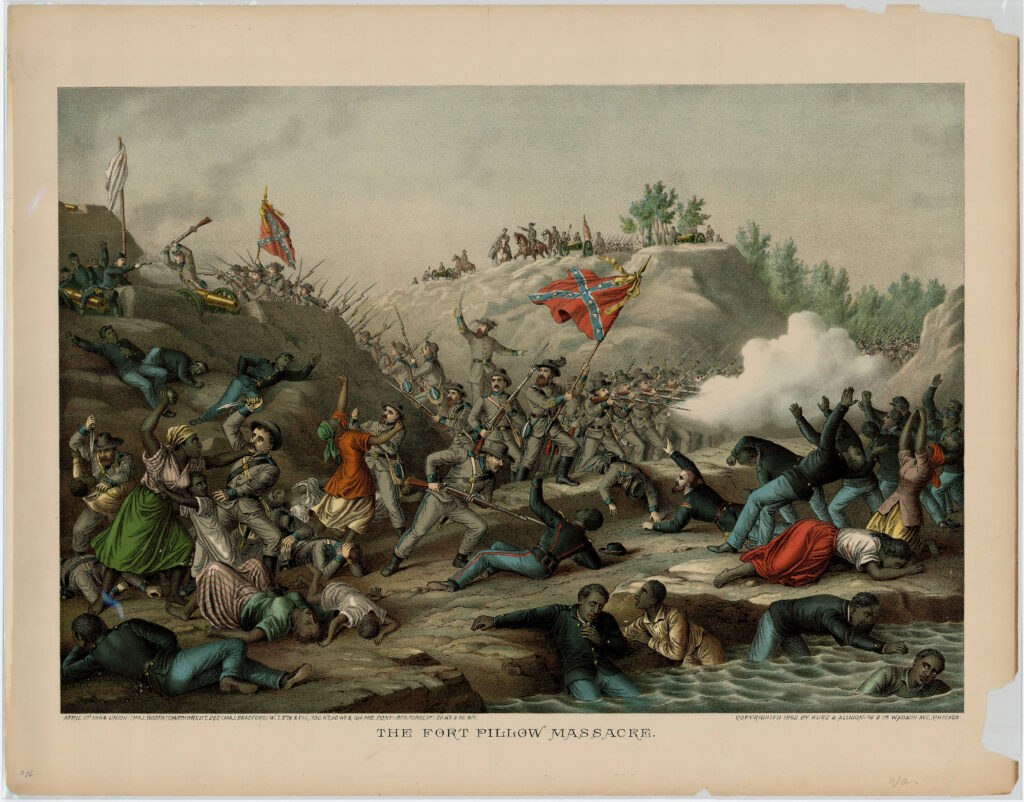
Or perhaps we could look at his actions during the Massacre of Fort Pillow, when his troops gunned down 300, mostly Black, Union soldiers who, by many accounts, had already clearly surrendered.
Another option is to go by what people who knew him said about Forrest. In 1879, a man who served under Forrest at the end of the Civil War gave a speech in Clarksville. This guy was a major fan of his former general, praising him up and down. But the things he said to show what a great guy Forrest was would, I think, give most of us pause. He boasted that Forrest’s lack of education was a plus, saying, quote, “he was restrained by no knowledge of law or Constitution…his favorite maxim was ‘war means fighting, and fighting means killing.’” He said Forrest, and this is a direct quote, “owed his success to knowing when to dispense with the rules of war.” He’s basically calling the guy a war criminal while suggesting that’s a good thing.
As for the KKK, that shadowy terror group that Forrest denied in that Ohio interview, I’ve read a lot of accounts from his contemporaries. I think there’s a good case to be made that Forrest was pro-Klan, that he was very aware of its reality, but that he wasn’t directly involved in any substantial way. He basically lost all of his money in the war and the only line of civilian work he’d ever succeeded in was eliminated by emancipation. His time and energy were spent scrambling for a way to make a dime. But that doesn’t clean his reputation, even where the KKK is involved.
Several sources suggest that the initial group that founded the Klan in Pulaski included men who had served directly under Forrest during the war. You can see echoes of his guerilla military tactics in their actions. It was probably an honor given at a distance, but they did name him their Grand Wizard. And in 1869, he did order them to disband. Yes, after swearing the KKK was imaginary, he signed a document urging its members to take off their white hoods.
Let’s just be clear, though, that order does not mean he thought they were wrong. The political winds had changed direction. Tennessee was close to the point of restoring the right to vote to former Confederates. Southern powerbrokers no longer found it politically convenient to have roaming groups of vigilantes getting in the way of restoring some degree of normalcy.
This, all of this, is the history that is bound up in the name Forrest. Does that sign on the outside of MTSU’s ROTC building convey even a piece of that long list of historical items? Did a regal equestrian statue give a sense of the fullness of who he was?
We are far from finishing the task of reckoning with the way that the Confederacy marked Tennessee, or the way that monuments erected in the 20th century oversimplify the 19th century actions of Forrest and people like him. There will be many more accusations of erasing history as our communities keep questioning whether we should keep monuments, markers and placenames. As we have these conversations, again and again, I just hope that if we are evoking history as a thing to be remembered and understood that we do our best to really be honest and clear-eyed about what that history is.
Credits:
This is a production of Nashville Public Radio
Host/producer: Nina Cardona
Editor: Miriam Kramer
Additional support: Mack Linebaugh, Tony Gonzalez, Rachel Iacovone, LaTonya Turner and the staff of WPLN and WNXP
 On Air - 90.3 WPLN-FM