

What did tourism have to do with a high-profile court case about evolution?
When science and religion went head-to-head in a small-town Tennessee courtroom, the entire nation watched. Plus, the local news for July 10, 2026, and hamburger influencing.
Below is a partial transcript of the episode:

It’s July 10th, 2026.
One of the most high profile court events in American history started in a small Tennessee town on this day in 1925. The Scopes Monkey Trial was technically a challenge to a Tennessee state law barring public schools from teaching about evolution. But really, it was about the theory of evolution itself, about the conflict between religious beliefs and scientific knowledge, and about who should control school curriculum. It was one of the hottest topics of the day, and as two of the nation’s most prominent lawyers essentially held a multi-day debate, the world watched — and listened — carefully.
If you aren’t familiar with Dayton, it’s in Rhea County. It’s midway between Chattanooga and Knoxville, near the Tennessee River. And back in 1925, town leaders really wanted more people to know about their community. Visitors mean money, and they were hungry for both.
So, when the ACLU announced it would pay the court costs of any teacher willing to be formally accused of breaking the law by teaching evolution, the powers that be in Dayton were eager to make it happen in their town.
The high school’s science teacher refused, but a substitute named John Scopes was game. He couldn’t recall ever teaching a formal lesson on the topic, but said he remembered once telling kids to review a diagram about evolution in their textbooks. That was actually perfect. Just enough to justify arresting him, but vague enough for him to legitimately plead not guilty — guaranteeing a trial.
The man who agreed to defend Scopes was one of the most famous trial attorneys in the nation at the time, Clarence Darrow. On the other side, William Jennings Bryan: a former Congressman and presidential candidate who had spent four years leading a national campaign to ban discussion of evolution in American schools.
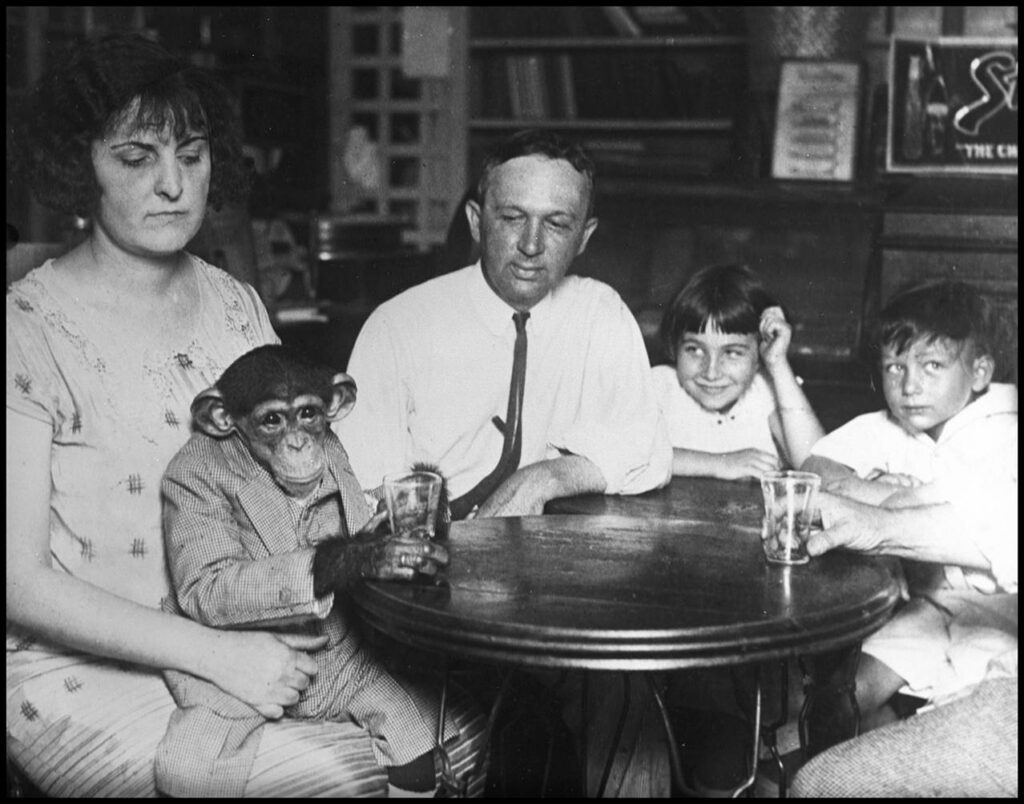
With such high-profile lawyers on board, the Dayton plan to draw visitors to town worked beyond anyone’s wildest dreams. The entire downtown area became a sort of primate-themed festival. There were six blocks of booths selling food and souvenirs like stuffed monkeys. Someone brought a trained chimpanzee to perform shows. Musicians played novelty songs about evolution.
It was also the very first American trial to ever be broadcast live. WGN radio from Chicago had to lay miles of rented cable connecting Dayton to their studios, it cost them a thousand dollars a day. The judge allowed them to place four microphones in the courtroom and even rearranged the furniture to make it more convenient for the radio.
For six days, the nation listened through the opening statements and expert testimony delivered in the Rhea County Courthouse. You can only imagine how stuffy it must have been. I mean, think of the weather we’re getting right now, but without air conditioning, in a room stuffed to the gills with people. So, on day seven, the judge decided to move the proceedings outside under the trees, so that they could at least benefit from any breeze that came through.
And that’s when Darrow made an unusual and iconic decision. He put the prosecuting attorney, William Jennings Bryan, on the stand as an expert witness on the Bible. At this point, it truly became a direct back and forth. Darrow with questions like “When exactly was the earth created? How many days did it take? Where did Cain get his wife?” Bryan pounding his fist and declaring that he was “simply defending the word of God.”
That was too much for the judge. Bryan’s testimony was struck from the record. But Darrow knew he’d made his point as well as anyone ever could. He and Scopes decided to end things the next day by changing the plea to guilty.
But that direct confrontation on the courthouse lawn had radio listeners around the nation sitting on the edge of their seats. They couldn’t forget what had been said there. It’s the reason we all still remember the Scopes Monkey Trial.
And it was dramatic and compelling enough that the town of Dayton still uses it to bring people to their town. Since the trial’s 75th anniversary in 2000, Dayton has hosted an annual play each July, acting out key moments of the legendary event with lines taken directly from the court transcript.
This year’s run of shows lasts two weekends, starting next Friday. They mark the trial’s 101st anniversary. And after all this time, the battle over whether religious ideas should dictate what is taught in Tennessee schools is still being waged. It’s at the heart of the moves to ban books from school libraries and the new state law requiring schools to teach about the positive impacts of Christianity.
Credits:
This is a production of Nashville Public Radio.
Host/producer: Nina Cardona
Editor: LaTonya Turner
Additional support: Mack Linebaugh, Tony Gonzalez, Megan Jones and the staff of WPLN and WNXP
 On Air - 90.3 WPLN-FM