

When President Donald Trump deployed the National Guard to Memphis last year, crime in the city was already at a 25-year low. Tennessee Gov. Bill Lee had already invested $150 million in crime intervention grants and expanded the use of state troopers.
Since the Memphis Safe Task Force began operating, crime has continued to trend downward, but some Memphians question the task force’s influence. To date, the task force has made nearly 23,000 arrests. The majority — 64% — were for nonviolent crimes. Officers have mainly focused on traffic stops; in the past year, the task force has made one traffic stop for every three people living in the city.
The numbers show that those traffic stops have led to more immigration arrests. The majority of those arrested for immigration offenses did not have criminal convictions.
Maria Oceja, co-founder of the immigrant advocacy group Vecindarios 901, told WPLN News that the number of people detained for nonviolent crimes has led to overcrowding and a higher death rate inside the city’s jail.
“To me, this is not strategic to truly reduce crime,” Oceja said. “Memphis is a predominantly working-class city. The minimum wage is still $7.25 here. And so, for people to have to worry about additional traffic fines or having to worry about having money for bail, that is really concerning … People are struggling to make ends meet, and the cost of living continues to increase on a day-to-day basis.”
At a recent rally in Tennessee, President Trump said that the task force has taken 12,000 “career criminals” off the streets of Memphis.
“It was not even possible to walk a street without getting mugged, killed, shot, knifed,” Trump said.
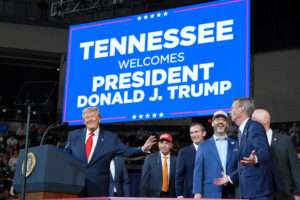
President Donald Trump, from left, speaks as Tennessee Republican congressional candidate Charlie Hatcher, Rep. Matt Van Epps, R-Tenn., and State Rep. Johnny Garrett, R-Goodlettsville, a Tennessee Republican congressional candidate, and Rep. Tim Burchett, R-Tenn., listen at a campaign rally at F&M Bank Arena on Oct. 10 in Clarksville. (AP Photo/Alex Brandon)
Oceja said that Trump’s statements play into racist stereotypes about the city. That rhetoric, she said, has only gotten worse since state lawmakers redistricted the city’s congressional seat to favor Republicans.
“I’m also reading this as a strategy to disenfranchise more Black voters. If we can get more Black people locked up, we can get their voting rights revoked, and we can have more power in Memphis,” she said.
In pursuit of lower crime rates, the task force has fatally shot four people. On Oct. 11, an MPD officer-involved crash killed five college-aged Memphians.
The vast majority of the task force’s arrests have been misdemeanors.
At a roundtable discussion Friday, U.S. Attorney General Todd Blanche said there was no timeline for when the guard’s deployment might end.
“We’re going to remain here in a heightened capacity — call it a surge, call it whatever you want — until the job’s done,” Blanche said.
At the roundtable, Dr. Andrew Sloas of Memphis’ Regional One trauma center said that, in the past year, the number of gunshot victims has dropped 30% without the usual summer spike in gun violence.
Republican U.S. Sen. Marsha Blackburn, who is running for governor, praised the task force’s efforts but stressed that she was there in her capacity as a senator and not as a candidate for governor. Her Democratic opponent, Memphis City Councilmember Jerri Green, has called the task force “federal overreach.”
The task force in Memphis could serve as a model for other cities like Chicago, Blanche said.
 On Air - 90.3 WPLN-FM