
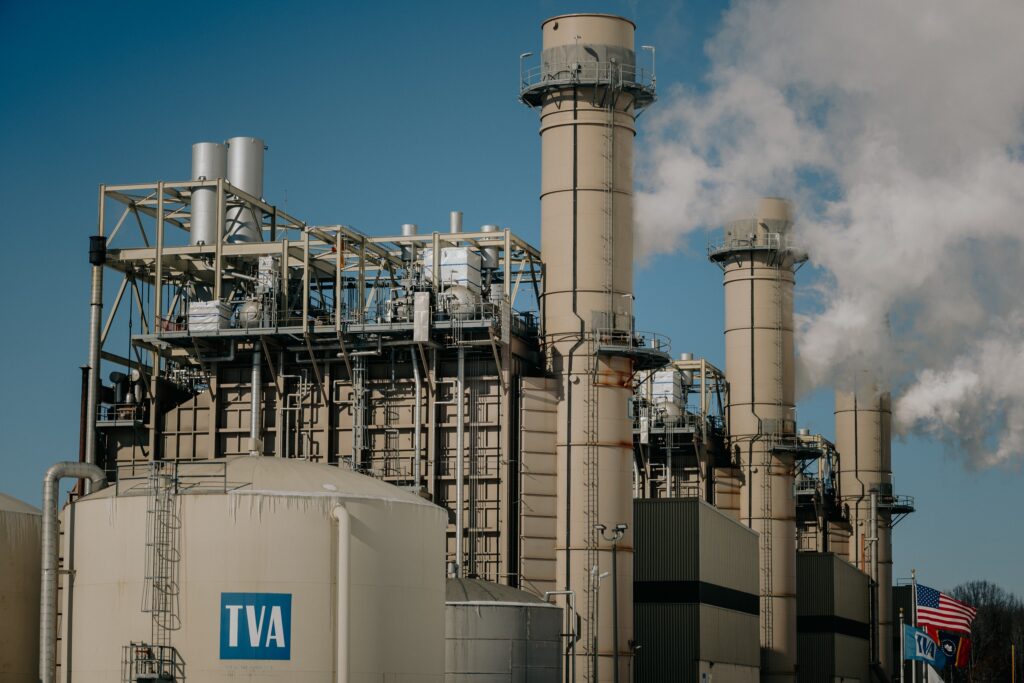
The Tennessee Valley Authority may be tripling down on fossil fuel infrastructure.
The nation’s largest public utility is moving forward with a long-term plan focused on building more gas plants. The TVA Board, the utility’s only regulator, with a majority of members appointed by President Donald Trump and trained by TVA staff, approved a draft “Integrated Resource Plan” on Thursday.
The utility is planning to grow its energy capacity by between 30% and 85% by 2040 to meet forecasted demand driven primarily by data centers.
TVA will mainly rely on gas turbines, which burn methane drilled from the earth, and two pipelines are under construction to support them. This buildout poses serious public health risks, as methane gas infrastructure emits large amounts of planet-warming emissions and air pollution across its entire supply chain of drill sites, pipelines, compressor stations and turbine plants. New gas infrastructure is particularly profitable for pipeline owners, who make billions of dollars each year selling their products, but it’s often considered financially risky long-term for utilities due to volatile gas prices and changing policies.
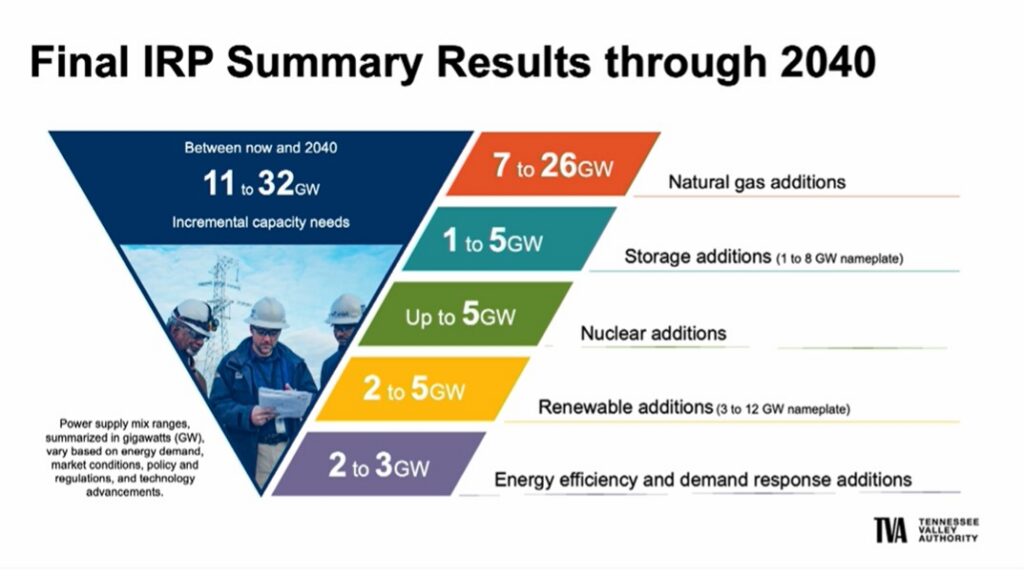
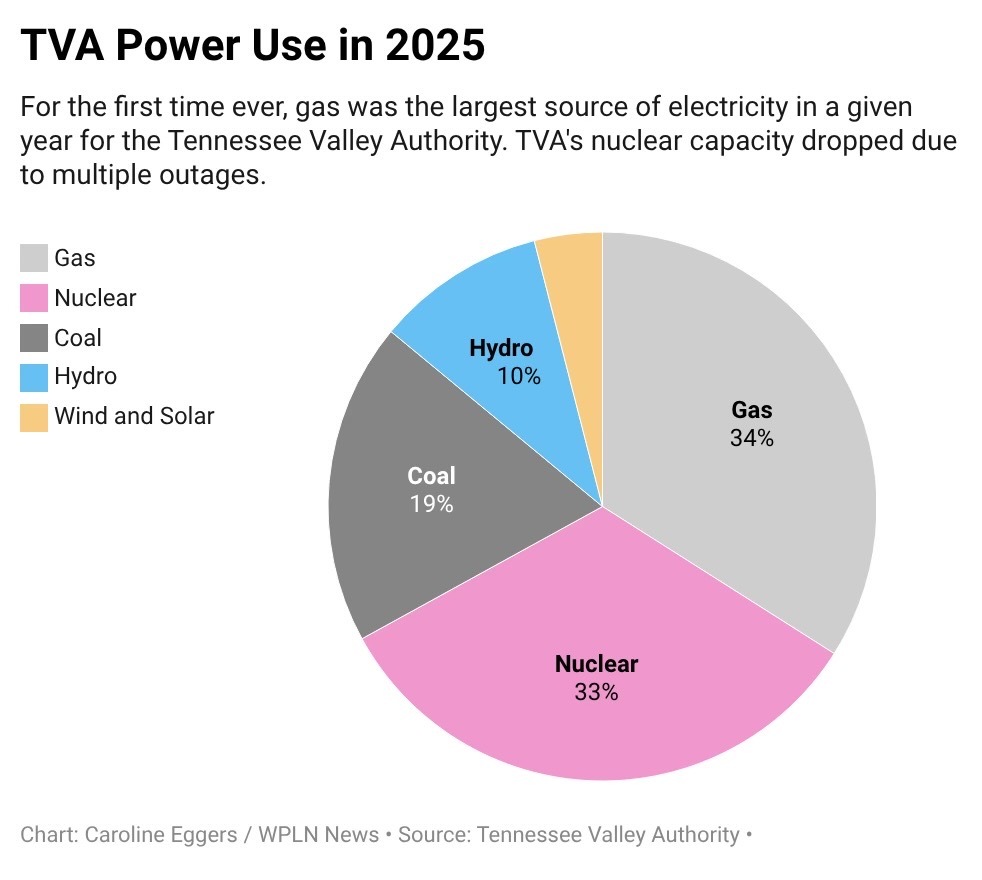
In the plan, TVA lists a buildout of between 7 and 26 gigawatts of new gas by 2040. On the higher end, the utility would be tripling its own gas infrastructure capacity, which was 12.6 GW as of late 2025.
TVA already has more than a dozen gas plants equivalent to at least 12 GW of power slated to come online between now and 2031 on its latest transmission queue. To reach 26 GW, TVA would need to build as many as 30 new gas plants.
Renewables are largely out. Nuclear is in?
TVA is promising far less from every other type of energy resource: 1 to 5 GW of storage, up to 5 GW of nuclear, 2 to 5 GW of renewables and 2 to 3 GW of energy efficiency and demand response.
Significant nuclear additions by the 2040 timeframe may be unlikely. The utility’s sole nuclear project that has any type of regulatory approval, a 0.3 GW nuclear reactor in Oak Ridge, is projected to come online as early as 2033. Other nuclear projects announced in TVA’s region are based on designs that have not been proven commercially.
TVA slashed its promises for renewables compared to its previous long-term plans. It already has enough solar projects in development to fulfill half of its suggested renewable cap, according to its 2025 federal financial filing.
TVA also already has 2.5 GW of storage projects on its latest transmission queue.
The utility began switching up its plan shortly after Trump took office last year, starting with reversing plans to shut down all coal plants over the next decade.
TVA changes plans to align with fossil fuel interests
Over the past two decades, TVA has greatly expanded fossil gas infrastructure while repeatedly delaying investments in renewables.
TVA published its last long-term plan in 2019. That plan promised “up to 14 GW” of new solar additions and between 2 to 17 GW of new gas before 2040. Over the next five years, TVA announced plans for nine gas plants, equivalent to a 60% increase in gas capacity, and added less than 1 GW of solar.
The utility is required to publish long-term plans every five years, but it postponed the process for its 2024 plan, initially by one year. The 2025 plan, drafted in 2024, listed energy additions of 3 to 20 GW of solar; 4 to 19 GW of gas, hydrogen and carbon capture; up to 10 GW of energy efficiency, demand response and storage; up to 4 GW of wind and 1 GW of nuclear.
The process again stalled after some political drama and Trump firings.
TVA released a new draft in June that stripped out renewables, increased fossil fuels and promised nuclear expansion.
TVA ignored most public feedback
The utility provided a comment period of four weeks on its new plan, and about 250 people submitted comments. The overwhelming majority implored TVA to protect people, the environment and the climate by replacing its plans to build fossil fuel infrastructure with renewable projects.
“As a public utility, I want TVA to be a national leader in renewable energy–wind, solar, and battery storage especially. Renewables are reliable and not subject to the fluctuations of the global economy and foreign wars,” wrote Cassandra Gronendyke of Cookeville.
Among the public comments, some people describe their experiences living with the health effects of nearby fossil fuel pollution or taking care of children with persistent coughs. Some people supported the expansion of nuclear energy — a few folks requested cleanups of nuclear waste or opposed new reactors — and other folks protested the rapid proliferation of data centers. Very few commenters supported new gas plants or keeping coal online.

 On Air - 90.3 WPLN-FM