
Nashvillians are worried about data centers.
Hundreds of citizens, including many young people and a few children, stood in line for hours to speak Thursday at the city’s first public hearing on proposed regulations for data centers.
Many people voiced opposition to a data center proposed near the Nashville Zoo, which created a petition earlier this month that now has nearly 400,000 signatures.
Wilder, a ten-year-old from East Nashville, said he wants to protect clouded leopards and other animals.
“When my mom told me someone was trying to build a data center near the zoo, I said, ‘Wait, why would they do that? That makes no sense,’” Wilder told the Metro Planning Commission. “We don’t need more technology or air, water, and noise pollution. We need peace, trees, and each other.”
More: Tennessee communities are blocking data centers. Nashville could be next. | WPLN News
Adrienne Flannery-Reilly, who was there with Wilder, expressed concern for a data center planned at Fisk University.
“The smarter we make tech such as AI with our thoughts, the more our brains are harmed,” she said, pointing to research connecting reliance on AI to cognitive atrophy.
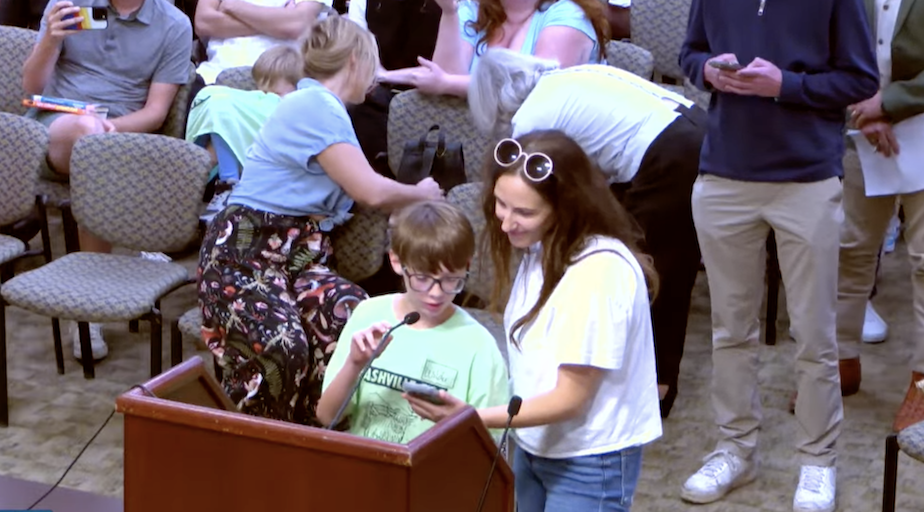 Courtesy Metro Planning Commission
 Wilder and Adrienne Flannery-Reilly spoke in front of Nashville’s Metro Planning Commission on June 11, 2026.
Data centers are rapidly spreading across the nation. The tech giants Amazon, Google, Meta and Microsoft plan to spend about $700 billion on them this year, primarily to support AI.
Tennessee has more than 60 data centers, and the greater Nashville area has at least 27 facilities in operation and more proposals in progress. Amid public backlash to projects, the city is considering up to a five-month moratorium on data centers while officials weigh how to define and regulate them. Metro Council passed the measure on the first of three readings earlier this week.
Many people who spoke at the hearing Thursday warned officials about the potential negative impacts of data centers; some folks questioned what benefits they offer to communities.
“It’s kind of a new data-mining gold rush all over the country and the world, and it’s largely for the rich to get richer,” said Graham Gerdeman, a local wildlife photographer. “It really behooves us to pump the brakes on it and put some commonsense legislation in.”
Hani Latif, a musician and camera operator from West Nashville, said AI has impacted both of his industries negatively, “making those art forms sterile.” He wants to help protect people, animals and the environment from a rushed industrial buildout.
“I go to the zoo on my birthday as a grown man every year, and I love these animals dearly,” Latif said. “I’m also super disheartened about the targeting of marginalized neighborhoods.”

 On Air - 90.3 WPLN-FM