
When Lori Baute first learned about precautionary full-body MRI scans, she dismissed the idea.
“ I heard Kim Kardashian got one, and some other wealthy people,” Baute said. But at 59, she was worried about her long-term health. She has a family history of cancer, and she’s a critical caregiver for her aging mom and her adult brother with special needs.
After a close friend was diagnosed with bladder cancer, Baute decided to make an appointment with a clinic that offers full-body scans near where she lives in Ocala, Florida. Her results came back a week later. One major finding: She has lesions on her pancreas. “When I got that, I was really petrified,” she said.
Worried about pancreatic cancer, Baute shared the results with her gastroenterologist, who ordered a targeted MRI scan as a follow-up. That test showed the lesions were benign cysts.
Baute’s experience is becoming more common as companies pitch body scans directly to consumers as a way to detect cancer and other diseases early. But no major medical association — including the American Cancer Society and the American College of Radiology — recommends these scans for people without a very high risk of certain cancers.
And even medical screenings that doctors do recommend can carry some of the same reasons for caution.
The QTip: Before saying yes to the test, ask about the risks and benefits — even if your doctor recommends it.
Here’s what to know:
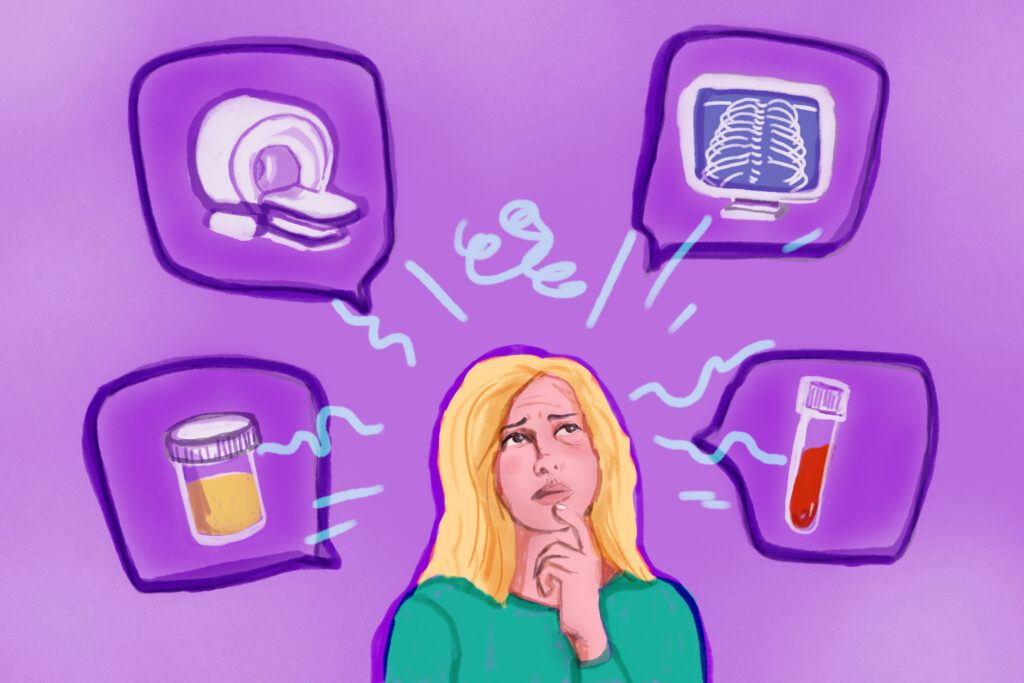
Every test comes with costs and risks.
At a minimum, a medical test will cost you time — and could mean a hefty medical bill. Many tests marketed directly to consumers, like full-body scans and at-home blood screening kits, are not covered by insurance, and some tests can cost several thousand dollars.
Some laboratory tests might involve only the discomfort of a blood draw or the awkwardness of collecting a urine or stool sample, but others carry the possibility of physical harm. For example, a small percentage of people who get CT scans each year will develop cancer because of the radiation exposure from the tests, according to estimates from the National Institutes of Health. Relatively simple procedures like a biopsy or an endoscopy come with the risks of pain, infections, tearing, a reaction to anesthesia, or further serious complications.
Plus, testing can cause anxiety and stress — as patients wait for results and if the results are inconclusive. “I see patients every week in my office who are tortured by the results of tests that they really didn’t need to ever have,” said Rita Redberg, a University of California-San Francisco professor and cardiologist and an advocate for less medical testing. For example, if you discover a cyst, then “you’re living for the next year, two years, three years getting repeated tests to figure out whether it’s benign or a cancer,” Redberg said. She cautions patients against testing unless they have specific symptoms.
Testing often leads to more testing — and more risk.
A reality of getting a medical test is that the results often lead to additional, and potentially more invasive, testing. Doctors call this “diagnostic cascade.”
Baute, for example, plans to continue monitoring her pancreas with annual scans. To her, she said, the financial cost and anxiety are worth it if she can feel “like I’m in control of my health and I have knowledge.”
But Redberg points to a worst-case scenario, documented by JAMA Internal Medicine in 2011: After starting an exercise program, a 52-year-old woman experienced chest pain and went to see her doctor. Her exam suggested that her pain was muscular and she had a low risk for heart disease. Still, her doctor ordered a scan of her heart to reassure her. The results led her doctor to order another test, during which her artery was ripped. She had emergency bypass surgery, experienced complications, and ultimately, Redberg said, “she ended up with a heart transplant — all from this unnecessary scan just to reassure her.”
A few simple questions can help you decide.
Before saying yes to the test, it’s important to know about the risks and benefits — even if your doctor recommends it, Redberg said. She suggests asking a medical provider and yourself questions like:
- What am I going to learn from this test?
- How is this test going to help in my care?
- Could I improve my health without doing this test?
She said many test results, especially in her field of cardiology, end up pointing patients back to the basics of a healthy lifestyle, like eating well, exercising, and not smoking. And those, she said, could be advised without a test.
People and Policy:
If your health insurance covers a medical test, that means the test has most likely met vetted, scientific standards that demonstrate benefits to patients. Insurers must cover evidence-based services that have a rating of A or B from the U.S. Preventive Services Task Force. Private insurers, as well as Medicaid and Medicare plans, must cover the full cost of recommended preventive screenings. Many medical tests marketed directly to consumers are not covered by insurance.
Emily Siner at Nashville Public Radio contributed to this report.
HealthQ is a health series from reporters Cara Anthony and Blake Farmer, approachable guides to an unapproachable healthcare system. It’s a collaboration between Nashville Public Radio and KFF Health News.

 On Air - 90.3 WPLN-FM