
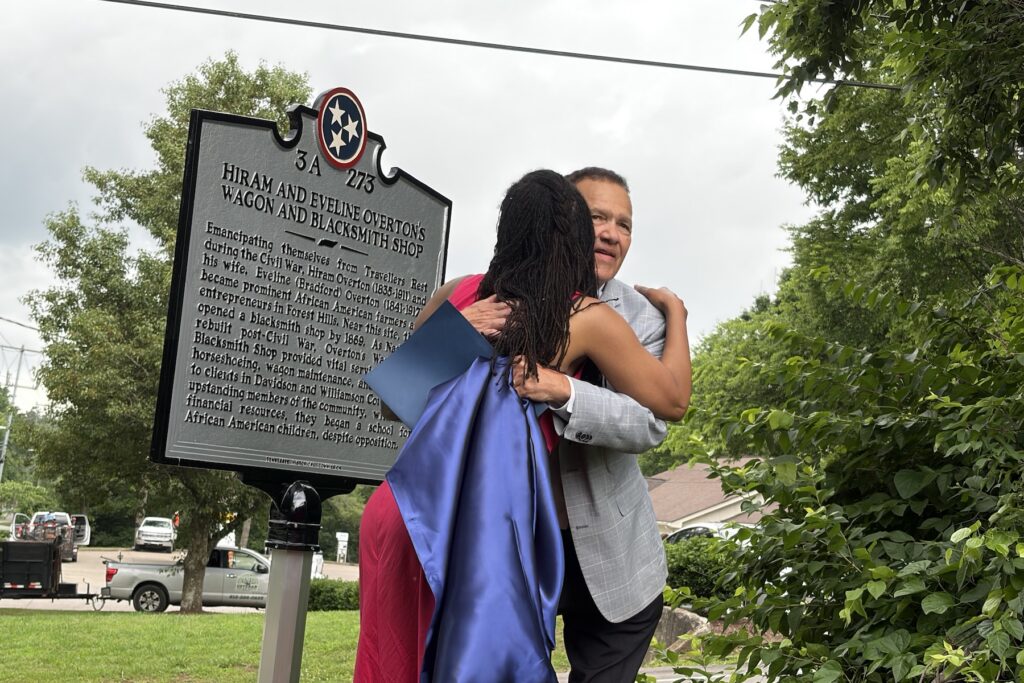
The descendants of a blacksmith enslaved by John Overton Jr. unveiled a historical marker to his legacy on Saturday. Hiram and Eveline Overton “self-emancipated,” as the roadside marker explains, and set up shop on Granny White Pike near Otter Creek Road.
They fled Travellers Rest in the early days of the Civil War and moved just a few miles away. Their enslaver — who was one of the richest men in Tennessee at the time — never came looking. That’s because Col. John Overton was off fighting for the Confederate Army. And when the war ended, he needed a presidential pardon to even return.
While Hiram Overton worked for the Union, both armies took property from him. A lawsuit seeking restitution was discovered in the National Archives and confirmed much of the information about his life.
“During the war, did you wish the Union or the Confederacy to win and why?” federal investigators asked him in 1910, according to a transcript.
“Almost any fool wants to be free. Birds want to be free. I wanted to be free. And I wanted the Union to win,” he replied.
His great-great grandson Jesse Overton III read from the transcript and repeated the freedom line to those who gathered, many of whom are cousins who still share the last name of their patriarch’s enslaver.
Continuing coverage: Historical markers in Tennessee
Hiram Overton’s great-great-great granddaughter, Aisha Francis, is responsible for spearheading the research. She grew up in Nashville and attended Fisk and Vanderbilt universities before moving to Boston, where she’s now president of Franklin Cummings Tech. She learned some of her family’s story from a great grandmother who lived with her as a girl. She didn’t start digging more deeply into her family genealogy until moving away.
“It is remarkable that we have this information,” Francis said. “Even though Hiram and Eveline did not have the chance to go to school, they were quite brilliant in their belief in leaving a legacy for their own children. So they purchased properties, and they left records.”
Francis said the Overtons also started a school for Black children on the site that existed until 1930.
The history was known by only a handful of people until now, said Jim Kay, a Tennessee Historical Commission member who has traced the history of Granny White Pike back to ancient times and attended the unveiling.
“It takes a lot of work to get a marker done. You’ve got to get your research done. You’ve got to have it reviewed by the marker committee,” Kay said. “Then it comes up for review and a vote, perhaps revisions. Then you’ve got to pay for it. They’re not cheap — $3,000. But it’s a beautiful marker that will be here for a long time.”
Curious Nashville: Yes, There Was A Real Granny White And Her Story Reads Like Legend
Saturday’s ceremony lacked any mention that the site is surrounded by Confederate commemorations. The roads that wind through Forest Hills are named for Confederate generals Robert E. Lee, Stonewall Jackson and Nathan Bedford Forrest. Confederate Drive is just around the corner. Beyond that is Jefferson Davis Drive, named for the president of the Confederacy.
“All of that is true,” Francis said when asked to reflect on the juxtaposition of the new marker. “I think it just means our family was part of that legacy as well, and there is a complicated history. But ultimately, the Union won.”

 On Air - 90.3 WPLN-FM