

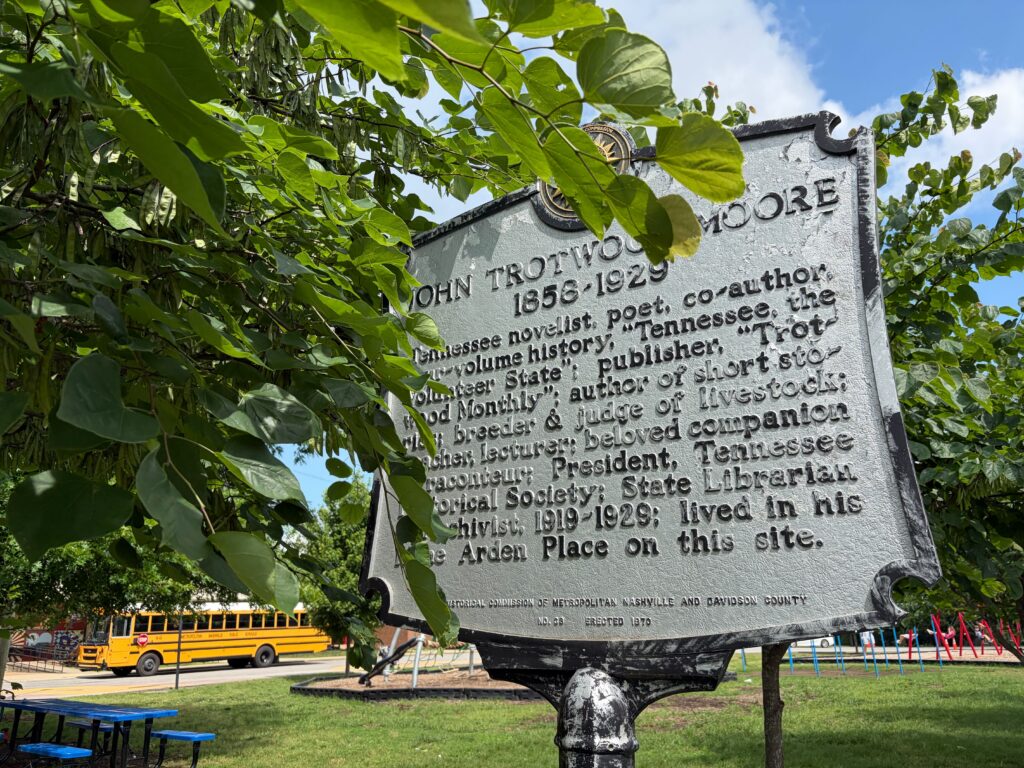
J.T. Moore Middle School in South Nashville bears the name of an openly racist segregationist.
Curious Nashville listeners like Daniel Barocas have wondered why Moore was bestowed with such an honor:
J.T. Moore Middle School is named after John Trotwood Moore, who was openly racist, a proponent of lynching and an apologist for the “Old South.” Please help us understand why schools in Metro are named after people with such heinous records and what can be done to correct this.
He isn’t alone in his questioning. Memorials of historical figures with racist views have garnered pushback in recent years. So, Curious Nashville set out to get a better understanding of Moore’s background, why he has a school named in his honor, and what makes renaming these public buildings so hard.
Who was J.T. Moore and why was a school named after him?
The sign outside of the school reads that Moore was a novelist, poet, teacher, lecturer, beloved companion and the official state librarian and archivist from 1919 to 1929.
It doesn’t note, however, that much of his writing promoted racist tropes and white supremacy.
“He wrote that the history of Tennessee begins with white people,” said Larry Woods, civil rights attorney and criminal justice professor at Tennessee State University. “He said that only the ‘pure breed’ — referring to white people — can ever reach the stars.”
Two of Woods’ kids attended the school, and he takes issue with students learning in a building that’s been named after a racist since it opened in 1969.
School names are often based on suggestions made to the school board. Many are named after influential people, and Moore held several prominent positions in the state government. Additionally, his home, Arden Place, was located at the school site.
Can the name be changed?
Renaming the school would be no easy feat. The Tennessee Heritage Protection Act – a 2013 state law – “prohibits the renaming, removal and relocation of any memorial on public property.” A school named after an historical figure is subject to this law.
If MNPS wanted Moore renamed, it would need to petition the Monuments and Memorials Commission for a waiver. Approval requires a two-thirds vote. (The Tennessee Historical Commission oversaw these requests until July 1, 2023.)
Sean Braisted, a district spokesperson, told WPLN News that MNPS has never tried to rename the school. He noted the commission has “historically construed their role as being in favor of historic preservation of names and memorials, denying attempts to change historic names.”
WPLN News reviewed the THPA’s records for the last 10 years and could not find a case in which the commission approved a renaming request. The commission refused to answer questions regarding its denial and approval record.
Serving the ‘public interest’
When deciding whether a memorial can be altered, the commission considers several factors. Has the proposed change garnered support or opposition from local residents? Would the change be offensive or have derogatory implications?
Also considered: Does the renaming serve a “compelling public interest?”
When Middle Tennessee State University attempted to rename Forrest Hall – which memorializes Ku Klux Klan and Confederate leader Nathan Bedford Forrest — the commission decided the answer was no. Twice.
Learotha Williams, Davidson County historian and Tennessee State University history professor, took part in these renaming efforts at MTSU. He told WPLN News that honoring those with racist views can be seen as an endorsement which, in turn, alienates marginalized people.
He cited, as an example, the presence of the Nathan Bedford Forrest bust in the state capitol before it was removed in 2021.
“Every time a Black person walked into the legislative chamber and they looked over there and they saw that statue, that was a whites-only sign,” he said. “A symbol of white supremacy in a place that was supposed to be committed to equality and democracy.”

 On Air - 90.3 WPLN-FM