
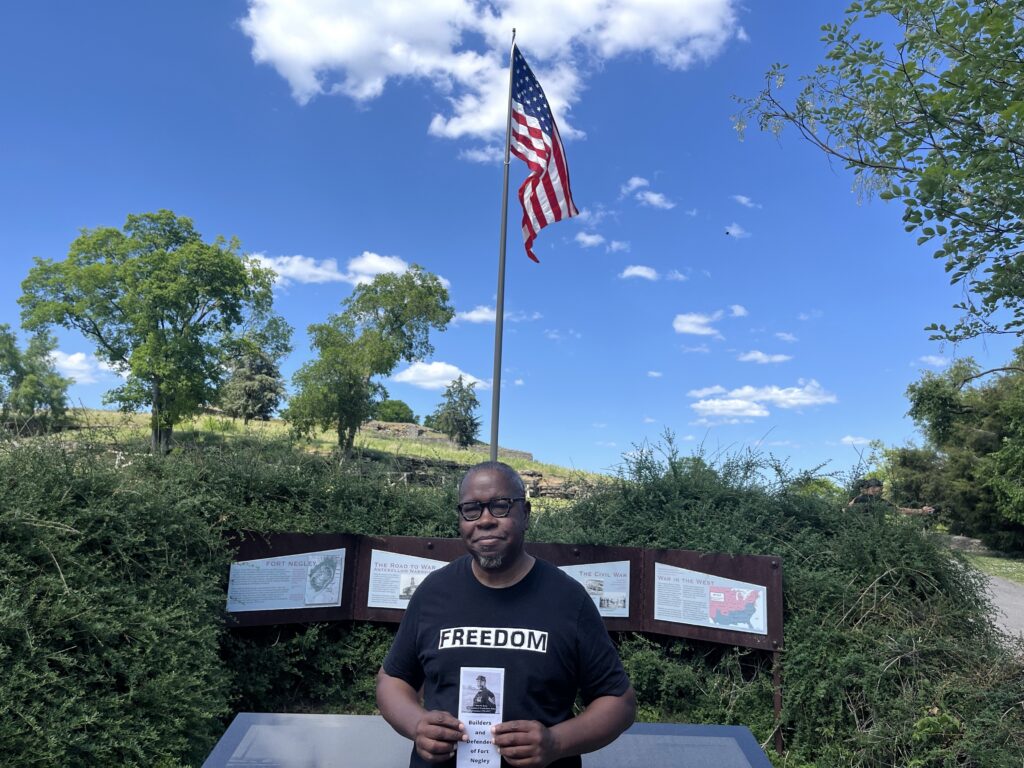
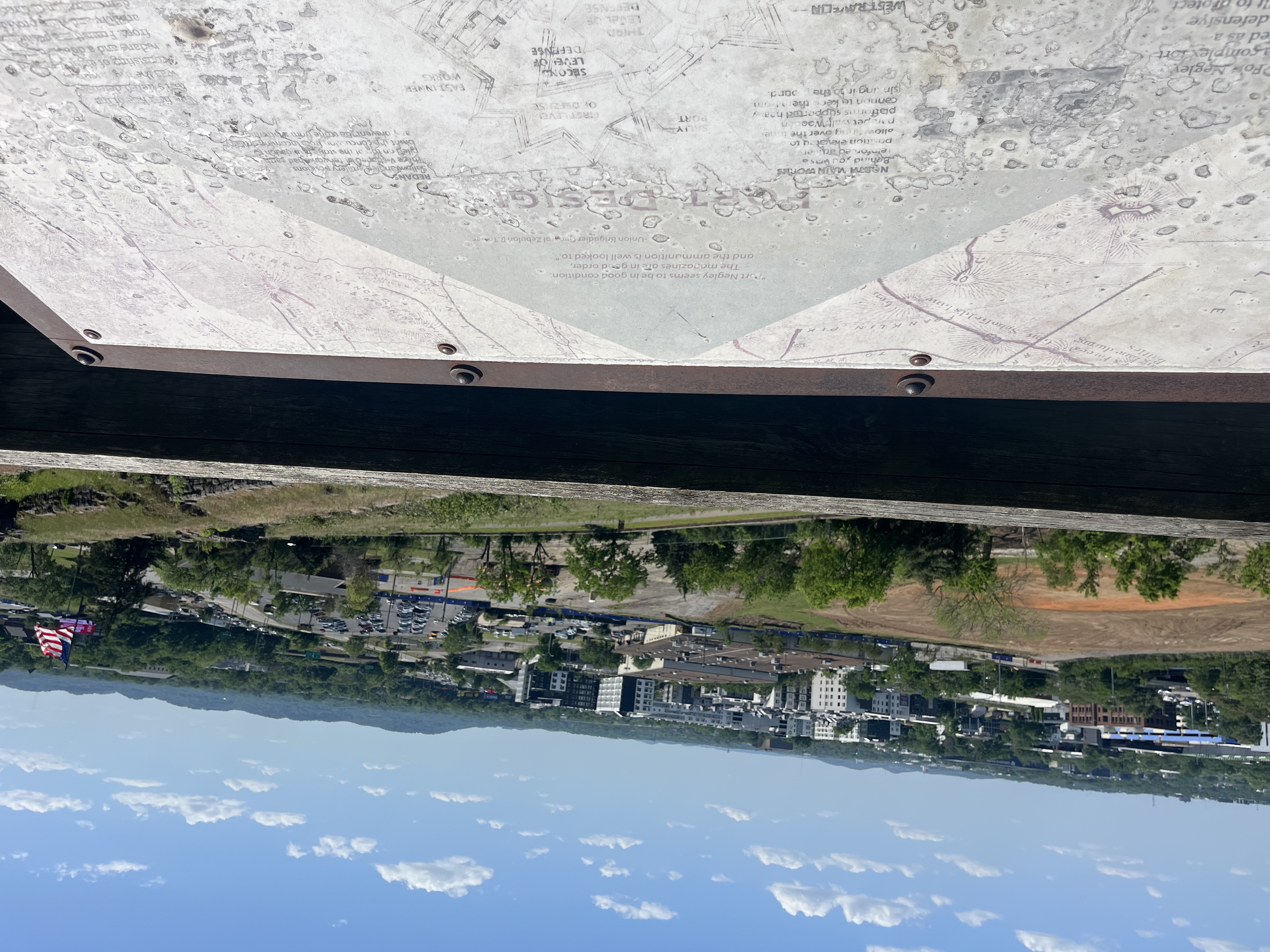
At the peak of Fort Negley, the historical plaques are so sun-bleached they’ve become unreadable, obscuring the story they’re meant to tell about one of Nashville’s most important sites.
It’s here that a group of college students recently gathered for a nontraditional final exam. Instead of blue books or essays, Tennessee State University’s Dr. Learotha Williams has them out for a meandering “walk-and-talk.”
This class is “Black Nashville in History and Memory.” It comes to life along the winding trail as Williams asks the students about the Black laborers who constructed the fort. He gestures toward the Nashville skyline of high rises, asking them to imagine how it once looked.
“It’s different telling a story in a space where the actions actually occurred,” Williams said. “As opposed to being in a synthetic space of sorts, like a classroom, with just desks and students and me talking.”
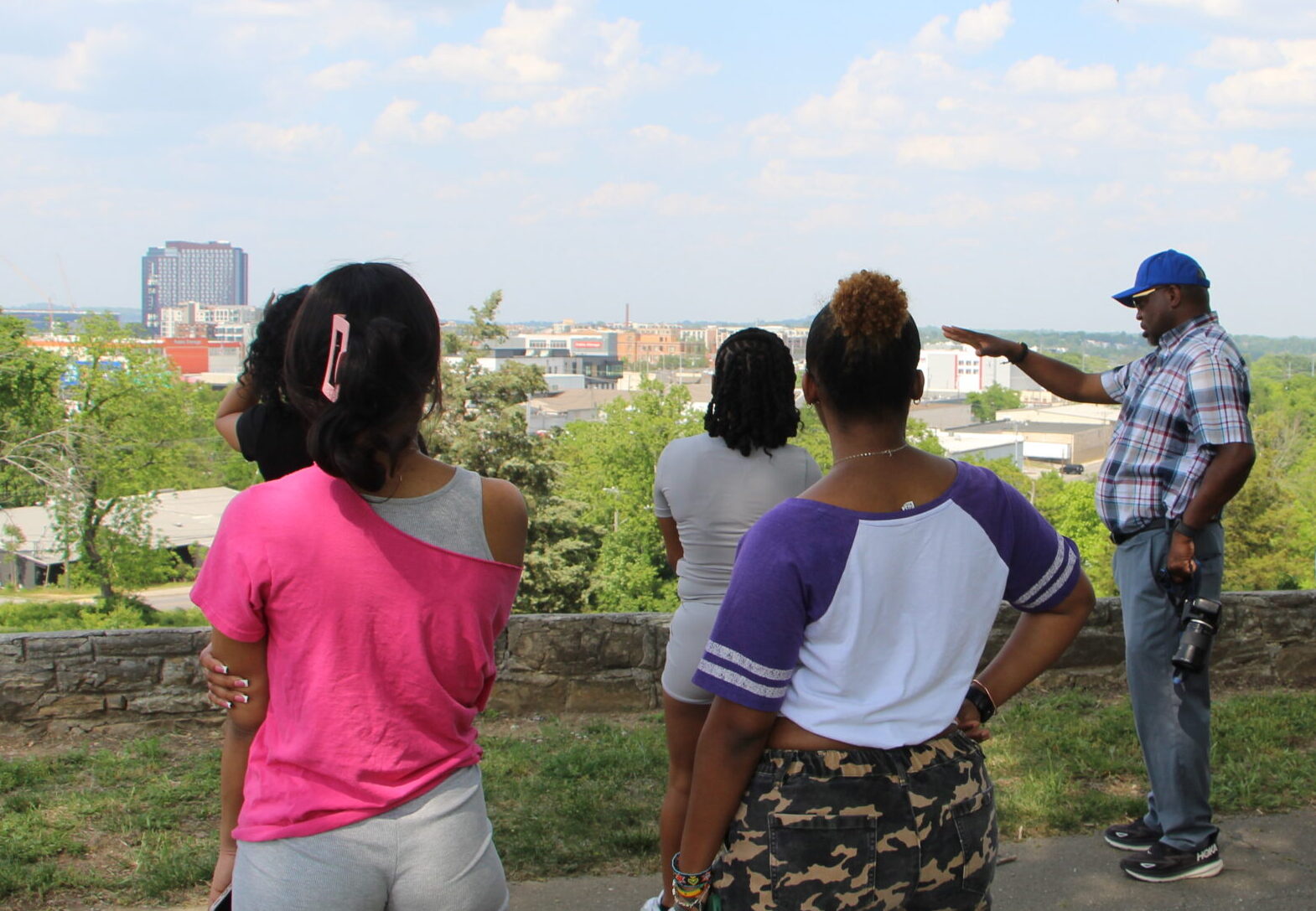
Dr. Learotha Williams’ Black Nashville History class visits Fort Negley.
It’s no coincidence that Williams has selected Fort Negley as the location of the final exam. It’s a key piece of Nashville’s Civil War-era history, and is in the midst of a long-awaited overhaul that will update the fort with a more accurate presentation of its complicated history.
The site was a Union fort. Nashville was captured by Union forces early on, making it the first Confederate state capitol to fall. It was also constructed by Black laborers, many of whom were pressed into work.
In 1862, roughly 3,000 men women and even children were forced to build through harsh working conditions, with little provisions, and, for many, no pay.
Earlier this year, Nashville kicked off an $11-million expansion, the first phase of it’s master plan. It’s adding an adjacent memorial lawn and “contemplative plaza” in honor of the laborers, accessible walking paths and new educational installations across the site.
Part of the reason for the effort is that Fort Negley has undergone decades of neglect. Scattered across the park are plaques with historical information. Some are weathered, their information faded. Others emphasize the site’s history as a Union fort, downplaying its importance in local Black history.
This whitewashing, Williams said, is another reason Fort Negley is emblematic of Nashville’s Black history.
“Who determines what we remember and what we forget?” Williams said. “This place is ground zero for that, right? This being a, quote, ‘Yankee fort’ in the Confederacy, there’s not going to be a lot of glorification of what happens here.”
Williams has been a key voice in the development of the master plan, pushing for it to feature a more comprehensive history, from the Civil War up to the Civil Rights movement.
“We are pushing it to become more than a Civil War fort,” he said. “We’re pushing it to become representative of the group that probably made up the majority of the people here. The enslaved people here.”
But this decision wasn’t a given.
“People were talking about putting a Kroger here, then tennis courts, all kind of bad ideas,” Williams said. “But we are here, and it’s a testament to council people and the mayors and the community who decided to say ‘Okay, this is a place that we are going to protect.’ ”
The tide began to turn in Fort Negley’s favor in 2017. Preservationists defended neighboring land against a major development plan. In 2019, the fort was named a “Site of Memory” by UNESCO and included in its Slave Route Project. And a Metro allotment of $1 million for upkeep followed a couple years later.
‘Amongst the ancestors’
Fort Negley has helped shape the city. After the war, laborers settled nearby, establishing important Black neighborhoods. While those were later decimated by the interstates, descendants carry on the memories.
Gary Burke, who grew up in East Nashville, is doing this work. He is the great-great-great grandson of Peter Bailey, a private in the 17th Regiment of the U.S. Colored Infantry. Burke participates in reenactments, has voiced the audio tour at Fort Negley, and often spends time at the site.
“Walking amongst the ancestors that once dwelled here brings me a sort of peace and a sort of comfort,” Burke said. “I’m here constantly giving [laborers] a sense of remembrance that they’ll never be forgotten.”
His goal is ensuring that the legacies of the builders live on.
“Unless you pay attention as you walk around the trail to the historic panels that give you information, you’ll never know what happened here, that this was a Union fort,” Burke said. “And that you had African-Americans who were forced into labor and what indignations they experienced while doing that.”
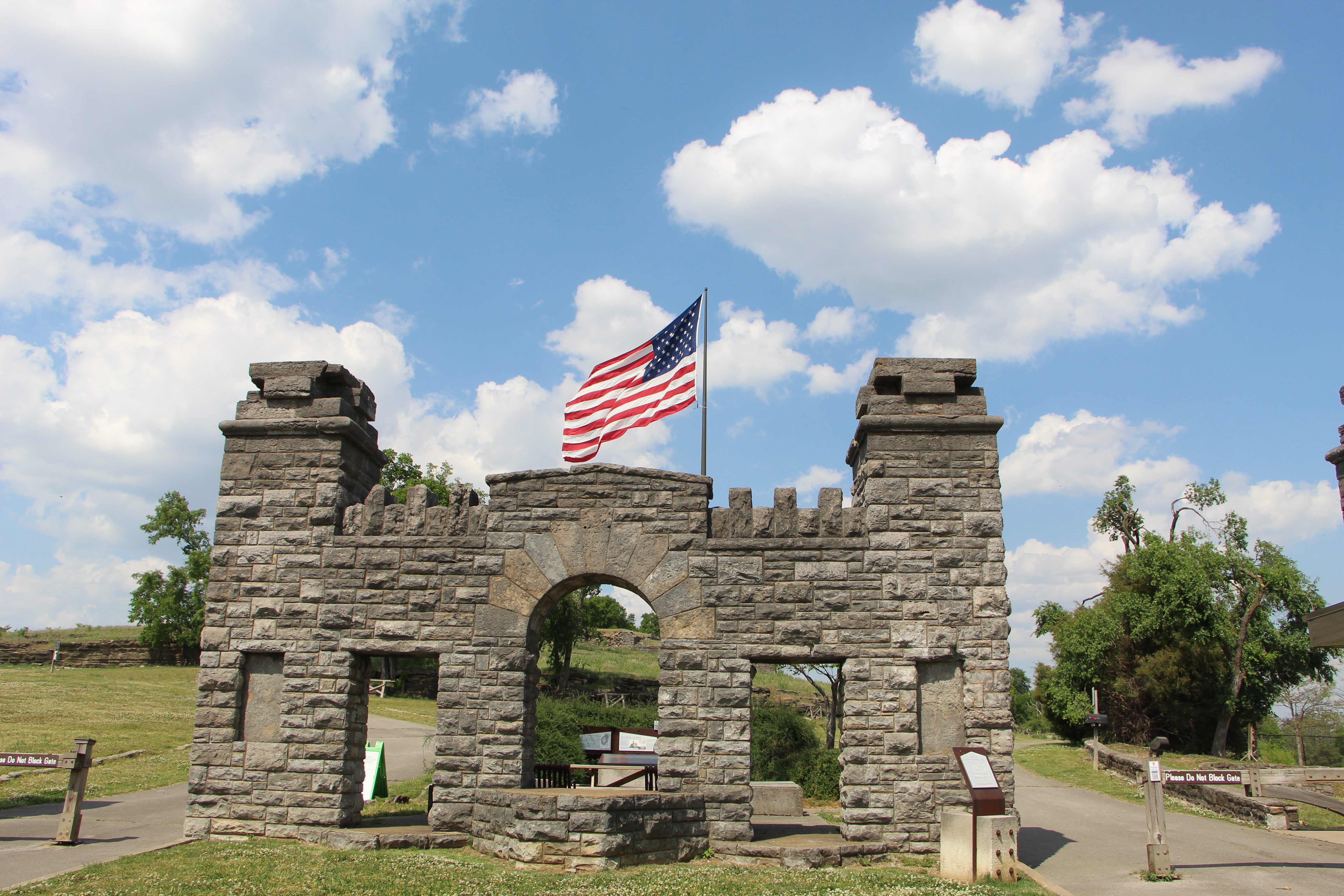 Cynthia Abrams WPLN News
Fort Negley is a Union fort near Wedgewood Houston. It was constructed by Black laborers, many of whom were impressed into work.
That sometimes-invisible history is something the students with Dr. Williams consider uncomfortable.
“Knowing that it’s just a place that people walk through and they don’t know the cultural significance behind it is, kind of like, hard to process,” said senior Zariah Browning.
‘Claim this history’
The city’s decision to try to rectify its portrayal of the fort’s history comes at a time when the federal government is dissuading similar efforts.
In 2025, President Trump issued an executive order directing agencies to remove, “divisive, race-centered ideology” from certain federal institutions and monuments. The order, which was one in a series aimed at rolling back diversity, equity and inclusion (DEI) efforts, describes a “revisionist movement” that “seeks to undermine the remarkable achievements of the United States by casting its founding principles and historical milestones in a negative light.”
Fort Negley isn’t directly impacted by the order, which singles out Smithsonian museums, educational and research centers, and the National Zoo. But Nashville Mayor Freddie O’Connell wants to push back on the president’s narrative.
“In its earliest years, the fort was a focal point for America’s most profound battle over civil rights and black history,” O’Connell said earlier this year at an event commencing Fort Negley’s renovation. “Now we’re engaged again in a modern version of that battle where we’re arguing about whether we can even claim this history. There are people trying to legally prevent histories like those of Fort Negley from being included in textbooks or even our discourse, and that is why the Fort Negley story is one worth knowing, especially right now.”
The efforts are underway.
Work is afoot at the future site of the memorial lawn (the former Greer Stadium), and archaeologists are frequently conducting small-scale excavations in spots where new educational plaques will later be installed.
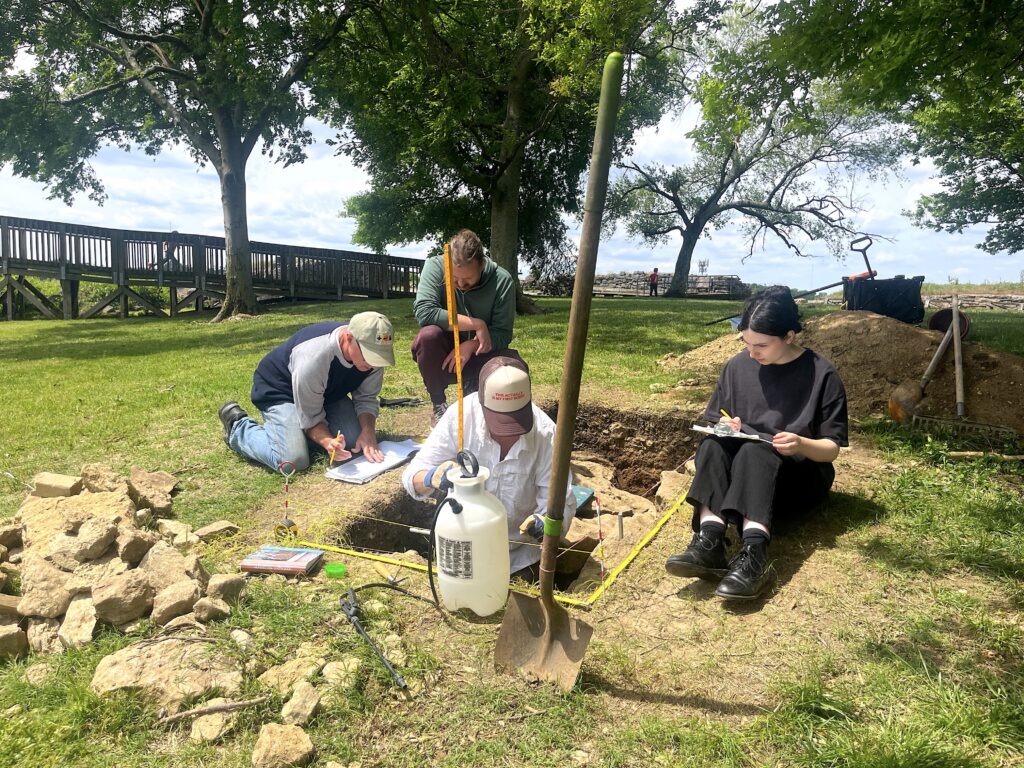 Cynthia Abrams WPLN News
A group of volunteers excavates a plot at Fort Negley where a new educational panel will soon be installed.
City archaeologist Adam Fracchia says careful digging is a critical way of filling in gaps in historical knowledge.
“If we don’t preserve these elements, elements all over the city, then we start to lose people, the picture of people, since a lot of these people weren’t written about in the historical record,” Fracchia says. “So the material that they left behind is their only record.”
On a recent Friday morning, as archaeology volunteers and students stand waist-deep in a hold, taking measurements, Fracchia shows their findings to a group of passers-by.
 Cynthia Abrams WPLN News
A porcelain doll head, from a doll known as a “Frozen Charlotte,” was discovered by archaeologists at Fort Negley.
He pulls out a percussion cap, an element of a musket. There’s also a fragment of a glass bottle, likely used for pickles or olives; a cow rib; and a porcelain doll head, known as a “Frozen Charlotte.”
“Just to think that a soldier probably had that artifact,” Fracchia says. “And why did they have that artifact? And who gave them that artifact, or what did that artifact mean to them? … And that’s all that’s left behind for many, many groups. So it’s our window into understanding these people of the past.”
And as Nashville compiles more artifacts, more voices and, ultimately, more understanding, the city is hoping to tell the whole story of Fort Negley.
 Cynthia Abrams WPLN News
The aging and sun-bleached signage at Fort Negley will be updated as one piece of an $11 million project.

 On Air - 90.3 WPLN-FM