
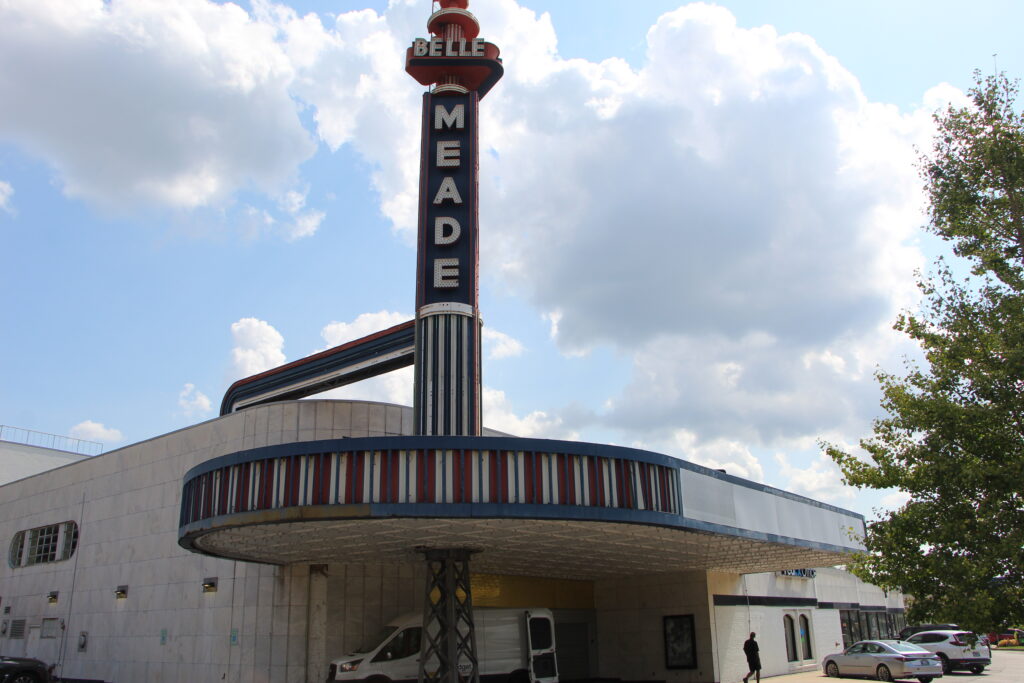
Along Harding Pike lies a relic of Nashville’s past: the towering red, white and blue marquee of the now-defunct Belle Meade Theatre.
While the facade lives on — conjuring images of a bygone era of movie-going during Hollywood’s Golden Age — the interior was gutted long ago.
Richard Daniel, an actor who works nearby, remembers driving in from Clarksville for showings in the 1970s and 80s.
“We used to, as a treat, come up to Nashville to see the movies here,” Daniel says. “And this is one of the places we would come. I saw ‘Star Trek: The Wrath of Khan’ here. Saw ‘This Is Spinal Tap’ here. The last movie they ran here was ‘Lawrence of Arabia,’ and I came to see that.”
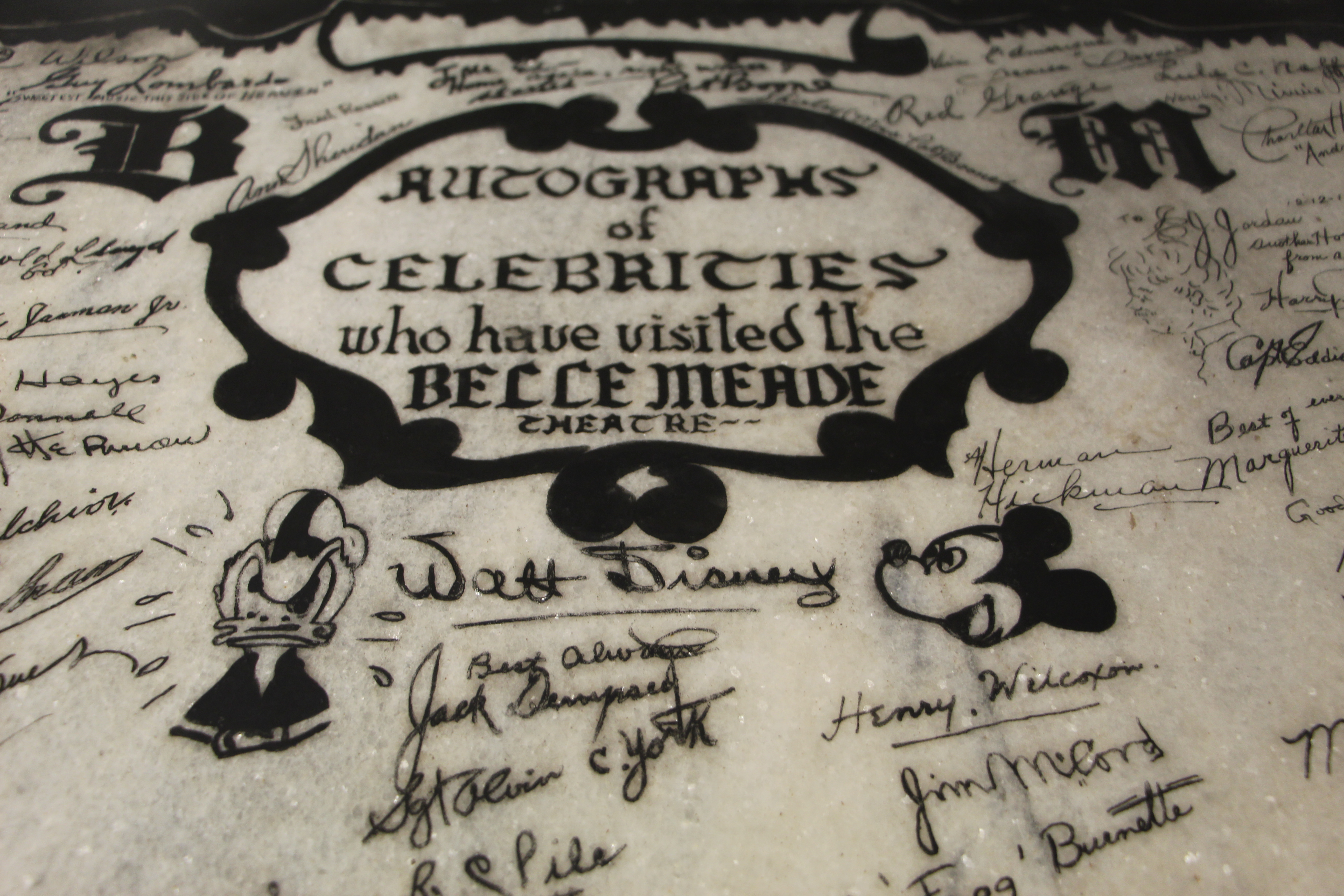
He remembers a lush theater — red curtains, balcony seating, a neon marquee — and inside the lobby, a sort of “wall of fame” made of three large marble slabs, signed by hundreds of celebrities.
“They’re not there now, and I’ve often wondered what became of those,” Daniel asked Curious Nashville. “Did they smash them when the bookstore closed and they turned it into a grocery store? Or are they still around somewhere in a collector’s vault or something?”
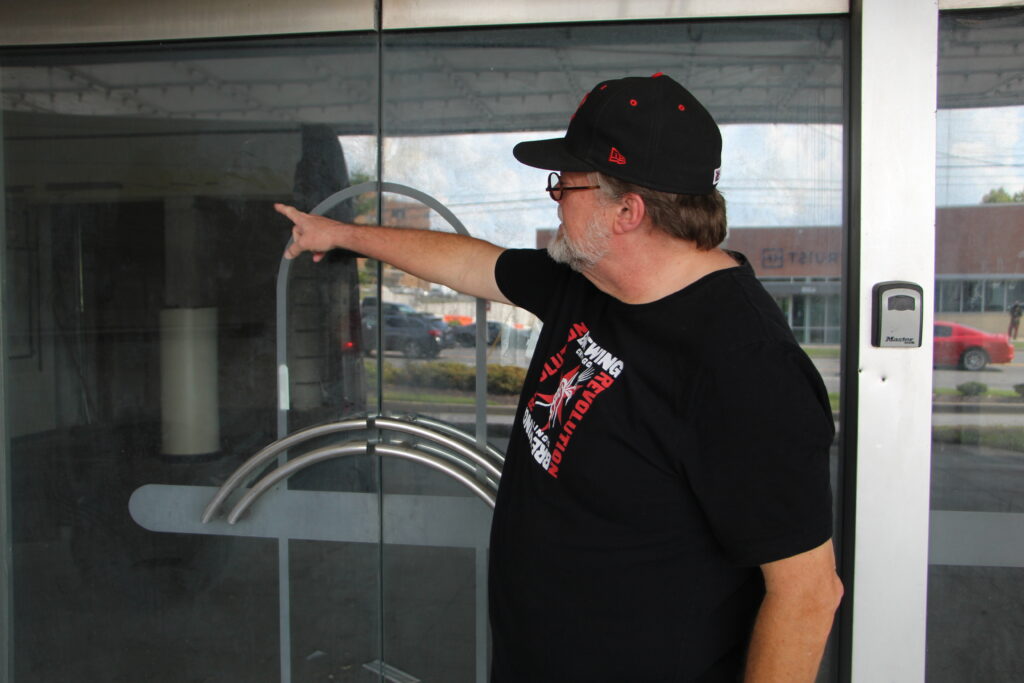 Cynthia Abrams WPLN News
Richard Daniel peers into what remains of the Belle Meade Theater.
The answer is: Yes. They are in a “vault or something.”
From Doris Day to Disney
In the 1990s, the three marble plaques were donated to the Tennessee State Museum, where they remain packed up in a storage facility — until head curator Richard White brought them out for Curious Nashville.
When the theater opened in 1940 they debuted with the inscription: “Autographs of Celebrities who have visited the Belle Meade Theater.”
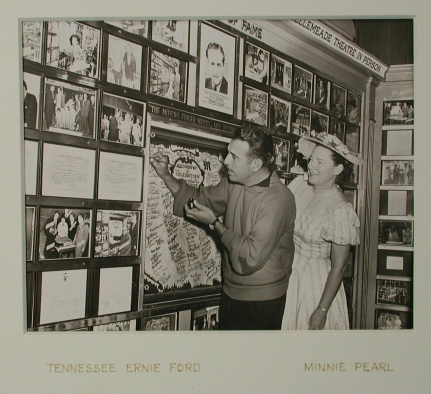 Courtesy Tennessee State Museum
 Tennessee Ernie Ford and Minnie Pearl signing a marble plaque at the Belle Meade Theater.
And, there are some big names on there: Walt Disney, alongside an original Mickey Mouse sketch. Actors like Doris Day, Fess Parker, Maureen O’Hara, Gene Kelly, and Ronald Reagan dot the plaques. And in classic Nashville fashion, there’s a robust list of singers — Bing Crosby, Perry Como, Paul Anka, Tennessee Ernie Ford, Johnny Cash and June Carter.
During the 1940s and 50s, when movies would open in select theaters (rather than the widespread releases we’re used to today), studios would host “roadshow theatrical releases,” where films would come to certain cities and stay for a short time.
“It was a way that the Hollywood industry was sort of throwing it back to the charms of live theater, of live entertainment,” Dr. Claire King told This Is Nashville. “In some cases, celebrities who were starring in the films that were premiering would come to these cities and make appearances to really add to the excitement of the event.”
Later, when the Belle Meade Theatre was converted into a bookshop, writers like David Sedaris and Norman Mailer added their autographs to the list. The plaques stuck around until the bookshop closed.
“From what I could tell, the original owner wanted this in the lobby,” curator Richard White said. “So he ordered one to put in, but apparently ordered several more to have extras as they filled up with names.”
That “original owner” was Tony Sudekum.
Nickelodeon era
Sudekum is a familiar name in Nashville — the large public housing complex in the Napier neighborhood, Sudekum Apartments, are named after him. He was a major philanthropist, in part because of his work in the entertainment business.
Well before the opening of the Belle Meade Theater, the Sudekum family sold ice cream. And, at the start of the 1900s, while on his deliveries, Tony Sudekum had an idea.
“He’s delivering ice cream and he has the same route all the time and it dawned on him that if he invested in these little kiosks that he had heard about, he was gonna go by them everyday,” said Marc Stengel, Sudekum’s great-grandson.
He’s recalling the original type of cinema, where movie-goers could watch a short film for the cost of a nickel.
“He raked in the nickels,” Stengel said. “The family started investing in real estate. They were making a lot of money just off of the nickelodeons.”
Pretty soon, the family started buying up Vaudeville theaters, and, eventually, converting those into cinemas.
They formed the Crescent Amusement Company and began building more theaters, including in Belle Meade.
“I think he probably made an even more lavish theater out of the Belle Meade because people weren’t really living in that density in the suburbs,” Stengel said. “And I think that was probably an attempt to draw audience.”
By the time Sudekum died, he owned roughly 150 theaters.
Today, his descendants still own the site, which is mostly sitting empty. The last thing housed in the historic building was a grocery store, and Kroger still maintains rights to the lease.
Stengel says the building is in a sort of limbo. But one thing is certain: its Art Deco façade will live on. Stengel says the lease protects the building’s exterior.
As for the plaques? They are safe at the state museum. They’re not on display right now, but they could be in the future. And, even as time goes by, the architecture and the relics of what that space used to be will be preserved.
 Cynthia Abrams WPLN News
This closeup shows one of the signature slabs held by the Tennessee State Museum.

 On Air - 90.3 WPLN-FM