
One of Nashville’s oldest roads has morphed into an industrial corridor whose name no longer makes sense given decades of development. Murfreesboro Pike heads to Murfreesboro. Gallatin Pike to Gallatin. Charlotte Pike to Charlotte (the seat of Dickson County).
So where is the “Elm Hill” of Elm Hill Pike? Curious Nashville listener Chad Smith, who works in an office on the pike, submitted just such a question after listening to a recent episode and posing the idea around the water cooler.
“Elm Hill Pike is very hilly. Where is the actual elm hill?”
A simple Google search is no help. Even a thorough history of the road from the Nashville Historical Newsletter only mentions that the road has gone by several names, including Stones River Road and Chicken Pike. No explanation of Elm Hill.
As an occasional bike commuter, I decided the best way to find a hill was to get on two wheels. So on a Friday free of in-studio interviews, this neon-clad cyclist set out with a recorder under the heat of the midday summer sun.
Starting at the end
Elm Hill Pike now terminates into Bell Road, so that’s where this ride starts. There are a few notable ups and down, but no prominent hills. Coming toward downtown, you’ll even pass one of the oldest structures in Middle Tennessee. The two-story log structure was built in 1808 by early settler James Buchanan. But there is no obvious Elm-tree-topped hill that might explain the road name.
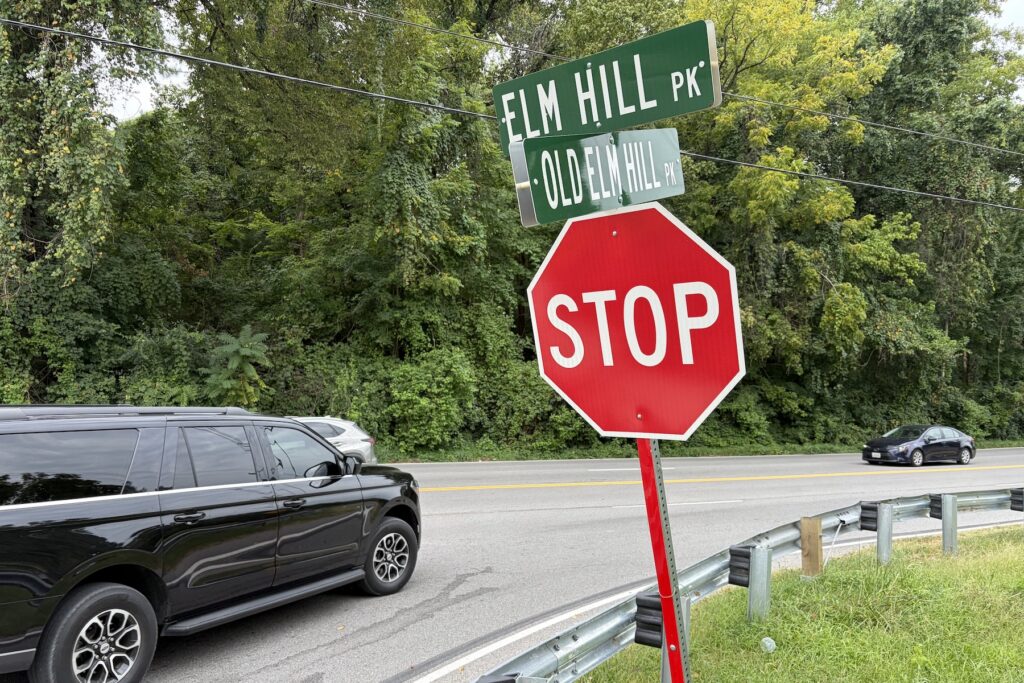
After crossing Donelson Pike (which leads north to Donelson), a road called Old Elm Hill Pike runs into Elm Hill at the base of a wooded rise. It’s promising evidence but not corroborated by old timers.
“We are on a hill, but I’m not sure where the names came from,” says Liza Brown of Hurd Real Estate, who has worked on the side street for nearly 30 years.
 Blake Farmer WPLN News
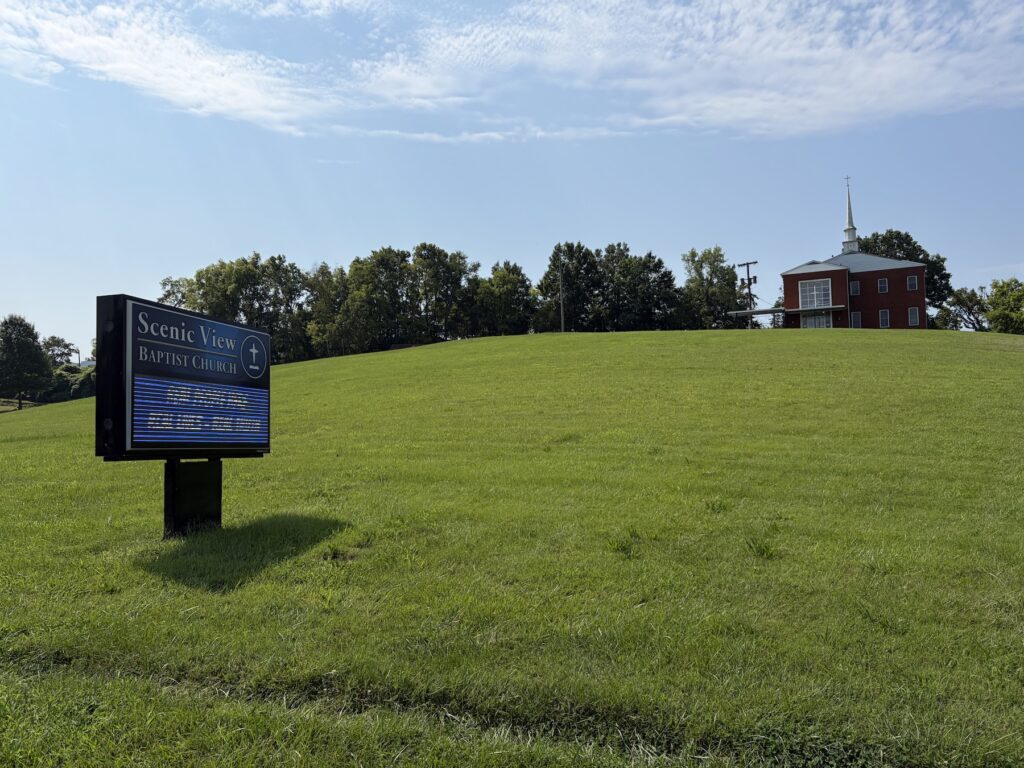
Scenic View Baptist Church sits atop a hill on Elm Hill Pike with a view of downtown buildings. There are also a few elm trees at the top of the hill.
Landmarks along the way
Continuing west toward town, Elm Hill crosses McGavock Pike. Illustrating how pikes were named for where they ended, McGavock heads toward what was an 1,100-acre plantation owned by the McGavock family, now Two Rivers Park. Elm Hill passes under Briley Parkway, then on the left is the most unmissable hill thus far. Atop a mound that rises 60 feet above the road sits Scenic View Baptist Church. And lining its parking lot is a stand of cedar trees and American elms. (I even used an app to check my leaf identification). Intriguing, but not exactly hard evidence, and messages left with the small Southern Baptist church have gone unreturned.
En route to downtown, the next historic landmark is Greenwood Cemetery, built on an open knoll by pastor and businessman Preston Taylor in a time when Black Nashvillians required their own burial grounds. Adjacent to the cemetery, he also built and ran the city’s first park that welcomed Black residents. Greenwood sits on a bit of a hill, but no stand of elms that might have descended from the namesake. Mostly magnolias.
A scant half mile from the city end of Elm Hill comes the view of all views.
 Blake Farmer WPLN News
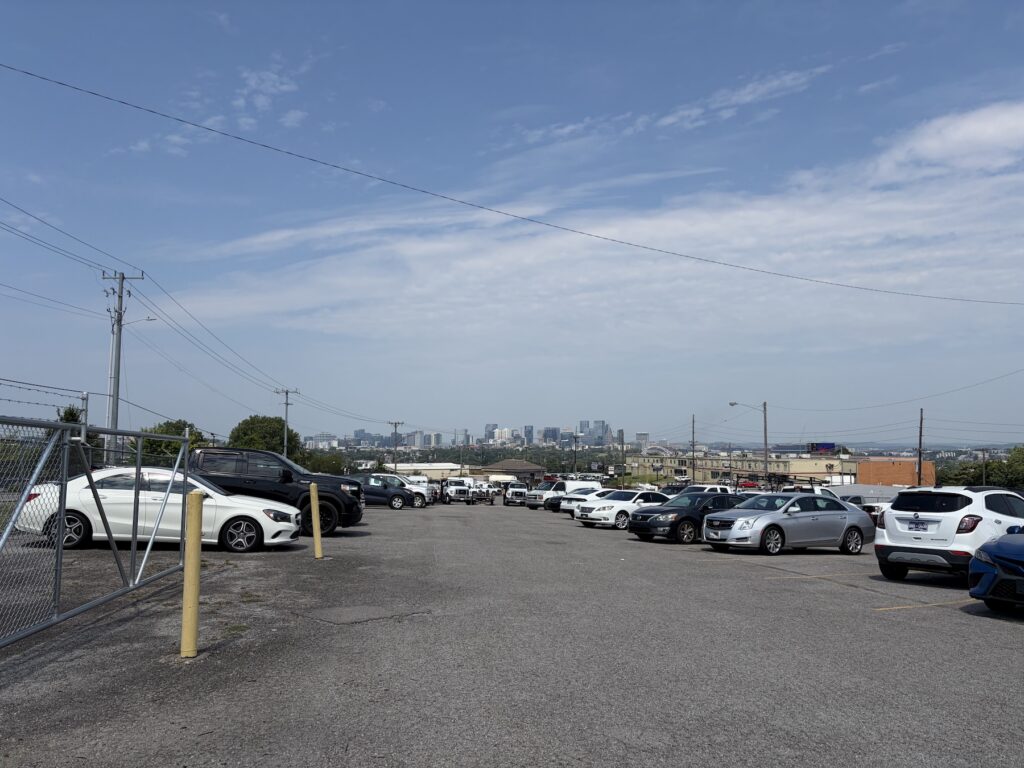
Behind the new Metro Nashville Police Department headquarters, this hill gives a view of Lower Broadway. However, on topographical maps, it has the name Fosters Hill.
The view of all views
From the overflow parking lot across the street from Care Supply, a Colony hardware store, Lower Broadway is easily visible. Early settlers would have been able to see down into Fort Nashboro on the Cumberland River. “You look out over Nashville and you can see the whole doggone thing,” says inside salesman Jeff Gleespen.
If he had to bet on where Elm Hill is, “I’m going to say it’s here, exactly where we’re at, the closest high point to Nashville on Elm Hill Pike,” Gleespen says.
The hill is unmatched along the rest of the pike, according to topographical maps. But those maps also have a name for that peak — Fosters Hill. And if there were ever elm trees, their remnants are now covered by asphalt behind the new Metro Nashville Police Department headquarters.
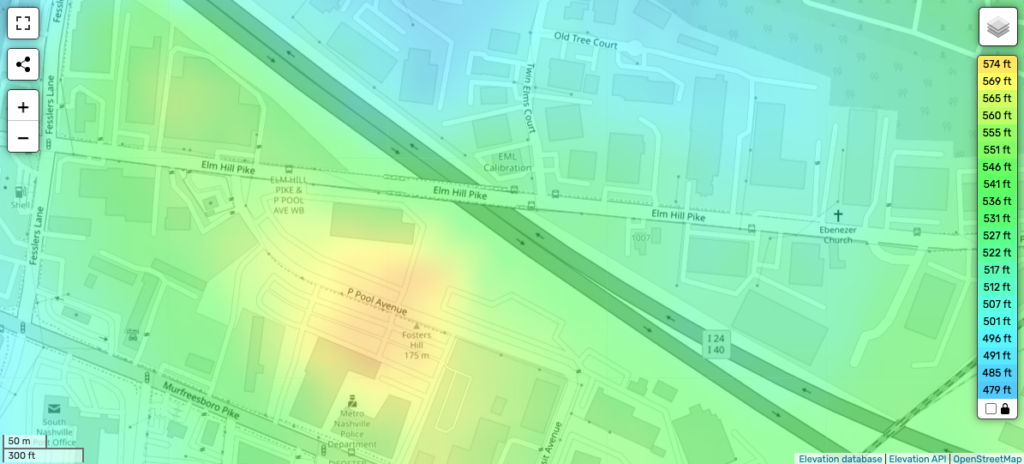 Courtesy topographic-map.com
 Topographical maps say the high point on Elm Hill Pike is called Fosters Hill.
A breakthrough
The bike ride proved to be good exercise and a reminder just how many places and roads in the area carry the elm name and the “pike” label. But digitally sifting through local archives proves far more effective.
A deep internet search starts to suggest the namesake of Elm Hill may not be within the Nashville city limits, which shouldn’t be surprising. Many of the “pikes” pinwheeling out of Nashville lead to towns a county or two away. Old legal documents suggest there was an “Elm Hill” post office.
The Rutherford County archives includes a paperback history of LaVergne (download PDF), called “Green Trees.” Published in 1993 by Shirley Chaney, the book briefly describes a prominent physician, Dr. James Charlton (1813-1892). His farm was on the north side of the LaVergne community. He made his rounds twice a week in town and also carried the mail, which made his farm, in effect, a post office. That post office was called “Elm Hill.”
“According to verification of a state highway historian, Elm Hill Pike terminated at the home of Dr. Charlton,” Chaney writes on page 63.
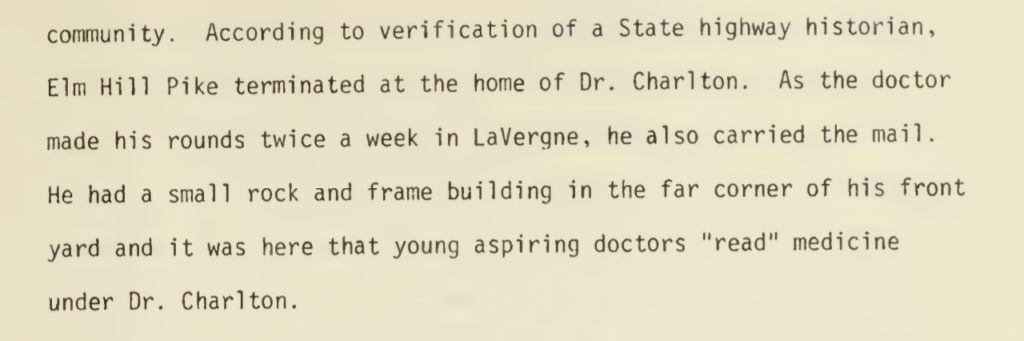
Page 63 of Green Trees by Shirley Chaney.
So why does modern day Elm Hill Pike end at Bell Road?
Before Percy Priest Lake
I’ve buried the lead, because that’s what Curious Nashville is known for. You’re going on the journey with us. And this journey leads us to Percy Priest Lake.
Recall that one of the early names for Elm Hill Pike was Stones River Road. But in the 1960s, the U.S. Army Corps of Engineers dammed up the Stones River to create Percy Priest Lake. The reservoir flooded many communities and their roads. While it’s hard to pin down precisely where Dr. Charlton’s house and post office was, we know that his body was one of hundreds that was moved to Mount Juliet before the lake was inundated in 1968.
Given pikes tended to be named for where they terminated, and given a state highway historian (though unnamed) confirmed that Elm Hill terminated at Charlton’s post office, we’re counting it as the namesake of Elm Hill.
The evidence may not be strong enough to secure a historical marker, but it’s good enough for Curious Nashville and question-asker Chad Smith.

 On Air - 90.3 WPLN-FM