
A race toward a century-old dream of near-infinite energy from fusion is heating up across the U.S., and Tennessee just took one step forward.
The state issued the nation’s first license for a nuclear fusion power plant this week to Type One Energy. The company envisions bringing a fusion power plant online by 2034 near Knoxville.
But the project will start with building a prototype — as fusion and the infrastructure required to produce a lot of energy from it still require more research.
The promise of fusion power
Tennessee became the first state to set up regulations for nuclear fusion machines in June. The Nuclear Regulatory Commission delegated that power to states back in 2023.
The state defines a fusion machine as one “capable of transforming atomic nuclei through fusion processes into different elements, isotopes or other particles, and directly capturing and using the resultant products,” according to the Tennessee Department of Environment and Conservation.
Fusion differs from fission, which powers the nuclear power plants in operation today. Broadly, supporters of fusion see a clean energy source to help with surging power demand from data centers. Notably, fusion doesn’t carry the same safety risks as fission, which uses uranium, produces long-term radioactive waste and carries a risk of the runaway chain reactions that lead to a meltdown.
Fusion, on the other hand, uses isotopes of hydrogen and produces helium and some shorter-lived radioactive waste. But the energy source has some of its own safety, financial and indirect weapons risks. Fusion has also long faced scientific skepticism, with some researchers noting “a running quip that ‘fusion is always 30 years away.’”
Support from clean energy groups is mixed on nuclear; some advocates think it’s not the safest way to mitigate climate change and achieve a clean electrical grid — and unnecessary for that purpose given that renewables like solar, wind and batteries are cheap and readily available.
Fusion does have one unique quality, however: it’s the only known energy source capable of carrying humans beyond our solar system.
A key challenge with fusion power is managing plasma, a state of matter that powers the stars, but isn’t exactly commonplace on Earth.
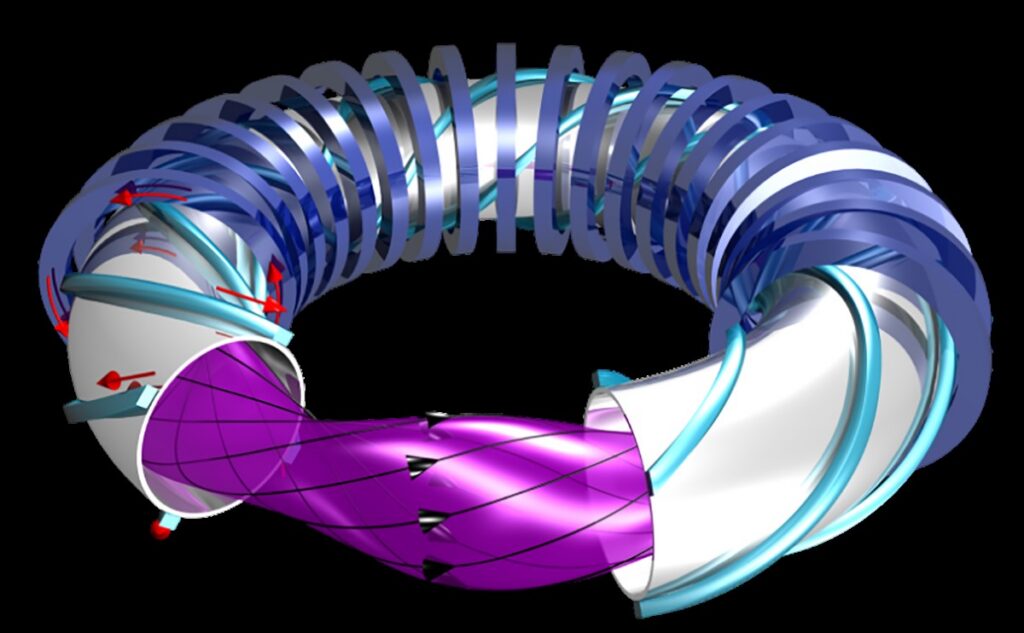
Scientists are pursuing two main methods for fusion power: magnetic and inertial confinement. More advancements have been made with two types of magnetic technology called tokamaks and stellarators. Both are machines that use magnetic fields to confine plasma in the shape of a donut, but tokamaks use strong electromagnets to generate twisting magnetic fields around external coils.
A prominent fusion project underway with a tokamak reactor is the International Thermonuclear Experimental Reactor, or ITER, project in France — that collaboration was initiated in the 1980s, site construction began in 2007 and current estimates for plasma operation and then energy-producing reactions are 2034 and 2039, respectively.
In contrast, Type One Energy is planning a stellarator. The commercial reactor will be capable of producing 400 megawatts of power, according to the company.
Who is Type One Energy?
Type One Energy began its story in Madison, Wisconsin in 2019 and opened an office in Oak Ridge several years later.
The startup has a number of investors, including the Bill Gates-founded Breakthrough Energy.
In 2024, the company announced plans to build a prototype machine at the Tennessee Valley Authority’s closed Bull Run Fossil Plant in Clinton. At the time, it said that construction could begin as early as the following year.
The company submitted formal plans to Tennessee regulators in January, and it now plans to break ground on the prototype this year.
The project will also entail setting up a research site through a partnership with TVA, Oak Ridge National Laboratory and the University of Tennessee.

 On Air - 90.3 WPLN-FM