
How will the city spend its $3.8 billion budget?
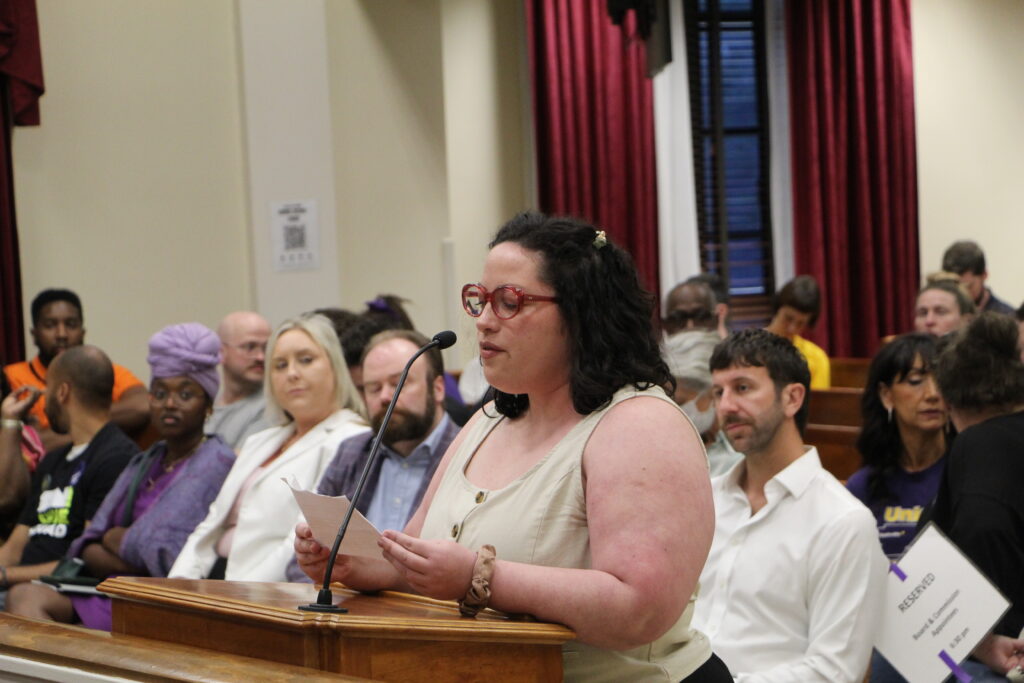
While the mayor has offered his spending proposal for the upcoming fiscal year, roughly one hundred Nashvillians went before the Metro Council Tuesday night to share changes they’d like to see.
Housing, hospitals, childcare and Metro employee pay drove the requests. Councilmembers will now draft an alternative to the mayor’s budget proposal that could integrate some of these asks. Not everything makes it in, and, in previous years, the loudest asks have resulted in minor budget reallocations.
Housing
This year, the affordable housing crisis was a prevailing theme.
“At the same time that we have this housing affordability crisis, we have thousands of vacant luxury housing units,” Nashville Organized for Action and Home member Kay Bowers said. “Yet the high rent levels remain. That’s the picture that we’re facing.”
The proposed solutions included increases to the Barnes Housing Trust Fund, funding for the Eviction Right To Counsel program, which provides free legal aid to people facing eviction, more funding toward the affordable housing bond that Mayor Freddie O’Connell unveiled in his budget this year and support for various programs that assist people experiencing homelessness.
The Nashville People’s Budget Coalition, a group that maintains a large presence at the budget hearing, has a $25 million plan that would go toward publicly-owned, permanently-affordable “social housing,” a community safety fund and REACH, Metro’s non-police mental health crisis response program.
Healthcare
Another focus of this year’s public budget hearing was Nashville General, Metro’s public safety-net hospital.
SEIU Local 205, the union that represents Metro employees, typically focuses on wage increases for city workers, and while that did come up, the union unveiled a “solidarity” budget that emphasized the needs of Nashville General.
“I’m not advocating for myself today,” said a Metro Nashville Public Schools employee who introduced herself as Ms. Honey. “I’m advocating for General Hospital. Even though I’m broke and all my babies know I’m broke … but our sisters and brothers at General Hospital, which my students go to, have not been made whole. We need to make them whole.”
Nashville General has a long history of financial instability, as it serves patients regardless of their ability to pay. But it also has a history of mismanagement, and a longtime CEO resigned last year after an internal audit revealed hospital management had falsified documents to media. Multi-million-dollar contracts were also signed off without board approval.
At this year’s hospital budget hearing, Nashville General’s Chief Financial Officer said they have since improved their financial situation under new leadership.
In the Mayor’s budget proposal, Nashville General would receive nearly $68 million. SEIU 205’s solidarity budget asks for an additional $7.8 million to fully fund the hospital; this would go toward cost-of-living adjustments for hospital employees.
Additional requests
During the hearing, residents also urged funding for childcare, community safety, food security and neighborhood organizations.
There were asks for to add fountains on Music Row, concerns about the property tax rate (which remain the same as last year), as well as pushback on the eliminated funding from Nashville’s Entertainment Commission.
Dave Pomeroy, the president of the Musicians’ Union, described a “nightmare of governmental inefficiency.”
“Many esteemed members of our artistic and business community have served on the commission since its inception, all on a volunteer basis,” Pomeroy said. “To be thrown under the bus after all this time and effort on the commission’s part is incredibly disrespectful to the very entities that generate billions of dollars for Nashville’s economy.”
Procedural dissatisfaction
Throughout the hours-long budget hearing, speakers voiced frustration with the process.
DarKenya Waller, the executive director of the Legal Aid Society of Middle Tennessee and the Cumberlands, had come to advocate for the Eviction Right to Counsel Program, but paused her remarks to speak to the hearing’s structure.
“I’d be remiss in my role as an advocate if I did not just speak to, briefly, the process for this today,” Waller said. “I’m disturbed by the fact that there are seniors, there are folks with disabilities, there are children, there are those who don’t speak the language well, who are vying for an opportunity to get in this line. And it is the strongest, the fittest who are getting there first. I think there should be a better process.”
Others, like community safety advocate Kelly Chieng, said they were frustrated with the way the budget is divvied up.
“People come here every damn year and beg for scraps and pennies and we act like there’s all these other things that can’t ever be touched,” Chieng said. “I have a specific memory last year discussing the substitute bill where somebody brought something and there was an ask for $10,000 or $15,000 and where it’s gonna come from. And somebody suggested an MPND budget — and we would never dare.”
Councilmember Kyonzté Toombs, who chairs the Budget and Finance committee, addressed the process after the hearing.
“It’s meant to be a conversation,” Toombs said. “It’s not meant to be where the public has to come here and beg us to include things in the substitute budget. … This is another opportunity to get in front of councilmembers and talk about what is important to you. It’s not begging, it shouldn’t feel demeaning.”
Central Business Improvement District tensions
Following the budget hearing, the Metro Council considered some elements of the budget — opting to reject the annual budget for the Central Business Improvement District.
The CBID helps funds services in downtown Nashville, including street cleaning, beautification projects, downtown ambassadors and off-duty law enforcement. These dollars are primarily funneled through the Nashville Downtown Partnership.
Some councilmembers expressed concern over NDP’s hiring of off-duty Tennessee Highway Patrol officers, as well as a previous contract with the controversial private security company Solaren, and its management of the public library garage that caught fire last year.
“We’ve heard from the lobbyists and leadership of the organization that they are going to try to address some of these concerns that people have brought up,” said Councilmember Sean Parker, who voted against the bill. “I need to see a little bit of a track record from these organizations before I’m comfortable approving these budgets.”
Following a lengthy discussion and ultimately unsuccessful vote, things got heated on the floor between Councilmember Jordan Huffman (who voted in favor) and Councilmember Deonte Harrell (who voted against). The two looked ready for a physical altercation before other councilmembers intervened.
The CBID budget will have to be resubmitted, and could be considered again later this month.

 On Air - 90.3 WPLN-FM