
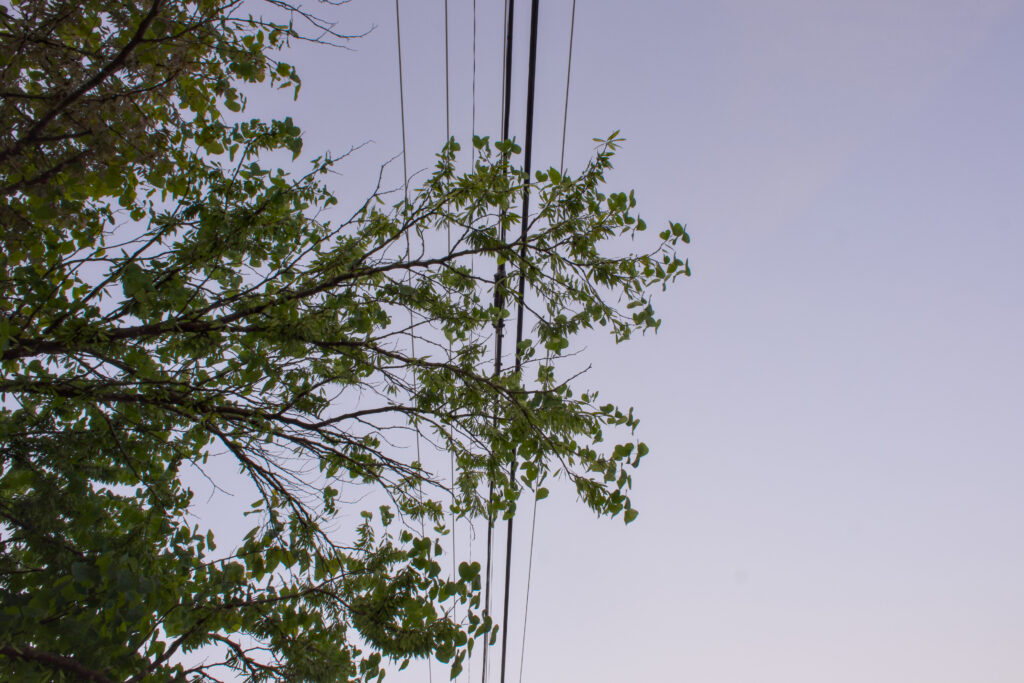
Nashville’s Metro Council is asking the Nashville Electric Service for a temporary moratorium on its new tree trimming policy — though it’s unclear it will make an immediate difference.
City leaders expressed concern around the lack of communication and transparency about the policy.
“The request here is very simple: It’s to pause the blanket application of the 15-foot clearance rule that’s being applied to every tree of every species in every neighborhood regardless of whether that tree poses any meaningful risk to the power grid,” said Councilmember Brenda Gadd. “Treat our trees like the living biological systems they are.”
NES recently expanded the zone it clears between trees and power lines from 10 feet to 15 feet for all tree species. The power company that distributes electricity across all of Nashville will now also cut or trim more vegetation growing directly below utility infrastructure.
The idea is to prevent more power outages during storms. In January, a record half of Nashville lost power during an ice storm.
NES does not plan to alter its policy, the company said in a statement to WPLN.
“Our team of arborists will continue the current trim cycle, periodically review the reliability data around trimmed corridors, and work directly with any customers who have questions or concerns,” NES said in an email.
Gadd encouraged NES to review policies of other cities and utilities that have adopted policies that cater to different trees; such as different clearances for slow versus fast growing species.
“Not all trees are alike. A willow tree grows fast and falls readily. An oak grows slowly and holds,” Gadd said. “These are not opinions. They are biological facts, and they matter when you’re making pruning decisions.”
Cuts decried
Residents have been experiencing different versions of tree trimming all across town in recent weeks.
Some people have complained that workers have cut down bushes underneath power lines that would not grow to any height of concern, Councilmember Tom Cash said during the meeting. He suggested there could be poor communication between NES leadership and the people who are doing the work on the ground.
Phillip Lehner lives in East Nashville. His hackberry tree was laterally trimmed about a month ago and has since bent towards his home during thunderstorms. He now plans to pay for it to be cut down. “This seems like swinging the pendulum way, way to the other side, and I feel like I’m being left to shoulder liability,” he told WPLN.
The Nashville Tree Conservation Corps and the Cumberland River Compact sent a letter to NES last month requesting a temporary moratorium on the new tree program. The groups wrote that the city lost upwards of tens of thousands of trees earlier this year.
“In the aftermath of the severe winter ice storm earlier this year, Nashville experienced near cataclysmic levels of tree loss and damage,” the letter says. “Its impact on our urban canopy will be felt for generations … Any policy that may accelerate additional tree loss should be approached with care, transparency, and data-driven justification.”
Councilmember Burkley Allen spoke of the city’s tree canopy as a valuable asset.
“While electricity is one utility, our tree canopy is also another,” she said. “It provides habitat for wildlife, stormwater retention; it reduces the heat island effect. It increases our property values.”
Allen also acknowledged the impact of downed limbs.
“We all understand the need to respond to what didn’t work during the storm and make changes,” she said.

 On Air - 90.3 WPLN-FM