
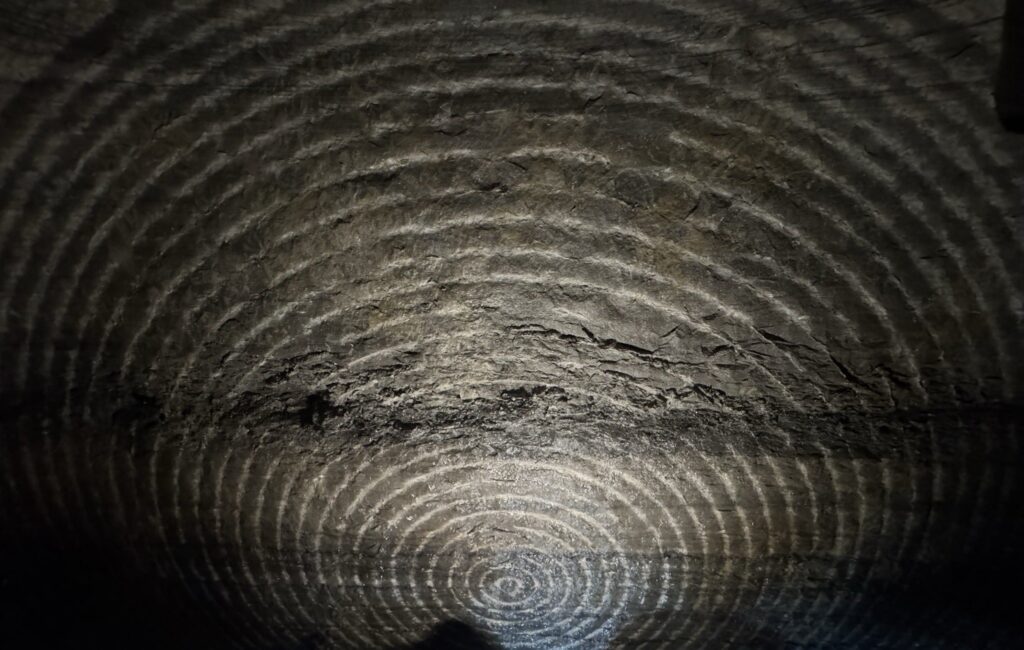
The Boring Company drilled near the Music City Center this week, suggesting the company has completed up to a tenth of its route between downtown and the airport.
But trickier terrain lies ahead as the tunnel extends underneath Nashville, according to a new report commissioned by the Southern Environmental Law Center.
Sinkholes, tunnel flooding and groundwater pollution from legacy industries are all potential risks as the project digs into Nashville’s limestone, according to the report.
“It can be machines that get stuck. It can be sinkholes forming on the surface. Huge inflows of water,” said SELC attorney Trey Bussey.
Nashville contains four layers of limestone between downtown and the airport along the company’s planned route of parallel tunnels: in order from highest to lowest, Leipers-Catheys, Bigby-Cannon, Hermitage and Carters.
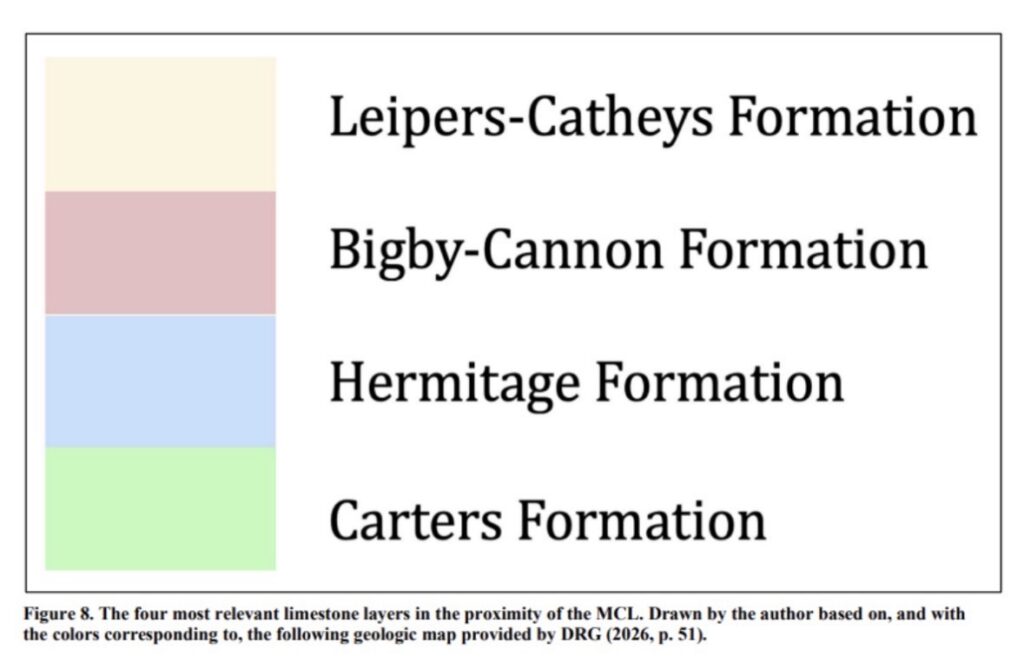 Courtesy Chris Groves/Western Kentucky University
Nashville has four layers of limestone underground along the Boring Company’s planned route between downtown and the airport.
The Leipers-Catheys, Bigby-Cannon, and Carters are relatively pure limestone layers of rock — and the more limestone, the more soluble the rock. They contain conduits, caves, and other karst features that have been enlarged by dissolution as groundwater moves through the soluble limestone.
“These conditions create potentially severe karst-related tunneling challenges,” says the report by Chris Groves, a professor of hydrogeology at Western Kentucky University. It references projects by other companies in karst terrain that have resulted in “massive water or mud inflow and flooding, sinkholes and ground subsidence above the tunneling, and machine entrapment.”
Without preparing for potential karst challenges, the report points to research referencing worst-case scenarios of “heavy casualties,” “serious economic losses” and “construction cessation.”
The tunnel will go through ‘problematic’ limestone
The Boring Company’s plan is to stay in the Hermitage Formation, which is a layer of limestone that’s mixed with tougher, less soluble minerals.
But the Hermitage layer is completely eroded in some areas. The tunnel will be forced to go through the Carters Formation underneath Browns Creek, Mill Creek and the Cumberland River.
“The Carters Limestone in this area has the most intense karst development and will likely be the most problematic to tunnel through,” the report says.
Several mapped caves are located in the Carters within two miles of the tunnel route. One void, called Pulley Cave, has a passage measuring 30 by 40 feet, according to Tennessee Cave Survey data.
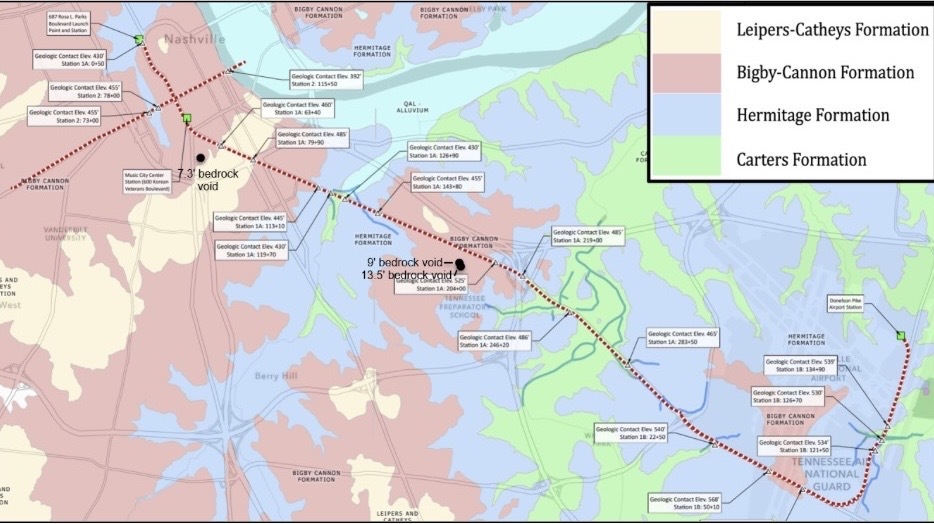 Courtesy Chris Groves/Western Kentucky University
The Boring Company plans to primarily drill through the Hermitage foundation, which is a less “pure” and thus less soluble level of limestone, but that layer has completely eroded away in some areas along the company’s planned tunnel route.
Before tunneling, the Boring Company published an environmental assessment of its plan at the end of last year. In the 150-page document, less than 10 pages directly addressed water, safety or geology. The assessment solely references studies published between 1958 and 1990. The Tennessee Department of Environment and Conservation chose not to require a permit due to this self-funded report.
“The environmental info provided by the company was simply not serious,” said Nashville Councilmember Clay Capp, who read the new report. “That goes to show what this project is: an inside deal for favored billionaires who want to ignore the normal rules.”
Capp suggested it was not too late to cancel the project.
An additional geotechnical challenge could emerge if the company requires blasting. While limestone is considered, geologically, “easy to scratch,” and thus easy to cut through, some areas may have a mixture of particularly tough minerals. If the company blasts those areas, it could lead to fractures in the surrounding limestone and potential sinkholes.
Sinkholes are not uncommon on construction sites in the region. But public awareness may be limited, as developers are not required to disclose incidents to the public, Jason Polk, a karst expert and professor of geoscience at WKU who was not involved in the report, told WPLN last year.
Where is the Boring Company now?
The Boring Company began tunneling underneath Nashville in February. The company has announced multiple projects, but it has only started tunnel construction on the route between downtown and the airport.
This week, Boring planned to dig a pothole on 8th Avenue next to the Music City Center to “expose and verify utilities,” according to a ticket published on Tennessee811, a database for all digging activities. The center is located about one mile from the state parking lot where the project began. The pothole location represents where the tunnel will turn from 8th Avenue onto Lafayette Street.
In eight months, the company has potentially completed as much as 10% of the parallel, one-way tunnel system’s roughly 9.5-mile length. It is unclear how much progress the company has made on both tunnels of the system. Since August, the company’s machines reached “a big milestone of both Prufrock-MB1 and Prufrock-MB2 tunneling at the same time,” the company wrote in a blog post on Oct. 1.
The speed of tunneling does not appear to match the company’s estimated date of completion. When first announcing the project, the company said the tunnel would be operational by late 2026. Officials later adjusted that timeline to early 2027.
The Boring Company did not respond to questions from WPLN about the report, its current digging location or its timeline for project completion.
The Boring Company may encounter decades-old pollution
The Boring Company may have been able to stay within the Hermitage Formation thus far, but it will very likely encounter karst features in the second half of its route.
Along the way, the tunnel may pass properties that currently or historically used hazardous chemicals such as fuel stations, dry cleaners, auto shops and other industries. The Tennessee Department of Environment and Conservation, or TDEC, has listed dozens of underground storage tanks for oil along the roads and mapped several dozen remediation sites.
Roughly three miles from the Music City Center, the company could come into contamination near the former Aladdin Industries on Murfreesboro Pike. The company manufactured vacuum bottles, insulated trays and lamp mantles between 1949 and 2002.
TDEC documented soil, groundwater and soil gas contamination by the carcinogen trichlorethylene, hazardous solvents, metals like arsenic, cadmium and lead, and a radioactive isotope of thorium, according to the report.
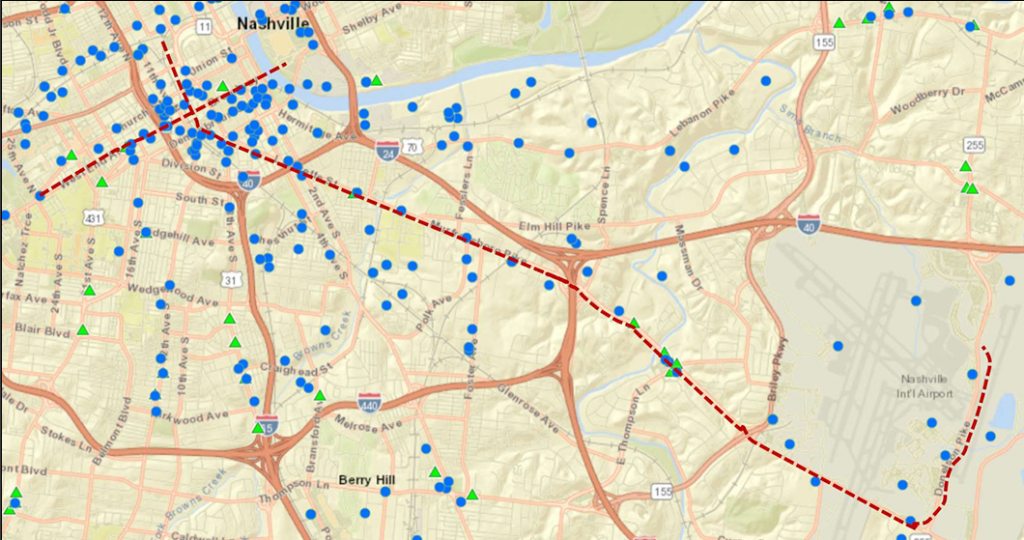 Courtesy Chris Groves/Western Kentucky University
The Tennessee Department of Environment and Conservation has information on dozens of known or suspected hazardous waste sites along the Boring Company’s planned tunnel route between downtown and the airport.
If the project runs through contaminated soil or groundwater, there is a risk that the contamination could spread.
“Because of the karst features, groundwater can move in new and unpredictable ways if there are changes in the geology,” said Bussey, the attorney.
Serious questions remain unanswered about the project and how the company will prepare for risks and handle complications, from potential pollution spread to fractured limestone, he said.
“What happens if a tunneling machine gets stuck under Mill Creek?” Bussey said. “What happens if there’s a sinkhole on downtown streets that undermines the structural integrity of the buildings along the route? Who pays to fix those issues?”

 On Air - 90.3 WPLN-FM