
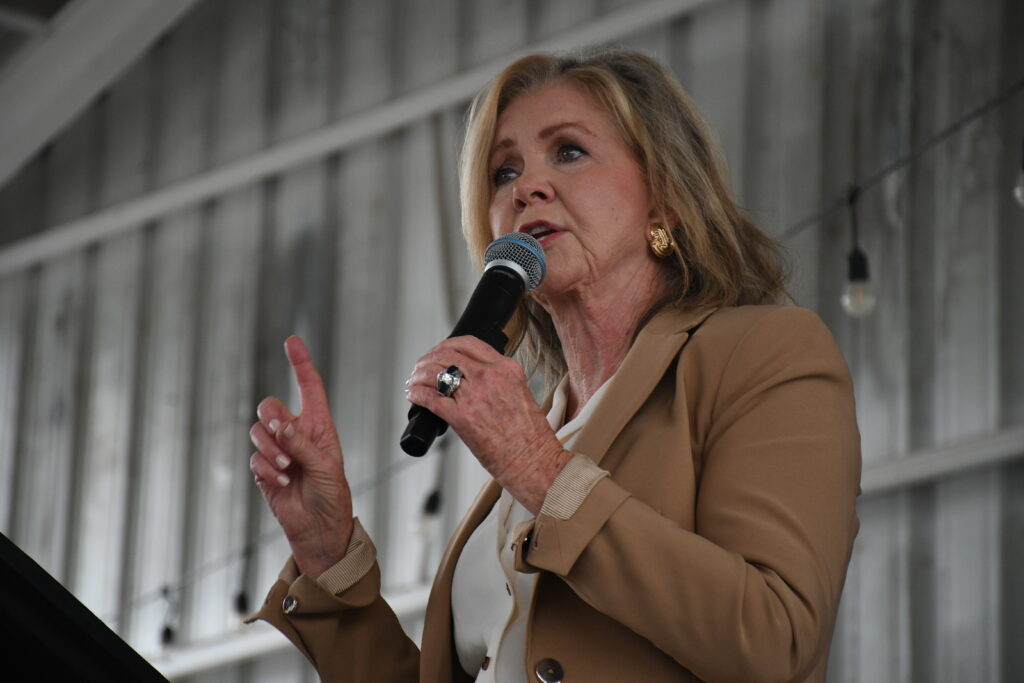
U.S. Sen. Marsha Blackburn received strong pushback after she posted an AI video of herself, imitating Kendrick Lamar’s Super Bowl LIX performance ahead of early voting in Tennessee. After more than two decades in Washington, Blackburn is running for governor in her home state.
For many X users, the video is a joke. A not-quite-right version of the 74-year-old senator dances like Lamar performing his song “Not Like Us,” flanked by other GOP candidates. Among her faux backup dancers is state Sen. Brent Taylor, who’s vying to flip Memphis’ newly redrawn seat.
When Taylor’s opponent, Democratic state Rep. Justin J. Pearson, saw the video, his first instinct was to laugh.
“I know you’re lying,” he said. “I know you’re lying.”
But Pearson told WPLN News the video isn’t really a laughing matter. In his home city of Memphis, data centers that produce AI-generated videos like this one also produce pollution that can lead to respiratory illness and higher cancer risks, according to the National Institutes of Health.
“You’ve got people in positions of power — and vying for positions of power — who don’t understand the consequences of their actions,” Pearson said.
MORE: Data centers and wetlands: where Tennessee’s District 9 candidates stand on the environment
Lamar’s actual halftime show drew sharp conservative pushback at the time. Right-wing podcaster Benny Johnson called Lamar a “talentless mumbling pagan satanic cultist.” The late conservative activist Charlie Kirk said, “This music is not my style,” while some asked for subtitles to understand the show.
The American flag loomed large in Lamar’s performance, a red, white and blue commentary on the policing of Black artists. Samuel L. Jackson, in the role of “Uncle Sam,” followed Lamar throughout, calling his music, “Too loud, too reckless, too ghetto!”
Cultural and legal fallout
Cultural consultant Cecilia Olusola Tribble said Blackburn’s use of the song is itself an attempt to erase Black artists from the culture they created.
“Colonization is dependent on erasure,” Tribble said. “To erase the voice and the people who are responsible for the very fabric of the culture that her team was trying to copy in this ad.”
That extends to voting, Tribble said, and how Blackburn cheered on redistricting Memphis. The city’s majority-Black voting bloc is now divided across three congressional districts with less direct representation in the U.S. House.
Blackburn told reporters that her team had not created the video; they had just reposted it.
“There would never be any action that was intended to offend,” Blackburn said.
A 2026 law prohibiting the use of AI in campaign ads may not apply in this case — or in most cases. GOP candidates for Tennessee’s 6th Congressional District tested the bounds of the law during the August primaries.
State Rep. Johnny Garrett, R-Goodlettsville, and former U.S. Rep. Van Hilleary used AI-generated videos to attack each other. To enforce the law, they would’ve had to sue each other, but neither did, and Garrett sailed to victory as the GOP nominee for the district.
Blackburn herself has supported anti-AI legislation to safeguard the intellectual property of songwriters, named the ELVIS Act after the King of Rock and Roll.
A White man from Memphis, Elvis Presley made millions off the song “Hound Dog,” while Big Mama Thornton, the Black woman who first recorded the song, received a flat fee of $500.
 On Air - 90.3 WPLN-FM