

Clay Capp is standing in a parking lot on a cloudy, windy day.
In one corner, a green fence shields a construction site from public view, with scaffolding and drilling machines poking out above.
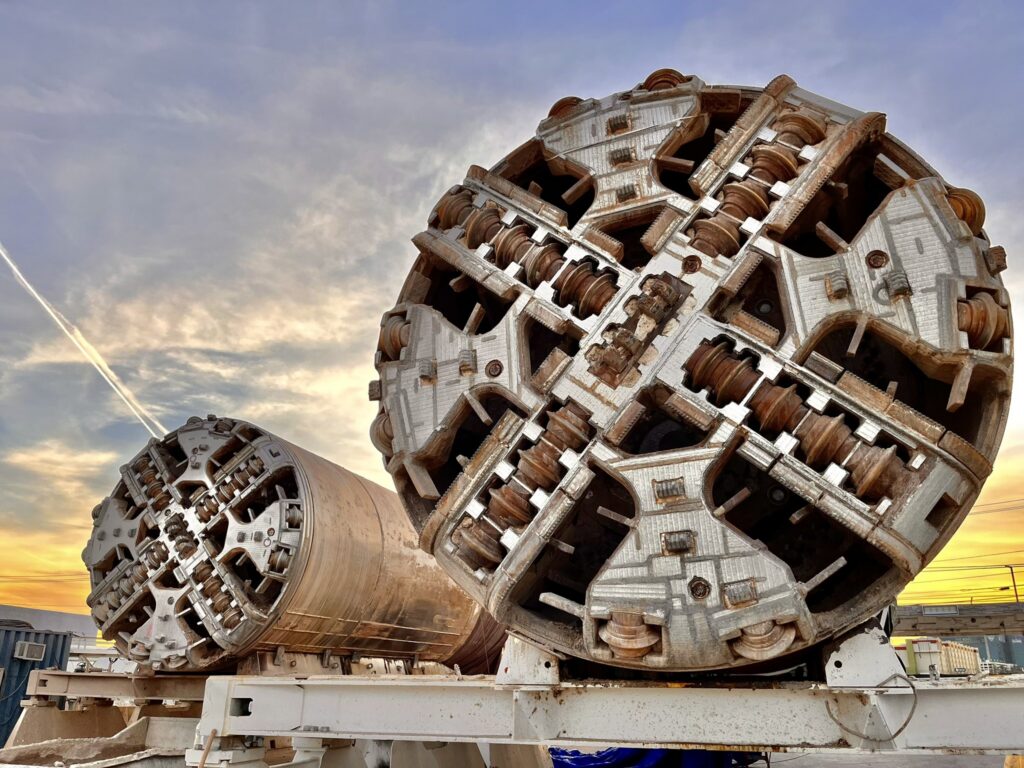
Inside, workers with the Boring Company are preparing to fire up a tunnel machine potentially 30 feet or deeper underneath downtown.
Though, as Capp points out, this site is not quite, effectively, downtown. The lot sits just outside of the neighborhood’s dense hubs of hotels and apartments.
“One of the biggest tells of this whole thing is they’re not proposing a tunnel based on where they think it will be most helpful to the needs of transportation in Nashville,” said Capp, a representative of Nashville’s Metro Council.
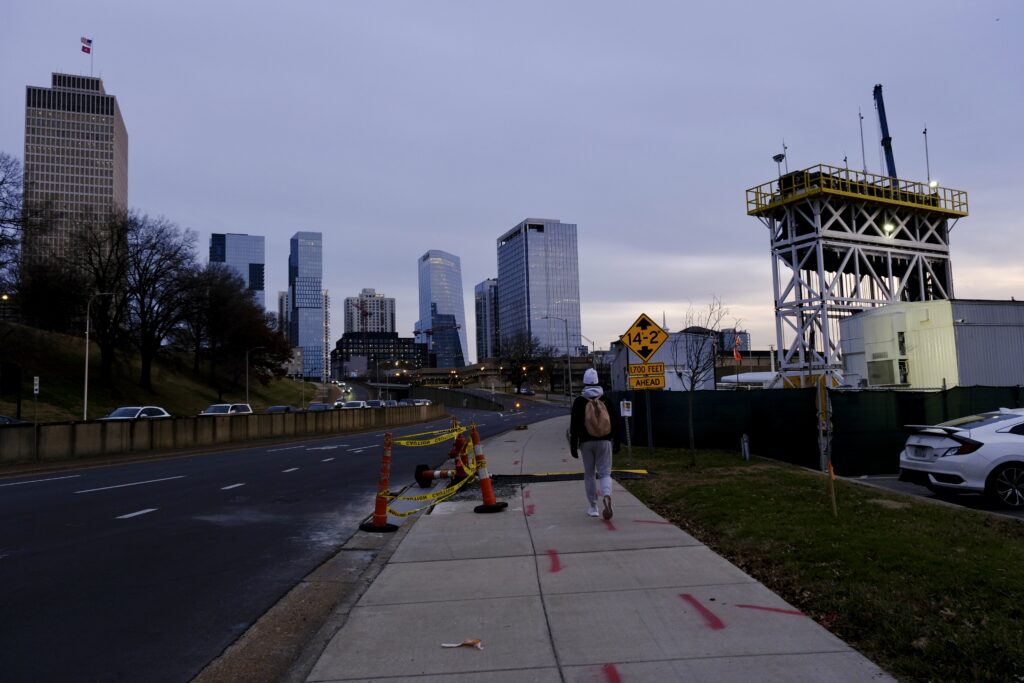 Caroline Eggers WPLN News
The Boring Company is constructing a tunnel near Rosa Parks Boulevard in downtown Nashville.
The Boring Company officially began drilling their tunnel between downtown and the airport last week. City officials and residents remain unclear about the potential impact to Nashville’s underground environment, the company’s plans for extreme weather, and the supposed public benefit of the tunnel.
Unless people are close enough to roll their suitcases to the tunnel, they will have to take additional transit.
“They’re not really concerned with addressing traffic,” Capp said. “They want to test out their tunnel machine where they think the state government will let them.”
The construction site is on a state-owned parking lot that connects to a state-owned highway. The Boring Company has obtained green lights for the project through state agencies, while skirting the need for approval from Nashville’s Metro Council. However, the company has acquired city permits through Metro Water Services and the Nashville Department of Transportation, as well as a lease from the Metro Nashville Airport Authority.
Lingering environmental questions
Usefulness aside, Capp is concerned that Nashville will be a guinea pig, chosen after failed attempts to land projects in other cities across the country. Nashville’s environment is also different from that of Las Vegas, where the Boring Company built its first tunnel.
Capp still has a lot of questions. He tried to ask them during a recent special-called meeting with Nashville’s Metro Council, which was the first public forum with the company.
“Does the Boring Company acknowledge that in Tennessee there is strict liability for anyone who causes erosion or subsidence or a sinkhole on a neighboring property?” Capp asked.
“Subject to applicable law,” the Boring Company’s general counsel Steve Schwarzbach said, a response repeated multiple times to various questions.
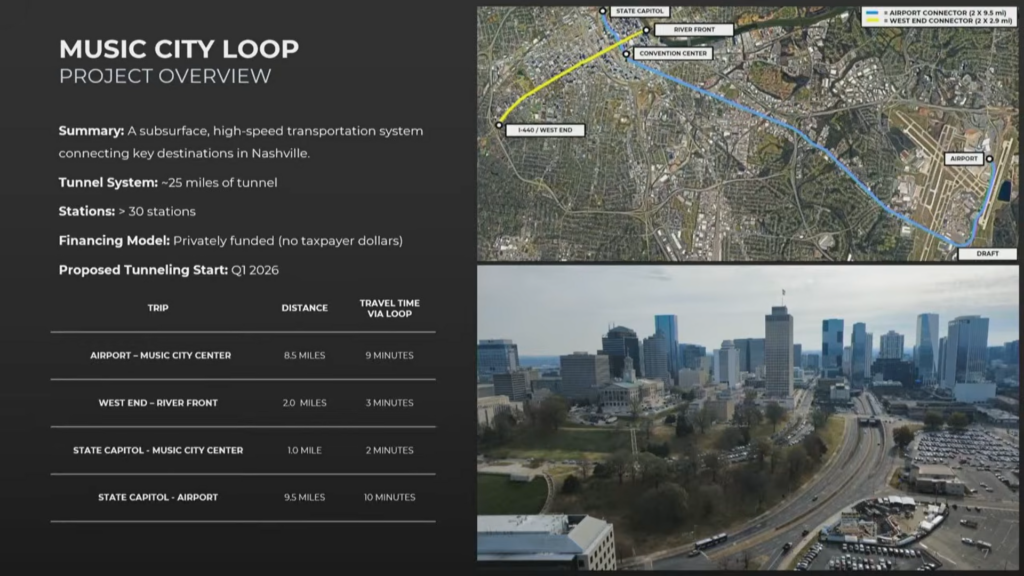 Courtesy The Boring Company
 The Boring Company plans to build 25 miles of tunnels across Nashville to offer a Rideshare-like service with Tesla vehicles. The first segment of the system is a roughly 10-mile loop between downtown and the airport.
Capp also attempted to address the Boring Company’s self-funded environmental review. The company paid the consultant Davey Resource Group to assess the potential environmental impacts of its project.
The resulting report claims that the company’s project will have minimal to no impact on Nashville’s environment. It provides little evidence for these assertions, claiming that local contractors have conducted extensive geotechnical investigations. Capp asked for those records — to which Schwarzbach replied that the company is “not making any commitments right now.”
In the 150-page document, less than 10 pages directly address water, geology and safety. The geology section references “well-known scientific literature” with studies published between 1958 and 1990.
How will extreme weather affect tunnel construction and use?
The report barely acknowledges extreme weather risks, mentioning “heavy rainfall” once. The question of how extreme weather will impact tunneling came up during the recent meeting with Nashville’s Metro Council.
“The short answer is it is generally unaffected by surface conditions,” said Boring Company Vice President David Buss.
This is misleading.
“While underground systems are insulated from direct atmospheric exposure, they are deeply affected by changes in soil properties, groundwater levels and thermal fluctuations,” scientists wrote in the journal Geotechnical Research last year. “Climate change presents a serious challenge to underground transport infrastructure.”
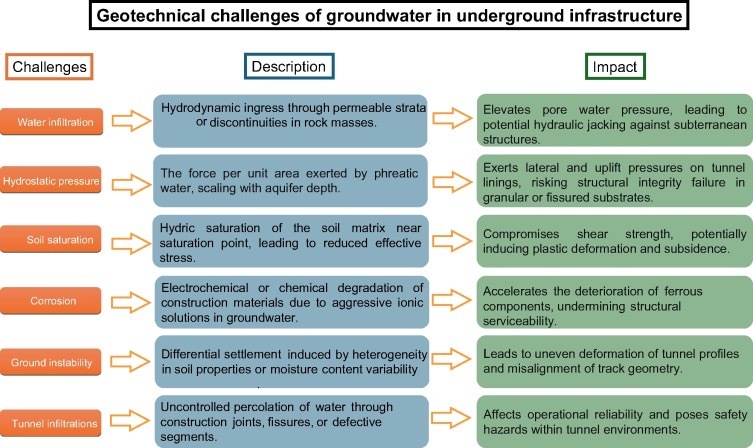
Drought, heat and flooding can affect both the construction and long-term maintenance of tunnels. In the past decade, flooding events have disrupted tunnel projects. Workers were evacuated from a tunnel construction project in China after heavy rainfall just four months ago.
‘We don’t trust you. Show us your work.’
The report also claims that the Boring Company will avoid “problematic karst development,” which could refer to limestone features like voids, caves and sinkholes.
Nashville is considered a “sinkhole hotspot,” according to research by U.S. Geological Survey scientists, but the report does not directly address the possibility of encountering or causing sinkholes.
“The public deserves to know that this company is aware of the serious, unique risks of tunneling through this area and that it’s ready for them,” said Trey Bussey, an attorney with the Southern Environmental Law Center. “I don’t think the report achieves that.”
The report funded by the Boring Company was initially described as a gesture of cooperation. But the document is affecting state regulations.
The Tennessee Department of Environment and Conservation told WPLN it decided not to require a permit after reviewing the report.
The Tennessee Department of Transportation recently approved a permit for the Boring Company and chose a “programmatic categorical exclusion” for an environmental review, meaning the agency felt like the company met enough criteria to skip a comprehensive environmental review.
 Courtesy Kansas Geological Survey
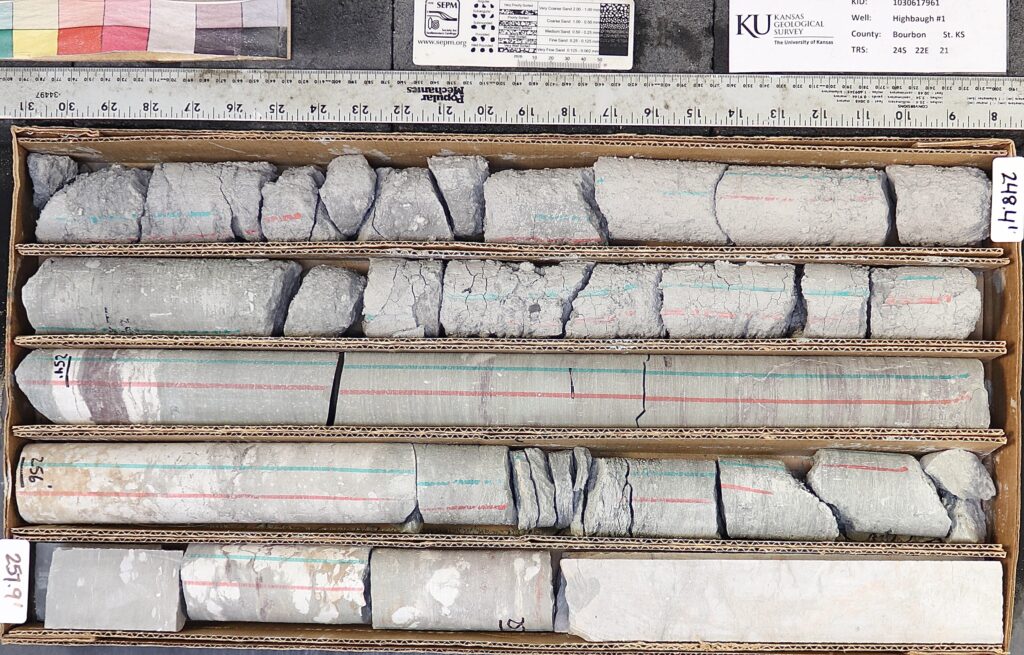
 Rock core samples can reveal fractures in various types of underground rock. In Nashville, fractured limestone allows water and soil to move through the rock, making the terrain vulnerable to karst features like caves.
Between the report and the recent public comments by Boring executives, Bussey suggested that the company is asking for public trust.
“Nashville leaders keep saying, ‘We don’t trust you. Show us your work,’” Bussey said.
As construction ramps up, it might not be long before some answers become clear.
The company supporting Davey’s report has ties to The Boring Company
When the Boring Company published Davey Resource Group’s environmental report back in December, it also provided a letter of support from a third party: Universal Engineering Sciences, an Ohio-based group that works with federal, military and private clients.
“We support the findings and recommendations presented in this Environmental Impact Assessment and believe the project can be constructed and operated with minimal environmental impact,” Leslie Moore of UES wrote in the letter.
Moore is a “national account leader” at UES for environmental and cultural resources. She was previously the senior environmental manager at the Las Vegas branch of UES. According to a UES Instagram post in 2024, Moore “spends most of her time writing permitting and compliance documents to support construction projects.”
One of the regional presidents at UES, James Bristow, worked on The Boring Company’s Vegas Loop, according to a company blog post published in 2021.
State, federal agencies warn their report guidance is for ‘informational purposes only’
Davey Resource Group consulted with two government agencies, the Tennessee Department of Environment and Conservation (TDEC) and the U.S. Fish and Wildlife Service (USFWS), and an archaeological consultancy for its analysis.
In the report’s appendix, all three organizations suggested that the information they provided was not part of an official review process.
TDEC’s Division of Natural Areas provided information about rare species that may be present near construction, including 10 plant and animal species within one mile of the project area and 34 species within four miles. The agency warned that it only manages data on the species.
“The Tennessee Wildlife Resources Agency has legal authority over wildlife, and the U.S. Fish and Wildlife Service has legal jurisdiction over all federally listed species,” the division wrote in a letter.
The agency also suggested that the company coordinate the project with TDEC’s Division of Water Resources, which handles permits for construction and pollution runoff.
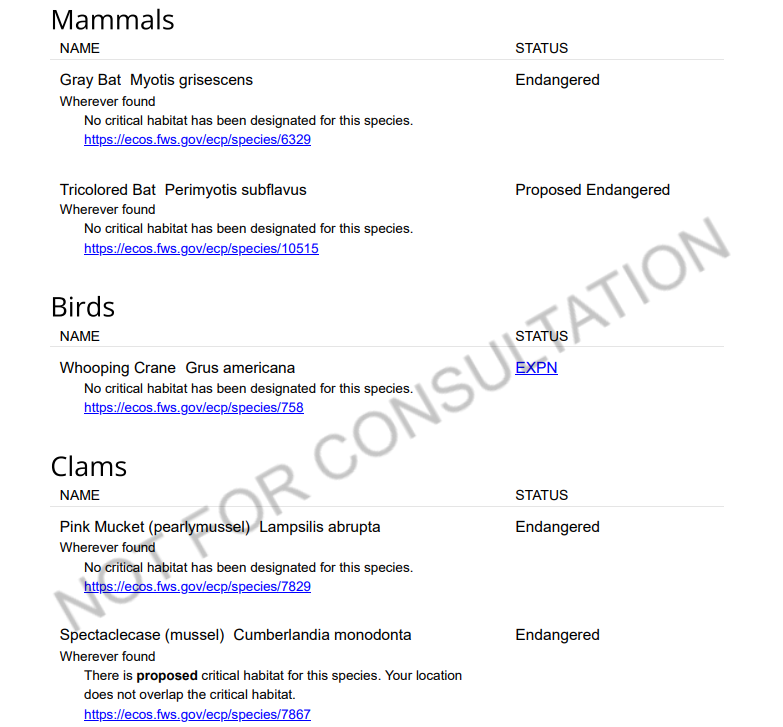
Davey Resource Group also included an “automatically generated list” of species and other resources known or expected to be on or near the project from USFWS.
“This resource list is for informational purposes only and does not constitute an analysis of project level impacts,” USFWS said in the document.
 Courtesy Davey Resource Group
 Davey Resource Group, which was commissioned by the Boring Company to produce an “environmental review,” cited several state and federal agencies in its appendix. Each agency warned that the information was not appropriate for an official review.
Davey Resource Group reached out to Midsouth Cultural Resource Consultants about historical sites in the project area.
Midsouth found 67 archaeological sites recorded within one mile of the project area, while a section of the Trail of Tears follows the airport route.
“The extent to which these previously recorded archaeological sites will be adversely affected by the project is undetermined,” wrote J. Scott Jones, a senior archaeologist with the consultancy. “This review does not constitute compliance with the National Historic Preservation Act.”
The project may involve more ‘blasting’ than initially promised
The tunnel will be installed between 30 feet and 60 feet below the ground surface depending on sub-surface conditions, according to the report.
In August, Buss, Boring’s vice president, said the company has a goal for “zero blasting” once tunneling commences downtown at the site on Rosa Parks Boulevard. Blasting generally refers to setting off explosives to break up rock. In preparation for tunneling, which only began last week, workers blasted the site in late October and early November.
The report suggests there may be additional blasting. The company plans to create at least 20 vertical passageways called “egress shafts” for people to exit the tunnel in emergency situations, based on the length of the planned tunnel and the National Fire Protection Association’s standard of shafts spaced less than 2,500 feet apart.
“The egress shaft excavation methods will vary depending on the ground conditions but may require drilling, blasting, pipejacking, sequential excavation method, or other trenchless mining technology,” the review states.
The company could also require additional blasting at other segments of the tunnel route. While limestone is considered, geologically, “easy to scratch,” the local karst terrain along the route may have areas with a mixture of tougher minerals. The company may need to blast those areas, which could lead to fractures in the surrounding limestone and even sinkholes.
Sinkhole-related challenges on construction sites are not uncommon in the region, but developers are not required to disclose incidents to the public, Jason Polk, a karst expert and professor of geoscience at Western Kentucky University, told WPLN in the fall.
“Anytime you do any kind of alteration of the landscape in karst, there’s always a chance that it could create a higher potential for sinkhole activity,” Polk said.
This story was produced by the Appalachia + Mid-South Newsroom, a collaboration between West Virginia Public Broadcasting, WPLN and WUOT in Tennessee, LPM, WEKU, WKMS and WKU Public Radio in Kentucky, and NPR. Sign up for the weekly Porch Light newsletter here for news from around the region.

 On Air - 90.3 WPLN-FM