
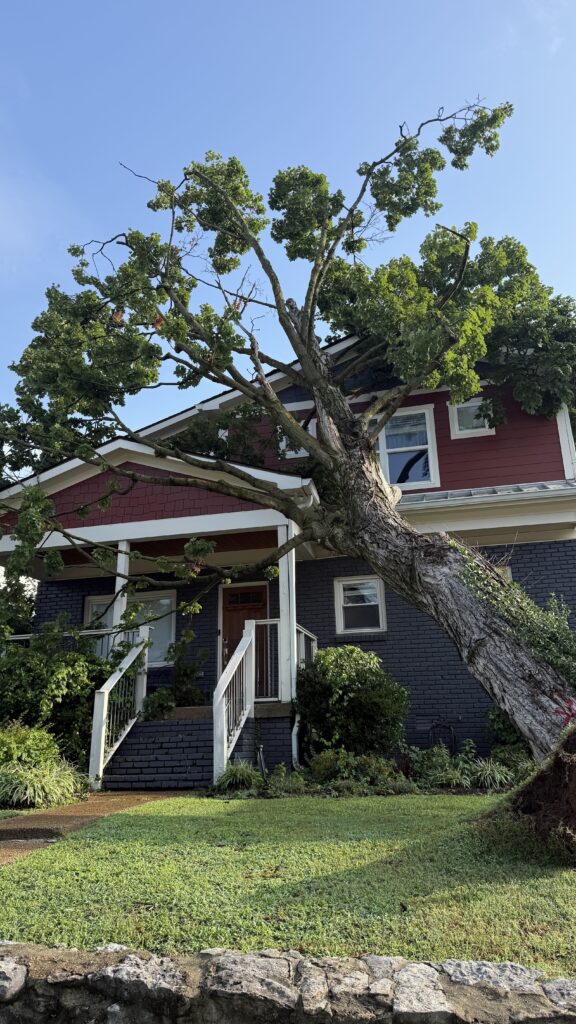
The Nashville Electric Service ramped up tree trimming efforts earlier this year to mitigate power outages. But critics worried the move would cause more harm than good. That proved true in July when a recently trimmed tree fell onto an East Nashville home.
NES implemented a policy that expanded the zone it clears between trees and utility infrastructure from 10 to 15 feet following the January ice storm that left thousands without power.
City leaders and local residents decried the decision – arguing that the clearance policy shouldn’t be applied unilaterally to all trees since they have varying growth rates. Others worried the trimming techniques left the trees vulnerable to falling.
‘Liability for the homeowner’
Taya Mashburn, an East Nashville resident, held that concern, and expressed it to NES contract workers when she saw them cut a tree in half while working from home last month.
“Don’t you feel like this could be a liability for the homeowner? Look at this tree down the street, what you’ve left behind is just completely facing the house,” she said. “I would be concerned if I were that homeowner.”
She worried the tree would be left unbalanced and eventually crash onto her neighbor’s house.
Mashburn told WPLN News that the workers said they understood her concerns, but were just following orders. So, she called NES and asked about the company’s trimming strategy:
- Is it designed to minimize damage?
- Is it backed by environmental assessments showing the need for a 15-foot clearance?
- Is guided by an arborist?
Those questions weren’t directly answered by NES, she says. A representative only reiterated the policy’s goal of reducing power outages.
When contacted by WPLN, NES provided this email statement: “The customer will have to follow NES’ standard claims process. This is the extent to which NES can comment on this situation at this time.”
Loud crash and breaking glass
Mashburn voiced her concerns to an NES representative on June 10 and, less than a month later, a large maple tree had fallen onto her neighbor’s house.
The neighbor, who asked not to be identified, told WPLN News that she was terrified after hearing a loud crash and the sound of breaking glass around 9:30 p.m. on July 7.
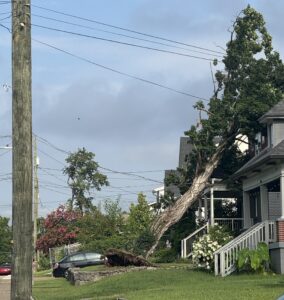
This large maple tree fell on a house about a month after a neighbor, Taya Mashburn, spoke to an NES representative on June 10, expressing concern about the company’s trimming policy.
She was stunned to realize that part of a tree was now in her home, and contacted an emergency tree removal company that deemed the tree was stable and could be removed in the morning. NES came out the next day to check if the debris included any live wires.
While the fallen tree didn’t hurt anyone, the homeowner is left in a logistical nightmare sorting out the cost of physical damage to her property.
One complaint about the new trimming policy is a lack of communication and transparency, with some residents saying they’d come home from work to find their trees removed without any prior notice. NES has a legal right to remove trees based on a 1935 Tennessee law.
In this case, however, NES did notify some neighborhood residents in May about plans to trim trees the following month.
‘Decimating the tree canopy’
What the company didn’t explain, according to Mashburn, is whether there is a plan to preserve the city’s tree canopy.
Tree conservation groups requested a moratorium on the trimming policy earlier this year, citing the volume of tree loss caused by the ice storm. Mashburn echoed those concerns.
“Part of why I think people move to this part of the city is because it’s walkable, but when it’s a hundred degrees outside and you have no tree canopy, walking is not great,” she said. “My concern is also, you’re completely decimating the tree canopy on this street. Is there logic behind the approach here?”
An NES representative previously told her that they had no plans to trim or cut any trees in her yard. Still, she feels personally affected when so many trees are being cut down in her neighborhood.
“It just really changed the face of the street,” she said. “A 100-year-old tree is not something that can be replaced.”

 On Air - 90.3 WPLN-FM