
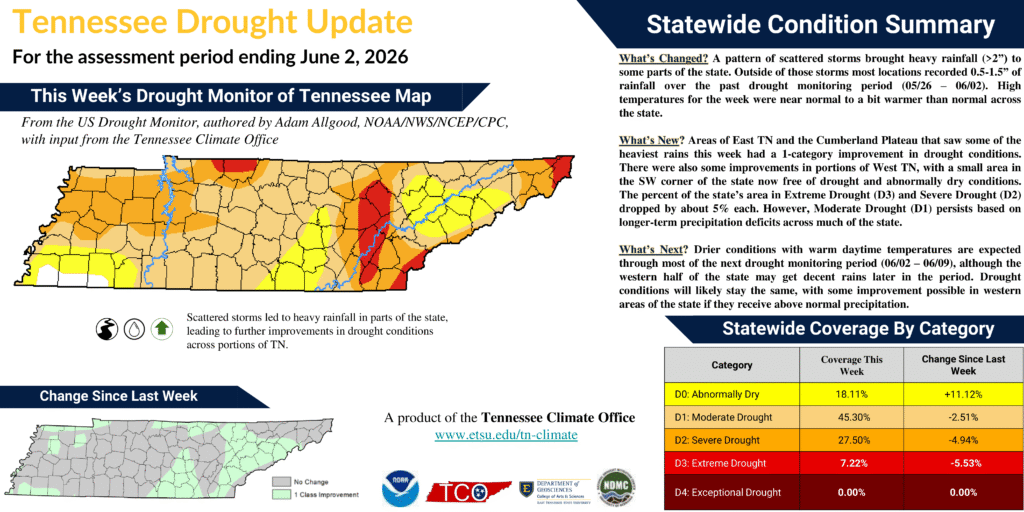
Tennessee has been in widespread drought since December, and even after a couple of weeks of steady rainfall, about 80% of the state remains in moderate drought, according to the latest U.S. Drought Monitor.
“We are still seeing long-term issues, mainly related to hydrology,” said Andrew Joyner, Tennessee’s state climatologist. The state has not had enough rain to balance groundwater, lake and stream levels, even if soils have partially replenished.
The current situation could now be considered a long-term drought, which the Drought Monitor defines as lasting “typically more than six months” and affecting hydrology and ecology.
Water supply stress is forecast to worsen in the coming decades due to climate warming caused mainly by burning fossil fuels.
Droughts affect ecosystems in many tangled ways; they can raise temperatures in a feedback loop, worsen air pollution, stress wildlife — from wildflowers to birds and bears — shift the ground enough to damage underground infrastructure, disrupt agriculture, increase wildlife risks and make flash flooding more likely.
Earlier this year, wildfires burned through tens of thousands of acres of forest amid drought in Florida and Georgia, where two wildfires destroyed more than 120 homes.
More: Black bears are threatened by climate change. How can we help? | WPLN News
The Cumberland Plateau and other spots across the state have experienced worse deficits of rainfall over the past six months and stayed in the “extreme” drought category, meaning water supply is inadequate for wildlife, aquatic species may die off and water quality is poor, among other impacts.
Tennessee has experienced periods of dryness for the past five years. Fall is the most common season for drought in the region, but drought conditions often set in quickly during heatwaves in the summer.
The National Oceanic and Atmospheric Administration forecasts that most of Middle Tennessee should recover from the drought this summer, but dryness will likely persist in East Tennessee, according to its latest three-month forecast.
Nashville briefly recovered from the drought after the ice storm earlier this year but has oscillated between moderate and “severe” drought classifications. In May, Nashville received four inches of rain, an inch less than the 30-year average.

 On Air - 90.3 WPLN-FM